NEWS


NORMAN, Okla. – Continuing the University of Oklahoma’s leadership in combating suicide, the Southwest Prevention Center (SWPC) at OU Outreach has received a five-year, $50 million grant to head the national Suicide Prevention Resource Center (SPRC). The federal Substance Abuse and Mental Health Services Administration (SAMHSA) funds the resource center and provides the award.
For nearly 40 years, SWPC has worked to improve behavioral health outcomes in Oklahoma and across the nation. Through the grant, its team will guide and refine SPRC in offering support and training to communities, health systems, institutions and organizations nationwide, equipping the people who do the frontline work in suicide prevention.
The new grant also renews OU’s management of the center. SWPC assisted with the OU Health Campus application for SAMHSA’s previous five-year grant in 2020, and it was designated as a major partner in the Health Campus’s work. During that time, SPRC Executive Director Shelby Rowe led SPRC staff on both campuses in working with the U.S. Department of Health and Human Services (HHS) to revise the National Strategy for Suicide Prevention, updated in 2024.
“This grant represents far more than funding — it is a profound commitment to saving lives and strengthening communities across our nation,” said Belinda Biscoe, OU Senior Associate Vice President for Outreach. “We are humbled and honored to lead this effort, bringing together science, compassion and innovation to advance suicide prevention. The significance of this award is national in scope, but deeply personal in its impact — it is about offering hope, reducing suffering, and ensuring that every life is valued and protected.”
According to HHS, more than 49,000 people in the U.S. died by suicide in 2022, equal to one death every 11 minutes. An online survey conducted in 2024 by The Harris Poll, in partnership with SPRC, found that nine in 10 U.S. adults believe suicide can be prevented at least sometimes, a shift in belief from decades ago that suicide was an inevitable outcome.
SWPC Director Marie Cox, the principal investigator on the grant, said the resource center trains more than 14,000 people annually and has garnered about 1.7 million website views over the past five years. She emphasized that its continued connection to the university environment and to OU Outreach provides unique advantages.
“Outreach has deep expertise in bringing research to practice in the area of health and human services, and SWPC is a national leader in building the capacity of public and behavioral health professionals to implement effective interventions,” Cox said. “Our SPRC team is setting the pace in this field, and we’re able to tap the resources of Outreach to guide and strengthen our work.”
Cox also credited key partnerships for advancing SWPC’s efforts in suicide prevention, including with the Education Development Center, the National Association of State Mental Health Program Directors, the National Council for Mental Wellbeing, the Center for Applied Research Solutions, Social Science Research and Evaluation, HealtheKnowledge and A-G Associates.
Looking ahead, SPRC leaders are confident renewed funding will help ensure that SPRC continues to expand its training, technical assistance and research translation efforts to strengthen suicide prevention systems.
“Our mission remains clear: empowering communities with the tools, data and strategies needed to save lives,” Biscoe said. “With SAMHSA’s continued support and our extraordinary partners, we will keep building a future where hope and help are within everyone’s reach."
About the project
To read about the work of the SPRC, visit sprc.org.
If you or someone you know is struggling or in crisis, help is available. Call or text 988 or chat at 988lifeline.org.
The Suicide Prevention Resource Center at the University of Oklahoma is supported by a grant from the U.S. Department of Health and Human Services (HHS), Substance Abuse and Mental Health Services Administration (SAMHSA), Center for Mental Health Services (CMHS), under Grant No. 1H79SM090640. The contents of this news release are solely the responsibility of the University of Oklahoma and do not necessarily represent the official views of SAMHSA.
About the University of Oklahoma
Founded in 1890, the University of Oklahoma is a public research university located in Norman, Oklahoma. As the state’s flagship university, OU serves the educational, cultural, economic and health care needs of the state, region and nation. For more information about the university, visit www.ou.edu.
What kind of building works for both bats and chimney swifts? University of Oklahoma architecture and construction science students designed and built one for WildCare Oklahoma in Noble, creating separate spaces where injured and orphaned animals can recover before returning to the wild.
The University of Oklahoma, partnering with the state of Oklahoma and academic and industry partners, has received funding from the U.S. National Science Foundation to build the nation’s first integrated platform for recovering critical minerals from existing oil and gas wells.
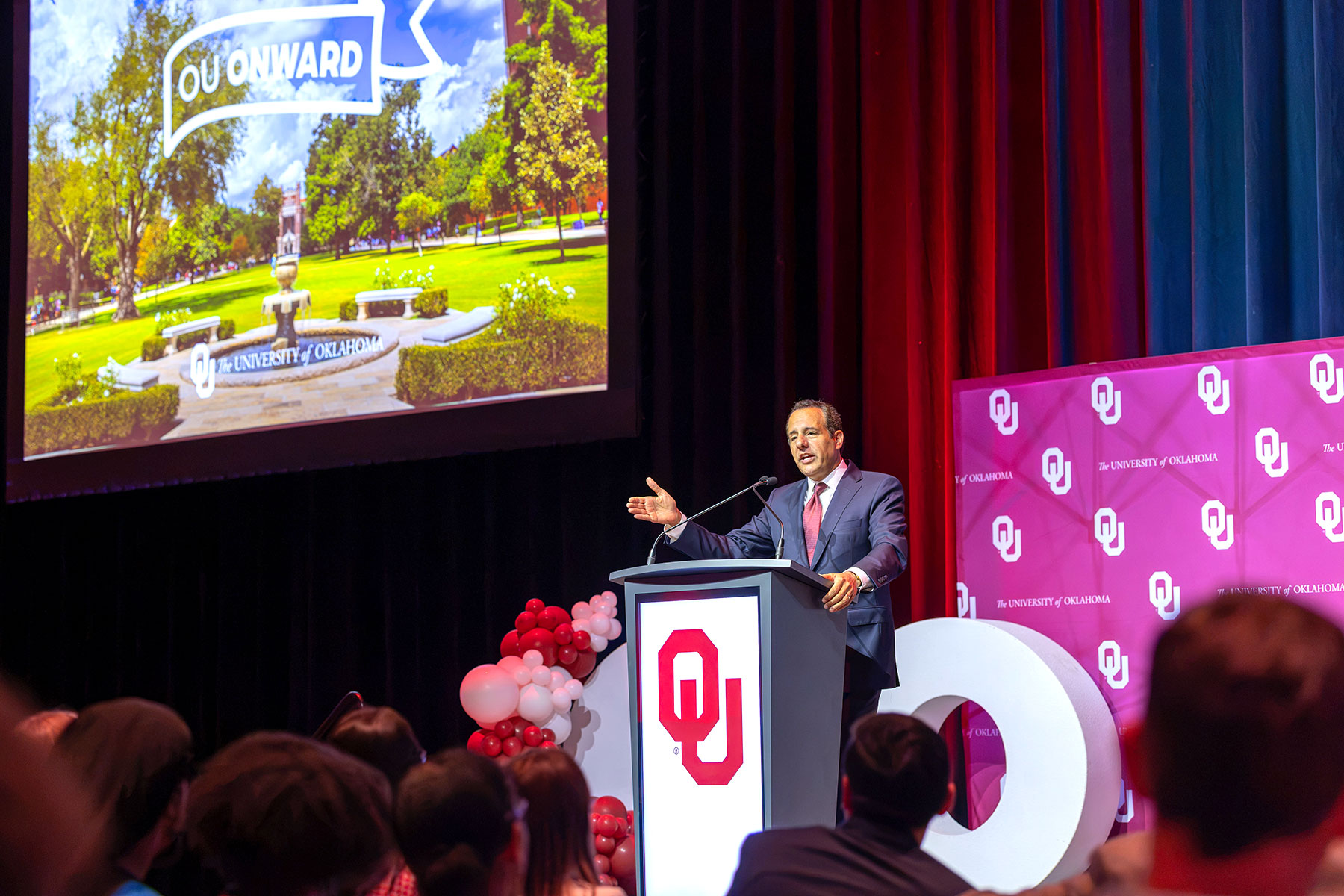
More Oklahoma families than ever will have a clear and affordable path to a University of Oklahoma education with the launch of OU Onward, a new scholarship that will help cover tuition and average fees at OU for qualifying Oklahoma students whose families earn between $60,000 and $75,000 annually.