NEWS

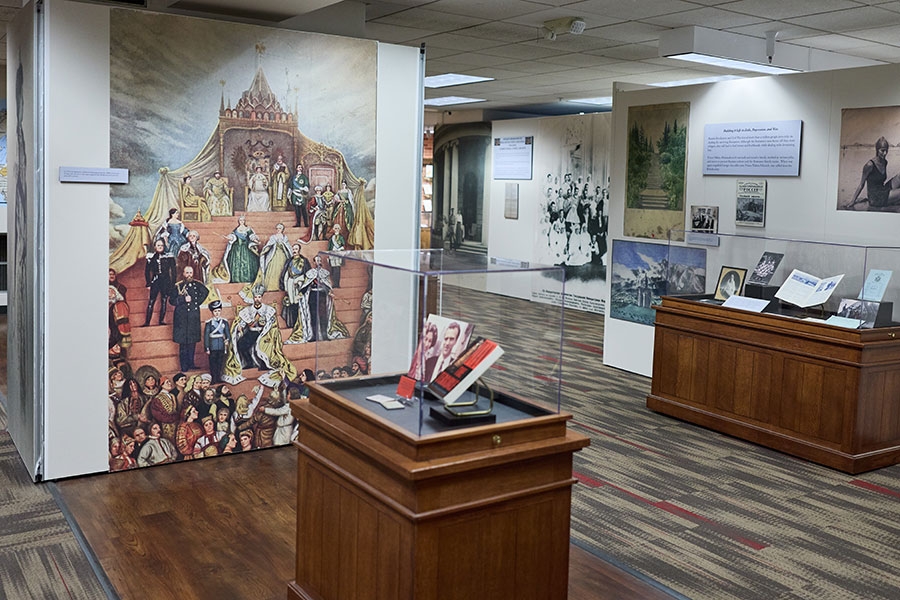
NORMAN, Okla. – A new exhibit at the University of Oklahoma is shedding light on a lost era of Russian nobility – with the help of a local connection. “Russia's Romanovs in War, Revolution, and Exile, 1916-2016: Stories from a Family Archive” is open for free to the public through the end of OU's spring 2026 semester at the Bizzell Memorial Library’s first-floor exhibition space.
Featuring items such as photographs, letters and mementos, many of which have never been publicly shown before, the exhibit highlights the embattled lives of the prominent Romanoff family during and after the Bolshevik Revolution. The family ruled Russia for more than 300 years from 1613-1917 and produced some of history’s most well-known leaders, including Peter the Great, Catherine the Great, Alexander I and Alexander II.
Their dynasty ended after the February Revolution in 1917. Amid the uprising and upheaval, members of the family were persecuted and executed by the new government. Surviving Romanoffs fled to other countries, including the United States.
That’s where then-Janet Schonwald, born in Oklahoma City in 1933, met Prince Nikita Nikitich Romanoff, a great-nephew of the last Russian emperor, Nicholas II, while the two were graduate students in California. The two married in 1961 and had one child, Prince Theodore, in 1974. After both Prince Nikita and Prince Theodore died in 2007, Princess Janet moved to Egypt before her death in 2017. Her ties to Oklahoma have endured thanks to her estate’s $2 million gift in 2022, which established OU’s Romanoff Center for Russian Studies and an endowed professorship in contemporary Russian politics.
Princess Janet’s gift also includes thousands of materials that help tell the story of her husband and his family’s exile from their home country. Those materials have been housed within OU Libraries’ Special Research Collections and are featured prominently in the new Bizzell exhibit, put together by Romanoff Center co-director Melissa Stockdale and Senior Exhibits Coordinator James Burnes.
“I picked three stories, broadly speaking, to tell,” said Stockdale, who is also the Brian and Sandra O’Brien Presidential Professor in History in OU’s Dodge Family College of Arts and Sciences. “One is war and revolution. The second one is exile and searching for a new identity. And the third one is the next generation, which is forging identity during the Cold War and then with post-Soviet Russia.”
Princess Janet’s donation to OU contains materials spanning from 1890 to 2008, including items brought from Russia by surviving members of the Romanoff family.
According to Stockdale, there was little expectation initially that the Bolsheviks’ hardline grip on Russia would last so long.
“That first generation of exiles dreamed of going home and meanwhile tried to preserve their culture,” said Stockdale. “For the next generation, in their advanced middle age or old age, to suddenly be invited back to the country that they grew up knowing about, and that their parents never stopped mourning…is a very powerful story.”
Among the collection’s featured items are diary pages from Prince Nikita’s father, written as a young man amid the Russian Revolution. It was carefully translated by an OU team consisting of Stockdale, Emily Johnson, head of the Russian program and fellow co-director of the Romanoff Center and Elena Doludenko Carmichael, a Russian lecturer.
The diary and some other materials are from a second collection of items previously held by Princess Maria “Mimi” Romanoff, the widow of Prince Nikita’s brother. OU obtained the items with the help of Nick Nicholson, the director of Russian art and artworks at Heritage Auctions. Nicholson kicked off the exhibit’s opening last month with the lecture “Accidental Curators: The Descendants of Prince Nikita Alexandrovich of Russia,” held at Zarrow Hall.
Stockdale said the combined collections are being meticulously catalogued to help researchers use them. They’re the latest historical Russian materials to be owned by OU, joining the School of Dance’s Ballets Russes Special Collections and Archive and the Fred Jones Jr. Museum of Art’s pieces by artists from the Russian empire.
Those materials entrusted to OU are a source of pride, said Stockdale.
“I don’t think anybody could ever have imagined that the University of Oklahoma would become the home to three very, very significant collections of Russian-related artifacts,” Stockdale said.
“Russia's Romanovs in War, Revolution, and Exile, 1916-2016: Stories from a Family Archive” is one of three new installations currently available for viewing in Bizzell Memorial Library’s first-floor gallery, which regularly features exhibits co-curated by the Libraries, OU scholars and local community members.
OU Libraries exhibits showcase distinctive archives and artifacts, highlight faculty research and expertise, and share unique stories about history and culture.
This story was updated on Oct. 22, 2025 to reflect an extension in the duration of the exhibit.
About the University of Oklahoma
Founded in 1890, the University of Oklahoma is a public research university located in Norman, Oklahoma. As the state’s flagship university, OU serves the educational, cultural, economic and health care needs of the state, region and nation. For more information about the university, visit www.ou.edu.
A team of researchers headquartered at the University of Oklahoma is taking an innovative approach toward advancing grassland conservation and management, with grant support from the the U.S. National Science Foundation. The project brings together experts and observatory sites from across the state.
Dorothy A. Rhoades, M.D., M.P.H., has been recognized for her impact on improving Native American health outcomes. She was honored by the Association of American Indian Physicians at its 54th Annual Meeting & Health Conference.
New research from the University of Oklahoma shows how unusual atmospheric conditions linked to tropical cyclones can contribute to compound extreme heat and ground-level ozone pollution, even far from the storm, increasing risks to human health.