NEWS


OKLAHOMA CITY – University of Oklahoma College of Medicine student Michael Lee is one of eight medical students nationwide to be named a Society of ’67 Thomas D. Kinney Scholar, a program of the Association for Academic Pathology (AAPath).
Lee, a third-year medical student, said the Kinney Scholar program will enable him to deepen his understanding of the critical role of pathology in health care delivery, research and education. He will attend the 2025 AAPath annual meeting in Colorado, where he will gain insight from national leaders in academic pathology.
“It’s a great honor to be selected,” Lee said. “This is a valuable and unique opportunity to attend the AAPath annual meeting and explore academic pathology, the challenges facing the field, and what my role might be in the future. It will be a great learning experience to connect with others in the field.”
Lee is the president of the OU College of Medicine Pathology Interest Group. He has long been interested in the role of pathology in medicine, both for its grounding in basic science and its essential function in patient care.
“During my preclinical education, I realized that pathology is a specialty that is deeply connected to the mechanisms of disease,” he said. “Now, during my clinical training, I see pathology in every part of the hospital. Pathology provides objective information and is a pivotal and guiding force in the kind of treatment a patient receives and their outcomes.”
Lee plans to eventually practice pathology in academia, where he can pursue two of his passions, research and education. He is particularly drawn to dermatopathology, a field that focuses on the diagnosis of skin diseases, and hematopathology, which centers on diseases affecting the blood.
“But I’m definitely keeping an open mind,” he said. “There are pathology specialties for pretty much every organ system, so there are a lot to choose from.”
The Society of ’67 Thomas D. Kinney Scholars Program was named in 2021 to honor Dr. Thomas D. Kinney, one of the founders of AAPath and a leader in pathology education and training.
About the University of Oklahoma
Founded in 1890, the University of Oklahoma is a public research university with campuses in Norman, Oklahoma City and Tulsa. As the state’s flagship university, OU serves the educational, cultural, economic and health care needs of the state, region and nation. In Oklahoma City, OU Health Sciences is one of the nation’s few academic health centers with seven health profession colleges located on the same campus. OU Health Sciences serves approximately 4,000 students in more than 70 undergraduate and graduate degree programs spanning Oklahoma City and Tulsa and is the leading research institution in Oklahoma. For more information about OU Health Sciences, visit www.ouhsc.edu.
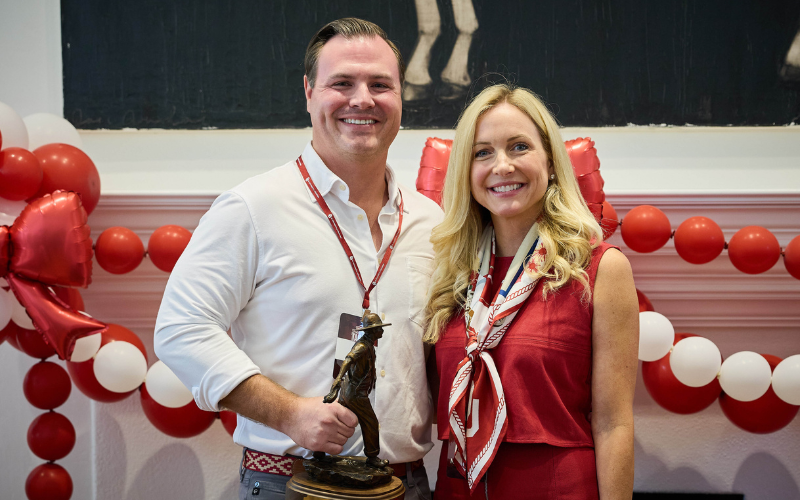
The University of Oklahoma has received a transformative gift from Jon and Shannon McCartney, which will name the McCartney Family Tunnel of Champions, the McCartney Family Gate of the Gaylord Family - Oklahoma Memorial Stadium and the McCartney Family Grand Lecture Hall in the Michael F. Price College of Business. The gift will also support the Inspiring Champions and the Athletic Director’s Discretionary Fund, in addition to establishing the McCartney DFW Career Trek program at Price College.
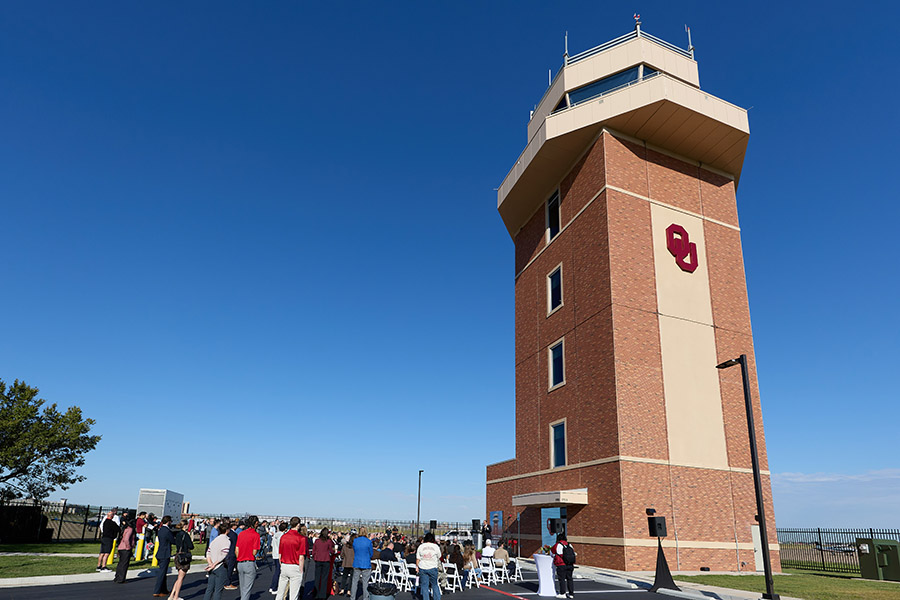
The University of Oklahoma today celebrated the opening of a new air traffic control tower at the OU Max Westheimer Airport. Standing 106 feet tall, more than double the current 52-foot facility, the new tower will modernize air traffic control operations and improve safety for pilots and students operating in the airspace.
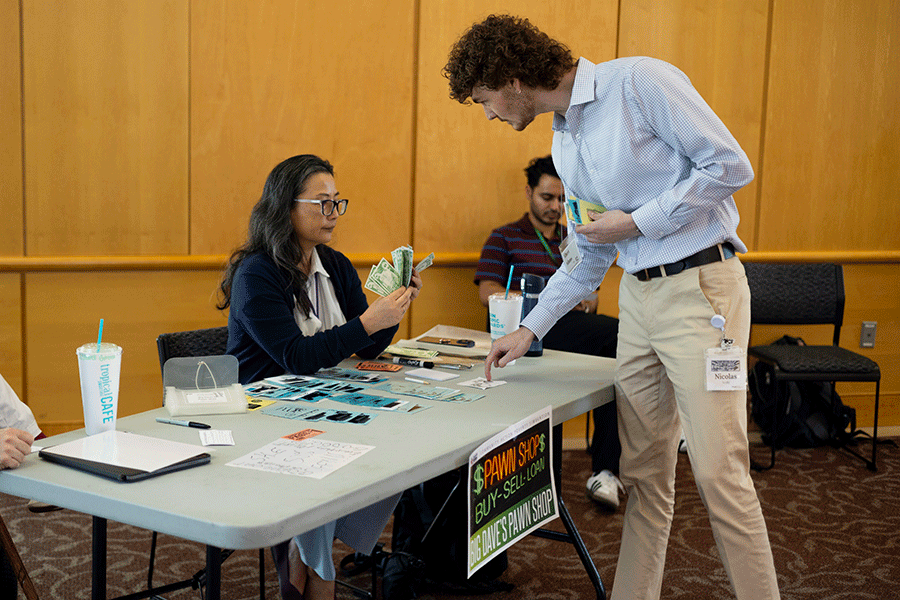
Do I buy groceries or pay the electric bill? Should I pawn some of my belongings to afford my prescription? My child is sick, so I will have to miss work to take care of him. Those are just a few of the difficult choices that OU-Tulsa health professional students confronted during the Community Access to Resources Experience. The role-playing activity challenged students to navigate the financial, family and other pressures that can affect a person’s health and ability to follow medical advice. Held annually during the SCM Institute orientation week, the experience is designed to generate understanding and build empathy.