NEWS

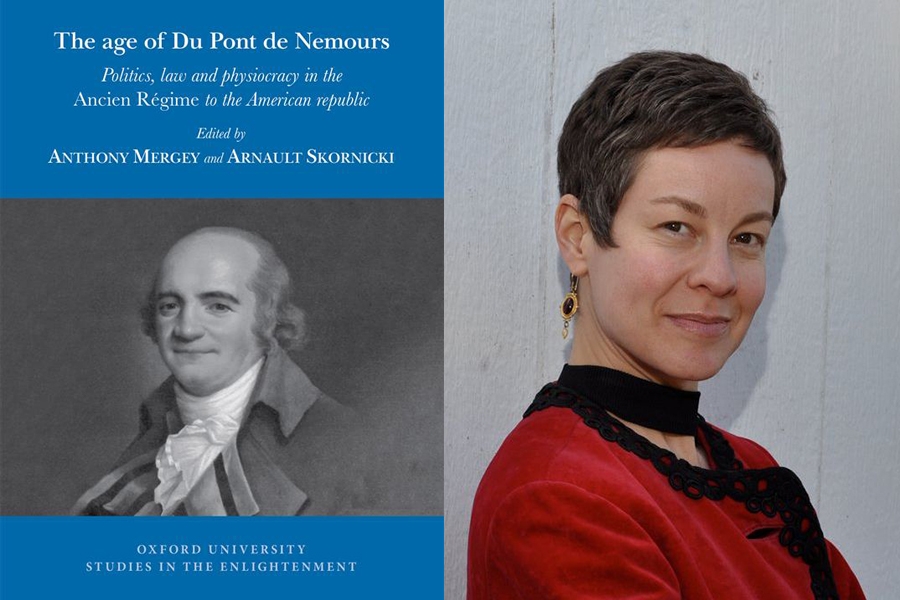
NORMAN, OKLA. – University of Oklahoma Associate Professor of French, Julia Abramson, has published an article with Oxford University Studies in the Enlightenment that reveals how religion, transatlantic networks and political upheaval shaped the earliest business efforts of the Du Pont family decades before their name became synonymous with American industry.
Titled “Family Business at Du Pont de Nemours, Père et Fils & Cie: Huguenot Connections, Credit and Capital in Post-Revolutionary France and America,” the article draws on extensive archival research from the Du Pont family and business archives in Delaware and sheds light on a little-known commercial venture founded by Pierre Samuel du Pont de Nemours, an Enlightenment economist and father of the DuPont Company’s founder.
Abramson’s research centers on a failed transatlantic business that Du Pont launched prior to the founding of the modern-day chemical company, which itself grew out of a gunpowder manufacturing business. Despite the earliest venture’s collapse within a decade, Abramson argues that it provides valuable insight into how trust and shared religious heritage motivated investment among Du Pont’s network of financiers.
“Many of these investors were highly savvy and clearly saw the business was unlikely to succeed,” she said. “What fascinated me was how and why they chose to invest anyway. The answer, I found, lies in the social bonds rooted in Protestant culture and a shared belief in a kind of ethical capitalism.”
Ethical capitalism, she says, prioritizes integrity and social responsibility in the conduct of business. It reflects a vision of commerce grounded in trust and human connection, rather than driven solely by profit. For some of Du Pont’s investors, the economic venture was deeply tied to moral beliefs. Du Pont’s own religious and philosophical writings reveal a commitment to civic stability and enduring relationships, and these beliefs could extend to conduct in commerce.
This research is part of a larger book project about financial culture and intellectual life in 18th-century France. Abramson notes that Pierre Samuel du Pont de Nemours, who served in the revolutionary French government, then fled the political upheaval of the 1790s, sought to build a new life and enterprise in the United States. His early company was founded to leverage the transatlantic trade and flow of financial capital between post-revolutionary France and the newly founded American republic.
“He envisioned a company that would not only generate revenue but also sustain relationships and values,” Abramson said. “Even though the business itself dissolved, it functioned as a kind of social glue. It reinforced family and friendship ties and a community of trust that extended across the Atlantic.”
By tracing these overlooked ties between religion, revolutionary politics and finance, Abramson explores a new vein of Enlightenment-era capitalism. Her article doesn’t just position Du Pont as a political thinker or failed entrepreneur, but as a figure whose vision of economic life remains deeply relevant to how we understand business and belief today.
About the project
This article is the lead story in The Age of Du Pont de Nemours: politics, law and physiocracy in the Ancien Régime to the American Republic, by Anthony Mergey and Arnault Skornicki, published by Oxford University Studies in the Enlightenment. Julia Abramson is an associate professor of French in the Department of Modern Languages, Literatures, and Linguistics at the University of Oklahoma. Her research spans Enlightenment studies, economic and religious history and cultural analysis. Her work has been supported by the Gustave Gimon Fellowship in the History of French Political Economy, from the Stanford University; Exploratory Research Fellowship in he Henry Belin du Pont Research Fellowship, both from the Center for the History of Business, Technology, and Society, of the Hagley Museum and Library; Travel Fellowship, from the Institute for Critical Social Inquiry, at The New School; and Senior Faculty Summer Fellowship, from the Dodge Family College of Arts and Sciences, of the University of Oklahoma.
About the University of Oklahoma
Founded in 1890, the University of Oklahoma is a public research university located in Norman, Oklahoma. As the state’s flagship university, OU serves the educational, cultural, economic and health care needs of the state, region and nation. For more information about the university, visit www.ou.edu.
The University of Oklahoma College of Medicine has honored two residents with the Lloyd Rader Award, which recognizes outstanding clinical and research achievements in residency.
The University of Oklahoma will receive up to $220 million over five years from the U.S. Department of Commerce and the National Oceanic and Atmospheric Administration to continue the life-saving weather research led by the OU-NOAA Cooperative Institute for Severe and High-Impact Weather Research and Operations, extending a nearly 50-year partnership that has helped give Americans earlier, more accurate weather warnings
The OU Food Pantry won the annual Red River Food Fight, collecting 31,815.9 pounds of shelf-stable food and drinks to top UT Outpost’s 22,567 pounds. OU has won the competition four years in a row.