NEWS

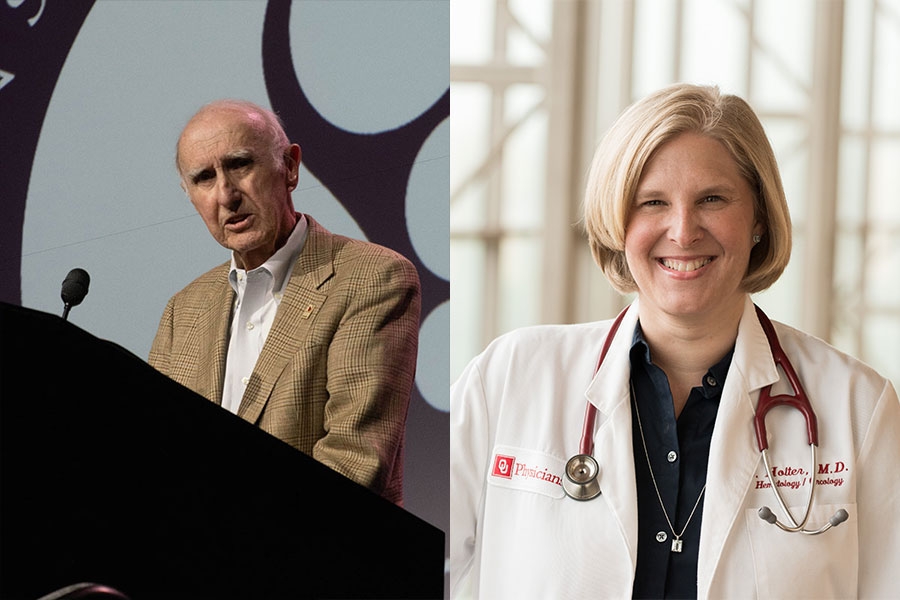
OKLAHOMA CITY, OKLA. – Two University of Oklahoma Health Sciences faculty members were recognized by the American Society of Hematology (ASH) during its annual meeting Dec. 7-10.
James George, M.D., a George Lynn Cross Research Professor in the OU College of Medicine and Hudson College of Public Health, was honored with the ASH Award for Leadership in Promoting Diversity. During his career in academic medicine, George has helped to build a stronger hematology workforce by mentoring the next generation of hematologists.
Under his leadership as ASH president in 2005, the society collaborated with the Robert Wood Johnson Foundation’s Harold Amos Medical Faculty Development Program (AMFDP) to create ASH-funded AMFDP positions in hematology. Since the program’s inception, ASH has supported nearly 30 recipients, many of whom have risen to the ranks of senior faculty in their institutions.
George was also a strong supporter of the ASH Medical Student Award Program, which provides research support for medical students underrepresented in medicine to encourage them to pursue hematology. To date, the program has supported more than 300 research opportunities for medical students. Additionally, George co-developed and directed the ASH Clinical Research Training Institute, an inclusive yearlong program that offers broad education for clinicians on clinical research methods.
Jennifer Holter-Chakrabarty, M.D., a professor in the OU College of Medicine and hematologist-oncologist at OU Health Stephenson Cancer Center, was elected to serve a four-year term as an ASH councilor.
Holter-Chakrabarty’s research background is in leukemia, transplantation and imaging of marrow failure syndromes. An active ASH member since 2003, she is chair of the Committee on Government Affairs, co-chair of the Advocacy Leadership Institute, and served as an appointed member on the Guideline Oversight Committee.
About the University of Oklahoma
Founded in 1890, the University of Oklahoma is a public research university with campuses in Norman, Oklahoma City and Tulsa. As the state’s flagship university, OU serves the educational, cultural, economic and health care needs of the state, region and nation. In Oklahoma City, OU Health Sciences is one of the nation’s few academic health centers with seven health profession colleges located on the same campus. OU Health Sciences serves approximately 4,000 students in more than 70 undergraduate and graduate degree programs spanning Oklahoma City and Tulsa and is the leading research institution in Oklahoma. For more information about OU Health Sciences, visit www.ouhsc.edu.
The University of Oklahoma has received a transformative gift from Jon and Shannon McCartney, which will name the McCartney Family Tunnel of Champions, the McCartney Family Gate of the Gaylord Family - Oklahoma Memorial Stadium and the McCartney Family Grand Lecture Hall in the Michael F. Price College of Business. The gift will also support the Inspiring Champions and the Athletic Director’s Discretionary Fund, in addition to establishing the McCartney DFW Career Trek program at Price College.
The University of Oklahoma today celebrated the opening of a new air traffic control tower at the OU Max Westheimer Airport. Standing 106 feet tall, more than double the current 52-foot facility, the new tower will modernize air traffic control operations and improve safety for pilots and students operating in the airspace.
Do I buy groceries or pay the electric bill? Should I pawn some of my belongings to afford my prescription? My child is sick, so I will have to miss work to take care of him. Those are just a few of the difficult choices that OU-Tulsa health professional students confronted during the Community Access to Resources Experience. The role-playing activity challenged students to navigate the financial, family and other pressures that can affect a person’s health and ability to follow medical advice. Held annually during the SCM Institute orientation week, the experience is designed to generate understanding and build empathy.