NEWS


NORMAN, Okla. — Maddy Keyes, a senior from the Gaylord College of Journalism and Mass Communication, has been chosen as a Pulitzer Center Reporting Fellow to explore the ecological grief caused by climate change for the Inuit in Greenland.
"I'm very excited to have the opportunity to work alongside and learn from those at the Pulitzer Center, which continues to do incredible and impactful work," Keyes said. "Climate change is often described as the story of our generation, and I'm honored to have the chance to tell a part of this story."
The Pulitzer Center Reporting Fellows at Campus Consortium partners get to pursue independent journalism topics, both nationally and abroad. Articles, photo essays, video, audio, and data visualizations produced by Reporting Fellows are featured on the Pulitzer Center website and in multiple news outlets, such as The New York Times, Miami Herald, Politico, NPR, The Guardian, Civil Beat, Grist, The Intercept and Yes.
“I am delighted that Maddy has been selected for this fellowship,” said David Craig, interim dean of Gaylord College. “It is exciting to see how her project will draw on the breadth of journalism experience she has gained during her time as a Gaylord student. I’m grateful to the Pulitzer Center for its partnership with us to support the kind of in-depth reporting she will get to do on a complex and globally significant topic.”
Reporting Fellows also benefit from Pulitzer Center mentorship, networking opportunities, and journalism resources.
"We're excited to work with Maddy on her fellowship that will take her to Greenland to report on the impact of climate change on the Inuit,” said Kem Sawyer, Pulitzer Center Reporting Fellows program director. “Maddy is asking important questions: ‘How does climate change disproportionately affect Indigenous communities across the globe? And what actions are communities taking to mitigate the risks?’ We also very much appreciate the tremendous support University of Oklahoma's Gaylord College gives its students.”
About the University of Oklahoma
Founded in 1890, the University of Oklahoma is a public research university located in Norman, Oklahoma. As the state’s flagship university, OU serves the educational, cultural, economic and health care needs of the state, region and nation. OU was named the state’s highest-ranking university in U.S. News & World Report’s most recent Best Colleges list. For more information about the university, visit ou.edu.
The University of Oklahoma has received a transformative gift from Jon and Shannon McCartney, which will name the McCartney Family Tunnel of Champions, the McCartney Family Gate of the Gaylord Family - Oklahoma Memorial Stadium and the McCartney Family Grand Lecture Hall in the Michael F. Price College of Business. The gift will also support the Inspiring Champions and the Athletic Director’s Discretionary Fund, in addition to establishing the McCartney DFW Career Trek program at Price College.
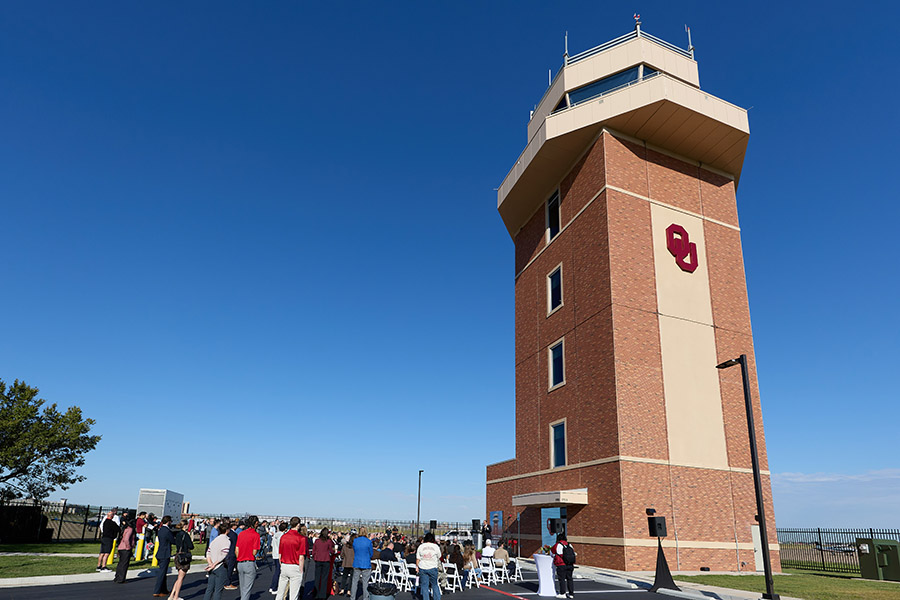
The University of Oklahoma today celebrated the opening of a new air traffic control tower at the OU Max Westheimer Airport. Standing 106 feet tall, more than double the current 52-foot facility, the new tower will modernize air traffic control operations and improve safety for pilots and students operating in the airspace.
Do I buy groceries or pay the electric bill? Should I pawn some of my belongings to afford my prescription? My child is sick, so I will have to miss work to take care of him. Those are just a few of the difficult choices that OU-Tulsa health professional students confronted during the Community Access to Resources Experience. The role-playing activity challenged students to navigate the financial, family and other pressures that can affect a person’s health and ability to follow medical advice. Held annually during the SCM Institute orientation week, the experience is designed to generate understanding and build empathy.