NEWS

By
April Wilkerson
Date
Media Contact
April Wilkerson
(405) 271-8001,
ext. 33182
April-J-Wilkerson@ouhsc.edu
OKLAHOMA CITY, OKLA. – Diabetes and heart disease often go hand in hand. People with diabetes face a much greater risk for heart attack and stroke than those without diabetes, and an estimated two-thirds of people with diabetes eventually die because of heart disease.
To better understand that risk, University of Oklahoma researchers are studying the role of platelets, tiny blood cells that help the body form clots to stop a wound from bleeding. Prabha Nagareddy, Ph.D., a researcher at OU Health Harold Hamm Diabetes Center and a professor in the OU College of Medicine, is leading the project, which aims to understand what causes platelets to function abnormally in patients with diabetes and subsequently damage cardiovascular health.
“We know that people have a higher risk of cardiovascular disease if they are obese, smoke, drink excessively and don’t exercise, but we are trying to understand how the risk actually causes the disease. And with this project, we are focusing on why diabetes is a risk for cardiovascular disease, specifically coronary artery disease,” Nagareddy said.

Platelet production is a regular ongoing process in the body. The bone marrow produces platelets, which are released into the blood vessels, and when the platelets get older, the body removes them, and the production cycle starts over. However, in people with Type 1 or Type 2 diabetes, high levels of sugar (glucose) in the blood increase the production of platelets. A higher amount of platelets is not itself a risk factor for heart disease, Nagareddy said, but with the increase comes more immature platelets — those that are released when they are too young and less able to function properly.
Although they are younger, immature platelets are actually larger than mature platelets. That is problematic because they have more surface space to carry “cargo” that triggers inflammation in the blood vessels. As a result, immature platelets are more likely to clump together and activate themselves to form a clot.
“LDL cholesterol, the ‘bad’ type of cholesterol created by high blood sugar, has already inflamed the blood vessels, and immature platelets just aggravate that inflammation,” Nagareddy said. “And if a clot is dislodged from the vessel, it can block the coronary artery and cause a heart attack.”
Nagareddy has demonstrated this process in mice, and now he is ready to test his theory in humans. His study is enrolling two types of participants with diabetes — those with high blood sugar levels and those with normal (or controlled) blood sugar levels — in addition to patients without diabetes for comparison. Blood draws will allow him to measure the volume and type of platelets and their ability to clump together, then determine a possible correlation with high blood sugar levels.
Understanding how the process works is critical for devising a way to prevent or slow the increased production and abnormal functioning of immature platelets. Anti-platelet therapies exist, but they tend not to work well in patients with diabetes, Nagareddy said. He hopes his research contributes to an improved way to lower the risk of cardiovascular disease in patients with diabetes.
OU Health endocrinologist and professor of medicine Mary Zoe Baker, M.D., a clinical collaborator on the study, said the research is exciting for its potential to uncover what constitutes the risk for cardiovascular disease in people with diabetes.
“Over the years, endocrinologists and researchers have begun focusing more and more on cardiac disease risk,” she said. “This is promising because researchers are honing in on exactly what the issue is. Once we characterize the problem, we’ll have a better idea of what to do about it. Ultimately, I believe this will help our patients.”
About the project
Research reported in this news release is supported by a grant from the National Heart, Lung and Blood Institute, a component of the National Institutes of Health.
About the University of Oklahoma
Founded in 1890, the University of Oklahoma is a public research university located in Norman, Oklahoma. As the state’s flagship university, OU serves the educational, cultural, economic and health care needs of the state, region and nation. OU was named the state’s highest-ranking university in U.S. News & World Report’s most recent Best Colleges list. For more information about the university, visit ou.edu.
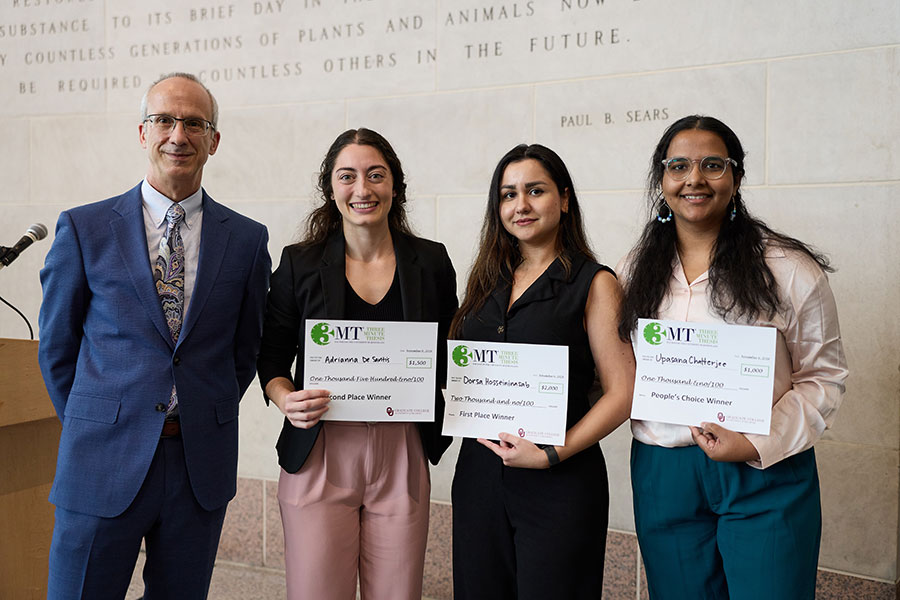
Three University of Oklahoma graduate students earned top honors in the 2026 Three Minute Thesis (3MT) competition, an annual event that challenges students to explain their research to a general audience in 3 minutes.
Researchers at the OU Health Harold Hamm Diabetes Center are investigating diabetes from numerous angles, including how the disease affects other organs, what factors contribute to its development and complications, and how new approaches to prevention and treatment could improve health.
A new five-year, $3 million grant from the National Cancer Institute will enable researchers at OU’s TSET Health Promotion Research Center (HPRC) to scale up a smartphone-based mHealth solution that uses targeted and tailored messages to motivate smokers to kick the habit.