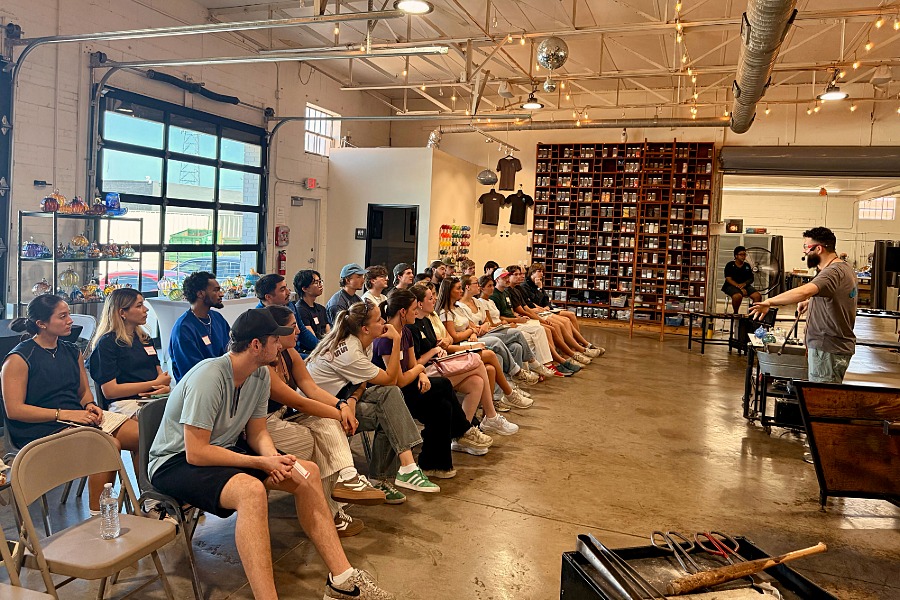
This semester, students in the LA 5535 Studio: Ecological Planning and Design, led by Prof. Afsana Sharmin, took on an ambitious hypothetical project to redesign key parts of the OU campus. Their mission: to tackle the critical real-world challenge of stormwater management through innovative green design.
The project was broken down into four sites—the Duck Pond, the Elm Avenue Corridor, the area east of Gaylord Stadium, and the South Oval around Gould Hall. The students were encouraged to treat it as a real-world project in which they evaluated potential economic and long-term benefits for both the university's consideration of investment, estimated timelines for profitability and implementation phases, and identified possible funding sources.
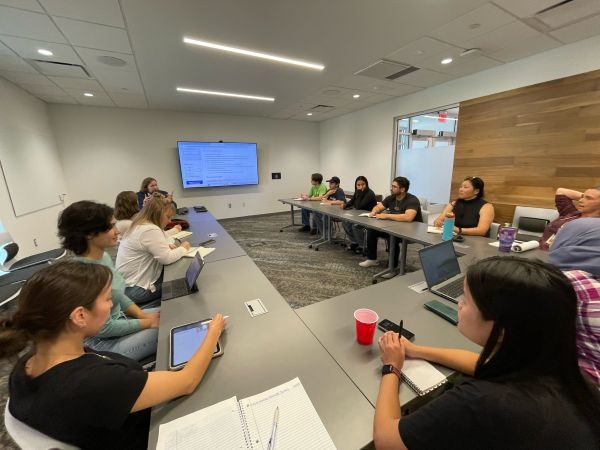
Landscape Architecture Students Meeting with the City of Norman
“In a traditional lecture, you learn the ‘what’ and the ‘why,’” Sharmin explained. “In this studio, they learn the ‘how.’ They are synthesizing human dimensions, ecological principles, and placemaking to create designs that are not only beautiful but functional and impactful.”
The project has given students an understanding of the differences between Norman’s outdated sewer system and the complex jurisdiction between OU’s Facilities Management and the City of Norman’s different stormwater programs, providing a crucial, real-world framework for their designs. Students met with OU Facilities staff and City of Norman officials at the beginning of their design process, communicating via email afterwards to obtain further data, relevant maps, statistics, and reports.
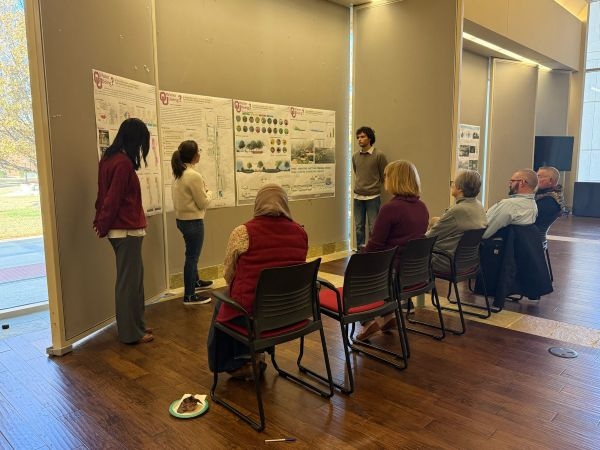
Student Final Presentations
Collaboration has been key to navigating these challenges. Students were intentionally grouped into teams, combining expertise in hand-drawing, software like AutoCAD, SketchUp, Photoshop, and skills from site engineering classes.
While there is no formal external client, the project was informed by their engagement with OU’s Facilities Management and City of Norman planners. Their final critique was attended not only by the Landscape Architecture faculty, but also by two members from the facilities team: Jeremy J. Debaets, Director of Utility Services, and Tom C. Hughes, Senior Administration Manager for the Utility Crew. They shared their expert insights into different problem areas and noted their appreciation for the students’ ability to address challenges like the Elm Avenue corridor.
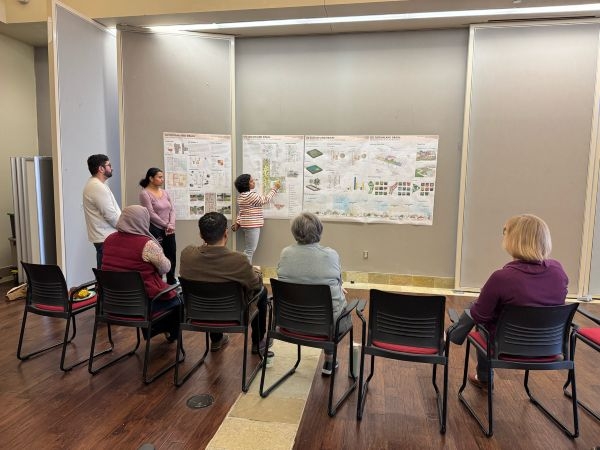
Students Showcase Their Work
The students’ work proposed a campus environment that is not only more sustainable but also more walkable and comfortable. Their designs calculate stormwater runoff reduction while also considering thermal comfort, aesthetics, shade, and placemaking, creating an enriched experience for the entire OU community.
At the end of their design process, students evaluated their design proposals using landscape performance metrics for both the environment and human well-being in the last phase of their design. From the instructor’s viewpoint, the most exciting element has been the students’ capacity for rapid, high-quality designs.
This kind of applied, project-based class is the bedrock of the Landscape Architecture program’s curriculum. What makes this class unique is the direct application to their own campus, a familiar environment the students are now seeing through the lens of a landscape architect.
Gibbs College is pleased to present the exhibition 200 Digital Drawings by Professor Tiziana Proietti, currently on display in the Gould Hall Living Room.
Gibbs College of Architecture Professors Amber Brown and Amy Leveno led 29 students to Dallas, Texas, in September for a learning experience as part of their Design 7 Studio course.
Christopher C. Gibbs College of Architecture professor and Institute for Quality Communities Director Dr. Amber N. Wiley’s book, Model Schools in the Model City: Race, Planning, and Education in the Nation’s Capital, has received two major honors from the Urban History Association.