OU Architecture alumni Wister Wu was recently honored with the Global Human Settlements Award on Planning and Design at the annual Global Forum on Human Settlements conference in Dubai. The GFHS is a global non-profit organization that promotes sustainable cities and human settlements for all through their annual forum and other academic conferences.
The GFHS annual Global Human Settlements Awards honors outstanding projects, progress and valuable experience on building safer, greener, more resilient, inclusive and sustainable cities and human settlements. This year, 17 different organizations and individuals from around the world received GFHS Global Human Settlements Awards, including Wu for his project, Dreaming in the Lotus Bay.

Part of the exterior of Dreaming in the Lotus Bay.
Dreaming in the Lotus Bay is a home improvement project in Norman, OK, exclusively designed and built by Wu. He began working on the project in early 2020 and completed it in 2022. His initial inspiration for the project stemmed from the COVID-19 pandemic. “I wanted to create something significant to honor people’s resilience, bringing a glimmer of light to the darkness of the pandemic and uplifting spirits,” Wu said.

An exterior detail shot of Dreaming in the Lotus Bay.
“The second inspiration was to bring to life the common philosophy of viewing life as a journey at sea and home as its harbor, creating a secure family haven amidst turbulence,” Wu explained. “Life is like sailing on the sea and home is like the harbor of life; this is a beautiful common sense of human civilization. During the COVID-19 pandemic, the profound feeling of home as a safe harbor was particularly felt.”

Part of the exterior of Dreaming in the Lotus Bay.
Presented through ship design language and other special expressions, this ship-like project further pays tribute to the boundless capability of mankind to overcome the pandemic. Wu transformed the courtyard of his home into a work of art that resembles a family harbor. The courtyard features 68 boat-shaped objects that are strategically placed to represent boats breaking through ocean waves.

The central courtyard of Dreaming in the Lotus Bay.
Upon entering the family harbor, visitors are faced with the bow of a ship from the fleet, made up of fifteen boat-shaped objects. The space also contains a lotus pond, a cruise dock, a floating island, a flying sailboat and a tea house, which enclose the pebble stone bay courtyard. Wu refers to this courtyard as the living room of the harbor, which offers a place for visitors to sit around and enjoy the scenery.

A courtyard table in Dreaming in the Lotus Bay.
According to the Selection Committee of Sustainable Cities and Human Settlements Awards, “The project independently and creatively designs a home harbor encompassing 68 boat-shaped objects, ingeniously combining daily life, plastic arts with fine spiritual pursuit, and forging a large piece of artwork of human settlement. This unique creation not only applauds the unswerving perseverance manifested during the pandemic and the spirit of free pursuit to dreams, but also soothes people’s trauma vividly, serving as a long-lasting sanative force. The project brims with Eastern charm and outer space elements, breaks the shackles of traditional notions and manifests the possibility of diverser human settlement environments within limited space, which is of great creative and exemplary significance.”

Tea service in the courtyard of Dreaming in the Lotus Bay.
Learn more about Dreaming in the Lotus Bay by watching the video below.
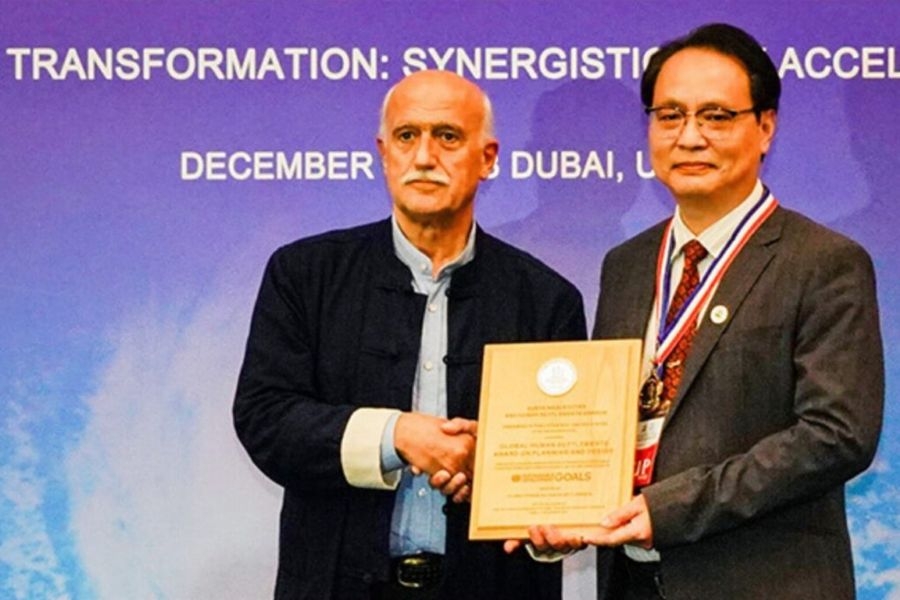
Featured Image: Wister Wu (right) recieving his Global Human Settlement Award from Dr. Arab Hoballah, Senior Sustainability Expert, former Chief, Sustainable Consumption and Production, UNEP (left).
Gibbs College is pleased to present the exhibition 200 Digital Drawings by Professor Tiziana Proietti, currently on display in the Gould Hall Living Room.
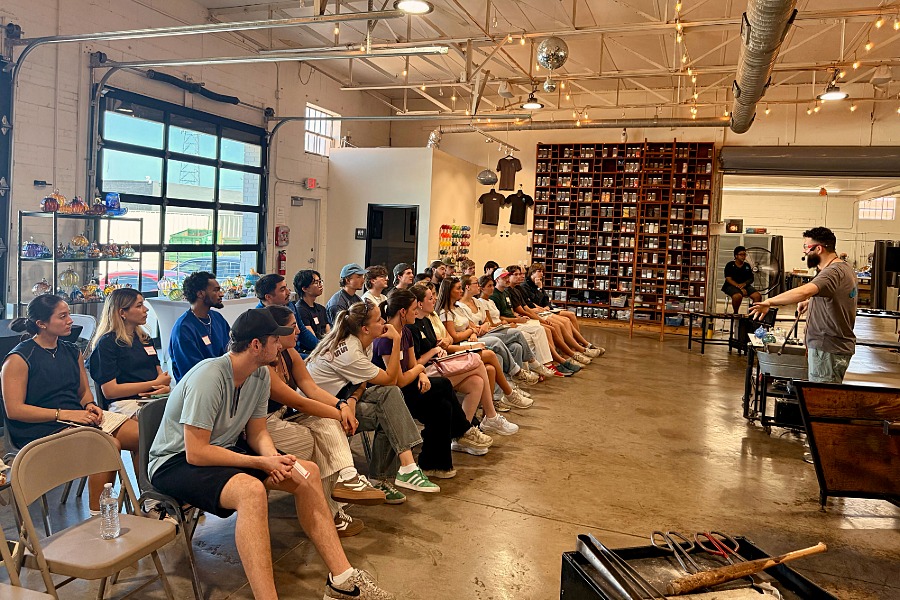
Gibbs College of Architecture Professors Amber Brown and Amy Leveno led 29 students to Dallas, Texas, in September for a learning experience as part of their Design 7 Studio course.
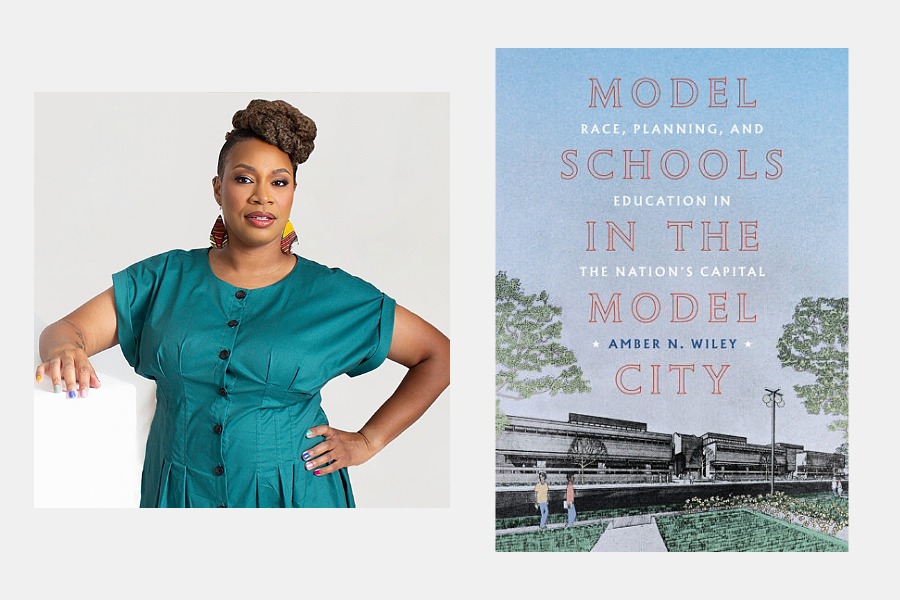
Christopher C. Gibbs College of Architecture professor and Institute for Quality Communities Director Dr. Amber N. Wiley’s book, Model Schools in the Model City: Race, Planning, and Education in the Nation’s Capital, has received two major honors from the Urban History Association.