Dr. Laura Harjo, an associate professor of Native American Studies and Regional + City Planning faculty affiliate, recently organized and presented the exhibition Muscogee (Creek) Tribal Town Futurity: Spatial Storytelling with Emergent Technologies in the Gould Hall Buskuhl Gallery. She was assisted by Gibbs College’s Dr. Angela Person (Architecture) and Prof. Shawn Schaefer (Urban Design), as well as several Architecture and Urban Design students, Gibbs College staff, and others.
The exhibition used emergent technologies, such as projection mapping and digital modeling, as well as audio tools in order to show exhibition visitors what it was like in the Alabama and Georgia tribal towns of the Muscogee people before they were forcibly removed from that area (pre-removal) to Oklahoma by the U.S. government. These technologies were used to allow those in the exhibit to experience these towns in ways they would not be able to if they were just looking at static displays.
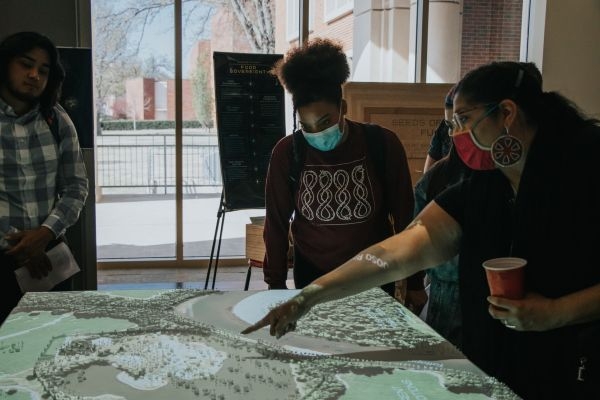
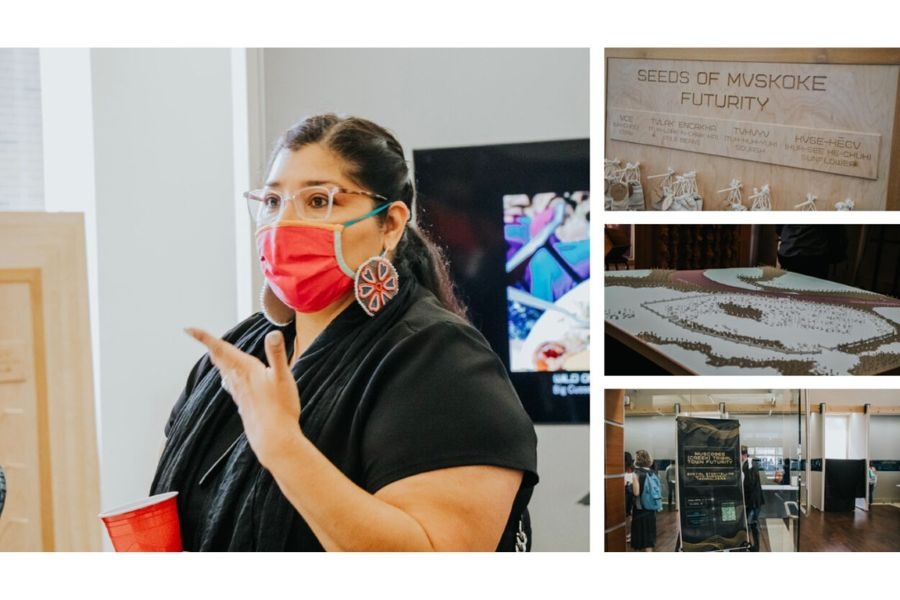
Dr. Laura Harjo explains features on the projected map.
Dr. Harjo describes the exhibition: “It really takes on the idea of Muskogee futurity, which is about realizing, or activating, the un-activated possibilities of our relatives, and pulling them forward into a current moment and a future moment.”
The exhibition presented elements of Muscogee (Creek) Tribal Towns found in pre-removal Alabama and post-removal Oklahoma using several visualization technologies including digital modeling, Geographic Information System mapping and spatial analysis, as well as a 3D physical models. It also explored how the community and knowledge fostered in these tribal towns are involved in planting the seeds of futurity for the Muscogee people.
The exhibit began with a video with audio of more-than-human elements of Muscogee homelands in Alabama in order to ground visitors to the exhibition and introduce them to the natural landscape experienced Muscogee people.
From there, the exhibit transitioned into three displays that utilized projection mapping, combined with physical models, in order to feature different tribal towns during different time periods.
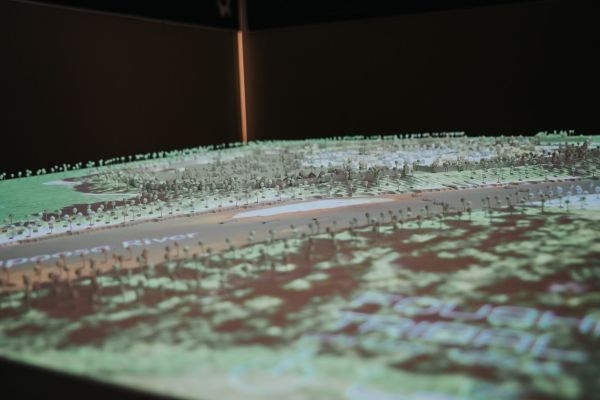
A close-up of one of the exhbition's model and map projection displays.
As Dr. Harjo describes, these three displays and the concepts they share, “are from my book Spiral to the Stars, which are grounded in Muskogee, ways of knowing, or a Muskogee epistemology.”
The first display conveyed the idea of “Relationality” by displaying topographic maps of Oklahoma and Alabama Creek Nation Reservations alongside a poster describing relational energy, matrilineal relationships, etvlwvlke (tribal town) networks, and caretaking. Relationality was explored in terms of town members relate to both each other and to their more-than-human kin.
The second display, “Community Knowledge,” showed a physical model of an Alabama Tribal Town during the time period 1000-1200 a.d., accompanied by a poster describing how the Muscogee etvlwa re-emerged in Oklahoma, as well as observational knowledge, felt knowledge, and agricultural knowledge.
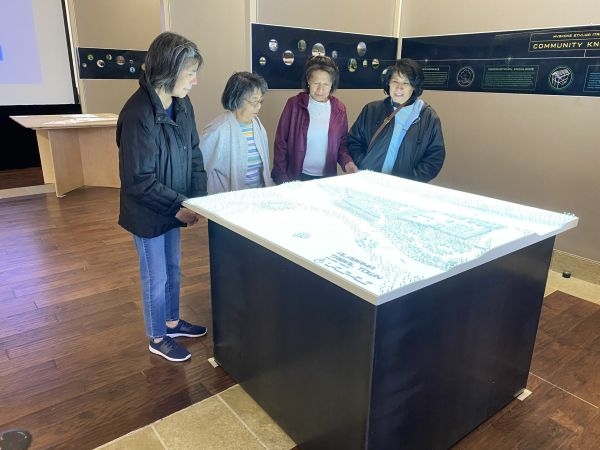
Guests at the Community Knowledge display.
The third display, “Collective Power,” included a physical model of the Foushatchee Tribal Town during the time period 1700-1900 a.d. The model was paired with a poster describing governance, community consensus, the Green Corn Ceremony, and agricultural sophistication.
Dr. Harjo describes how these three sections are laid out in the exhibition: “these three ideas go from the scale of what you can do as a person and a way to be in the world [relationality], […] to community knowledge, and scaled up to governance systems [collective power]–that has to do with organizing the entire town.”
The exhibition then presented the ideas of food sovereignty, inviting visitors to the exhibition to take seeds of the “four sisters” – corn, beans, squash, and sunflowers – in order to understand the importance of food sovereignty in planting Muskogee seeds of futurity.
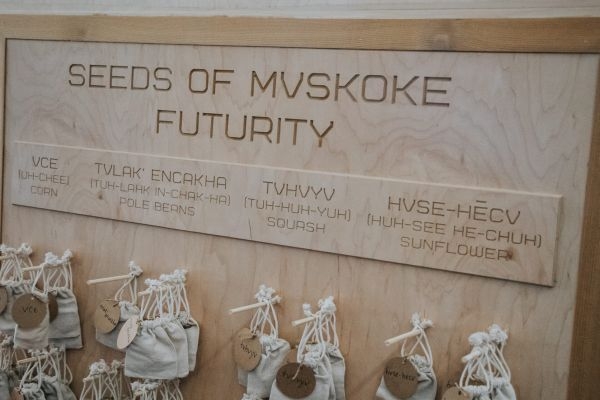
Seeds available for visitors.
The exhibition concluded with a video on the creation of arbors and the importance of this knowledge for Muskogee futurity. With this conclusion, Dr. Harjo said, “the exhibit takes on this idea of half a millennium because it does take on the past, the present and the future.”
Dr. Angela Person and Professor Shawn Schaefer from Gibbs College of Architecture assisted Dr. Laura Harjo in the planning and presentation of the Muscogee (Creek) Tribal Town Futurity exhibition. Urban Design studio students, Jeremy Banes, Courtney Graham, Soujanya Malla, and Roshita Taylor created the physical models of the tribal towns used in the exhibition. Architecture PhD student Felipe Flores provided support for the models and created the graphic posters, and many others, including Jerry Puckett, Mat Reed, Chris Morrey, and Peter Tran, provided critical support with construction and installation (see a full list of contributors below).
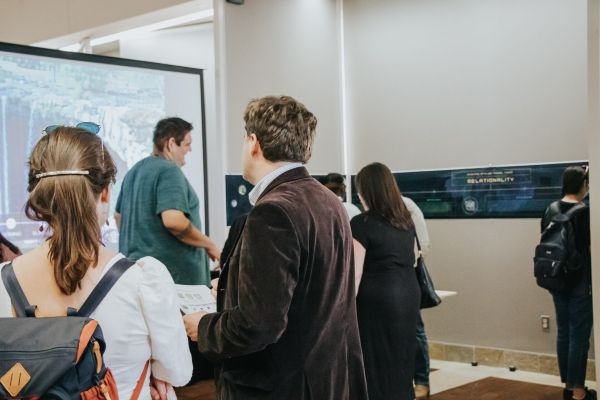
Guests at the exhibit.
Dr. Harjo reflected, “I don’t even think it could have happened without Gibbs College and the support of the faculty and Dean Butzer.” She also noted how rewarding it was to work with the Urban Design students and watch them grow as planning professionals.
The “Muscogee (Creek) Tribal Town Futurity” exhibition was made possible with seed funding from the OU Vice President for Research and Partnerships’ inaugural Social Science and Humanities Seed Grant program.
The Gibbs College of Architecture is honored to host and assist with the presentation of Dr. Laura Harjo’s exhibition.
View additional photos from the exhibition in the gallery below.
Gibbs College is pleased to present the exhibition 200 Digital Drawings by Professor Tiziana Proietti, currently on display in the Gould Hall Living Room.
Gibbs College of Architecture Professors Amber Brown and Amy Leveno led 29 students to Dallas, Texas, in September for a learning experience as part of their Design 7 Studio course.
Christopher C. Gibbs College of Architecture professor and Institute for Quality Communities Director Dr. Amber N. Wiley’s book, Model Schools in the Model City: Race, Planning, and Education in the Nation’s Capital, has received two major honors from the Urban History Association.