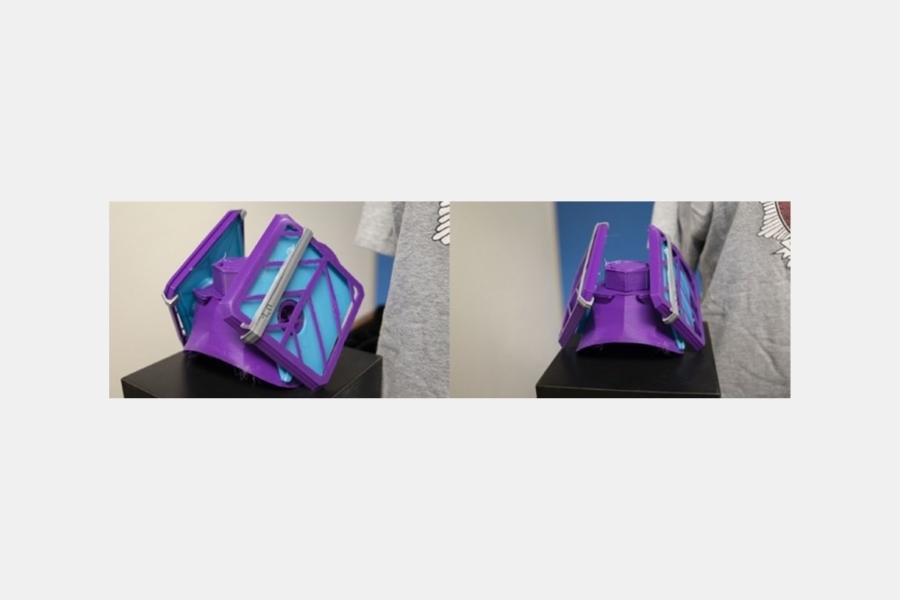
As coronavirus cases in Oklahoma see a new surge, personal protective equipment once again may become in short supply. Three University of Oklahoma researchers have validated 3D printed masks that may help.
At the start of the pandemic, Ken Marold, an assistant professor in the Christopher C. Gibbs College of Architecture, was awarded internal funding from the university’s Vice President for Research and Partnerships to fund COVID-19 related research.
“The funding allowed our team to develop a direct response to the COVID-19 crisis and the severe shortage of N95 masks required to protect healthcare workers and other essential service providers,” Marold said.
One of the ways members of the community were coming together to help alleviate this shortage was by 3D printing homemade, open-source face masks.
“This ‘maker’ movement highlighted three key challenges with homemade masks and current 3D printed designs that we aimed to rectify, specifically how to attain proper fit of the mask to the wearer’s face, attaining adequate filtration efficiency with home-sourced material, and achieving proper inhale and exhale airflow rates,” Marold said.
“Our team ultimately developed two mask designs that met or exceeded regulatory standards and fit requirements for N95 respirators by performing respirator fit tests using OSHA approved methods,” said Evan Floyd, an assistant professor in the Hudson College of Public Health and one of the researchers working on the project. “This level of pre-vetting was essential in obtaining FDA emergency use authorization and for ensuring reliable up-scaled production by the ‘maker’ community during this and future outbreaks.”
Bobby Reed, emerging technologies librarian at OU Libraries said the first mask design that was validated through the successful fit testing has been provisionally patented and has received FDA emergency use authorization.
“The design information for that mask is publicly available through the ‘For Oklahoma – OU Pandemic Response’ website for all 3D-printing ‘makers’ using common PLA-based filament materials to manufacture the design at home,” Reed said.
The researchers announced that the second validated mask design has completed its first round of validation tests and has exceeded the performance of the previous version.
“Version 2 includes a number of design and fabrication improvements including a lower part count, only 5 parts rather than the 16 used in Version 1, and offers an improved fit with regard to sealing along facial contours, a lower profile, lighter design, a simplified and more secure media clamping mechanism, and an improved design aesthetic,” Marold said.
The research team is seeking additional design patents for this latest version and are looking into options to increase production.
This story originally appeared on the OU Vice President for Research and Partnerships’ news page (linked here).
Gibbs College is pleased to present the exhibition 200 Digital Drawings by Professor Tiziana Proietti, currently on display in the Gould Hall Living Room.
Gibbs College of Architecture Professors Amber Brown and Amy Leveno led 29 students to Dallas, Texas, in September for a learning experience as part of their Design 7 Studio course.
Christopher C. Gibbs College of Architecture professor and Institute for Quality Communities Director Dr. Amber N. Wiley’s book, Model Schools in the Model City: Race, Planning, and Education in the Nation’s Capital, has received two major honors from the Urban History Association.