
There are only a few requirements that samples must meet for imaging or analysis:
Samples need be no larger than is necessary to be representative of a material, and are constrained in size for our instrument by the physical dimensions of the stage and sample holders. Samples can be no thicker than about 13 mm (~1/2"), but a variety of sample footprints can be accommodated. We have holders that can fit samples up to about 2 inches in diameter. Among these we currently have holders for up to three 27x 46 mm polished petrographic thin sections, up to six 1" round samples (thick sections or cut cylinders), two cylinders with 1.25” or 1.5”diameter, one 2”cylinder, and several devices that will hold small samples which we commonly mount (by casting in epoxy resin) in ¼" (up to six per device) or 3/32" (up to 43 per device) brass tubes. Small loose samples for surface analysis or imaging can be adhered to 1” diameter stubs (with or without a central well for particles more than 1 mm tall).
Samples submitted by private individuals for the purpose of material identification must be no larger than 5 mm x 5mm x 2 mm; we cannot cut samples for identification from larger bulk specimens.
Top referenced samples for analysis by WDS or BSEI
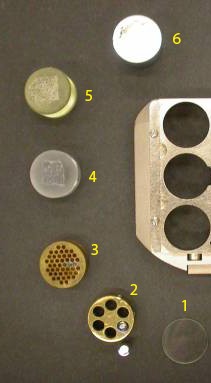
1 - 1" round polished microprobe thin section
2 - holder for six 1/4" cylinders (usually epoxy cast in brass tubes)
3 - holder for forty 3/32" cylinders (usually epoxy cast in brass tubes)
4 - 1" thermal plastic cast cylinder
5 - 1" epoxy or acrylic cast cylinder
6 - 1" epoxy cast in phenolic plastic ring form
7 - 1" carbon planchette
8 - 1" x 1/4" tall aluminum stub
9 - 1" x 1/2" tall aluminum stub
10 - 1" x 3/4" tall aluminum stub
11 - 1" x 3/4" brass stub with 1/16" deep recess (~1/2" across) for medium grains
12 - 1" x 3/4" aluminum stub with 3/16" deep recess (~3/4" across) for tall grains
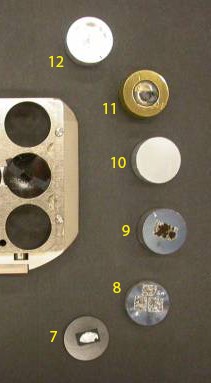
Mounts for loose grains or fragments; Samples cannot protrude more than 1-2 mm above mount surface; Samples can be affixed with adhesive (double-sided carbon tape, carbon putty, or glue)
