
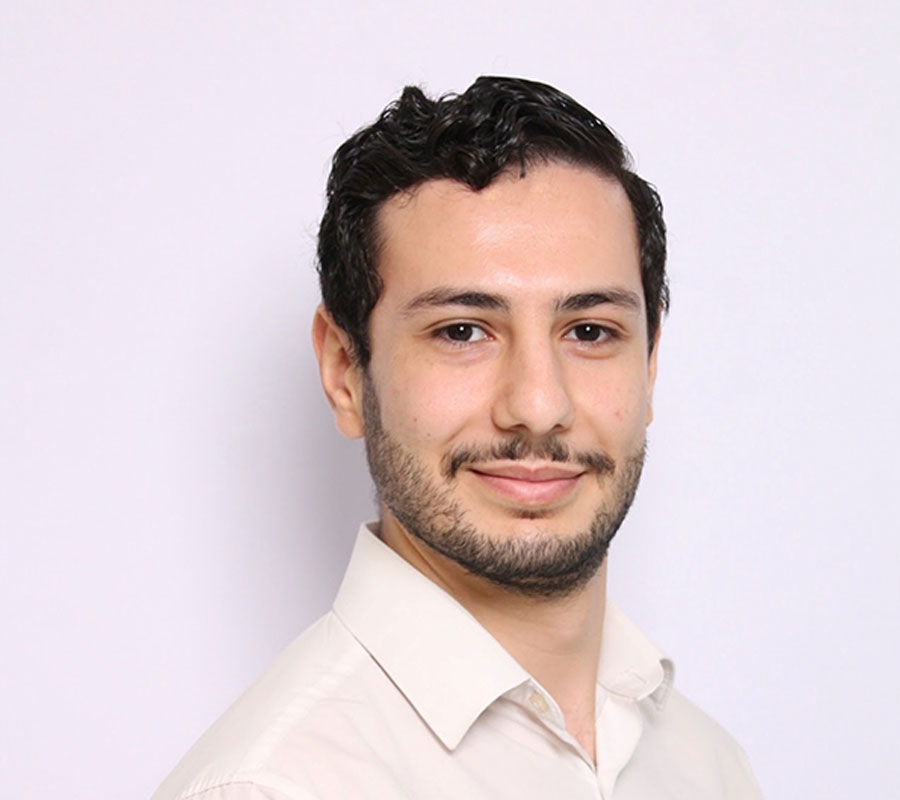
From war-torn Damascus to the heart of New York’s financial sector, Ali Al Khayer’s journey is defined by courage, curiosity, and the conviction to pursue a path that was authentically his, even when doing so meant stepping beyond what was familiar and expected. After leaving home as a teenager to pursue an education abroad, Al Khayer ultimately found his way to the OU Price College of Business, where he built a community, discovered his path in finance, and prepared for a career tackling complex challenges in finance, energy, and emerging technologies.
Price College caught up with Al Khayer to discuss his remarkable journey, the people and experiences that shaped him along the way, and why relationships, curiosity, and continuous learning remain at the center of his success.
“I was born in Damascus. During the war [Syrian Civil War], I lost my mother, and my family had to relocate within Syria in search of safety. That loss changed everything for me. As the fighting continued, I realized that staying meant a narrow set of paths, likely becoming a doctor or an engineer, because those were the safe, expected routes. But that wasn't who I was, and I couldn't shake the feeling that there had to be more out there for me.
So I broke from convention. I applied for schools abroad, and against long odds, I received a high school scholarship that took me to Canada. I was a teenager, alone in a new country, starting completely from scratch. A couple of years later, I applied to universities in the United States, and when I found OU, it felt like the right fit.
None of it was easy. I was on my own, far from my family, figuring out my path with no roadmap. But the people I met along the way, especially the OU community, made all the difference — people who believed in me before I fully believed in myself, who opened doors, offered guidance, and gave their time when they had no obligation to do so.
It took years of work and persistence, but it's what led me from war-torn Damascus to where I stand today, building a career in New York.”
“I was actually on track to finish with three majors—Finance, Management Information Systems (MIS), and Economics—but once I got a full-time job offer, I decided to drop Economics and focus on Finance and MIS. Finance fit my interest in numbers and working with people, while MIS gave me a foundation in technology and programming, which are only becoming more central to the future of business, automation, and AI.
Outside the classroom, I was involved in several organizations at Price College of Business, including the JCPenney Leadership Program, I-CCEW (an internship-based consulting experience), the Finance Student Association, where I served in a leadership role, and the Wealth Management Club, which I helped start under the guidance of Tom Hooper.
As an international student, I was also active in the international community through organizations such as the International Advisory Committee (IAC), United World Colleges, and various international events on campus. Those communities helped me build a sense of belonging and feel at home at OU.”
“Several experiences stand out. Through the JCPenney Leadership Program, I participated in a leadership retreat that included a whitewater rafting trip, which was both fun and a great bonding experience.
Another highlight was the President’s Community Scholars program. At the start of my first year, we went on a camping retreat. I did not know anyone when I arrived at OU, and that trip helped me form friendships that have lasted well beyond graduation. Those early experiences were critical in helping me build a sense of belonging.
The IAC’s annual international festival is one of my favorite memories. It brought together fashion, dance, and food from around the world and really celebrated the diversity of the OU community. I attended every year.”
“I started at Citibank and then transitioned to ING Financial Services, where I now focus on energy and new technologies, including midstream, downstream, and emerging areas like carbon capture, green hydrogen, and green methanol. It's a natural evolution from where I
started: at Citibank, we financed large-scale infrastructure and clean energy projects in the U.S. and internationally.
This is directly connected to my background. I grew up in Syria, where I studied by candlelight because reliable power, let alone clean power, was never guaranteed. Energy security isn't theoretical to me; it's something I lived without. That's part of why I've built my career around it, and why I see this work as more than a job. I'm building skills and experience I hope to one day bring back to support Syria's reconstruction, when time allows for it.”
“The hardest part for me was simply getting the right information. I arrived in the United States without a network, and I didn't understand how the system worked or what opportunities even existed. So my first piece of advice is to invest time figuring out what you actually want to do, even if it takes a while. I changed majors several times before finding the right fit. Talking to people was crucial along the way. Mentors, peers, professionals in different fields — they all helped me understand the landscape.
Second, understand the importance of internships, especially in finance. Many banks recruit very early. Most industries think about summer recruiting in the fall, but large banks often start recruiting in January for internships the following summer. I didn't fully grasp that timeline at first and missed the window for a finance internship, which is often the main pipeline into full-time roles. So know the calendar before you need to.
Third, learn how to network in a genuine way. When I started, I thought talking to someone meant they'd hand me a job at a big company. Over time, I realized networking is really about building relationships, learning from others, and understanding how the industry actually operates. The job usually comes later, as a result of those relationships and the effort and interest you've shown.
And beyond all that, stay curious and never stop learning. Ask questions, seek out feedback, and actually use it. That's how you keep improving, long after you've landed the internship or the first job.”
The University of Oklahoma Michael F. Price College of Business has experienced significant growth over the past five years, becoming OU’s second-largest college with over 7,000 students. The college offers highly ranked undergraduate, master’s, executive and doctoral programs across six academic divisions. More information is available at price.ou.edu
