NEWS


OKLAHOMA CITY – Young adults who want to quit vaping may turn to social media for support, but keeping them engaged with digital cessation programs over time can be challenging. A University of Oklahoma researcher is testing whether adding support from trained peers can help keep young adults engaged as they try to quit vaping.
Joanne Chen Lyu, Ph.D., a member of the TSET Health Promotion Research Center at OU Health Stephenson Cancer Center and an assistant professor in the Department of Family and Preventive Medicine at the OU College of Medicine, recently received a five-year, $1 million grant from the National Institutes of Health for the study. Through clinical trials, she will test her peer-supported, social media-based intervention to help young adults quit vaping.
“Young adults have integrated social media into their lives, but a major challenge with digital interventions is how to sustain engagement,” Lyu said. “That’s why we wanted to incorporate peer mentors who have successfully quit vaping themselves, leveraging their lived experience and emotional support to keep trial participants engaged throughout the quitting process.”
Since her postdoctoral fellowship at the University of California San Francisco, Lyu and her colleagues have been working on Quit the Hit (QTH), a program designed to help young people quit vaping through Instagram groups. Each group includes 10-15 participants and is led by a tobacco cessation counselor who provides evidence-based support and strategies for quitting vaping. Through that work, Lyu and her colleagues identified a challenge: participant engagement tends to decline over time, which may reduce the effectiveness of the programs.
In focus groups with young people who are trying to quit vaping, they said they would like support from peers who had quit vaping themselves. To address this need, Lyu developed a program called PEERS, which equips young adults who have quit vaping with the knowledge and skills to provide peer mentoring in social media groups.
“The peer mentors may be more relatable because they were in the same situation and know the challenges themselves,” Lyu said.
In the newly funded project, Lyu and her team will evaluate the combined PEERS plus QTH among young adults. Through a pilot randomized controlled trial, they will examine whether the program is feasible and acceptable by comparing PEERS plus QTH with Smokefree.gov, a federal tobacco cessation resource. They will also interview participants and peer mentors to learn what worked well and what could be improved. Finally, the team will assess the preliminary effectiveness of the peer mentoring approach in a three-group pilot trial comparing PEERS plus QTH, the original QTH program, and Smokefree.gov.
As a prestigious NIH career development award designed to support promising early career researchers, the grant will also provide Lyu with additional training to accelerate her path toward becoming an independent investigator.
“The grant will not only further my academic and professional development, but it will also allow us to gather preliminary findings on whether peer mentoring can strengthen social support, help participants stay engaged in the program, and ultimately improve abstinence outcomes,” Lyu said. “I believe it will be valuable for participants to have someone who says, ‘I’ve successfully quit vaping. I know it is not an easy journey. I’m here to help you, and I believe you can make it too.’”
About the project
Research reported in this press release was supported by the National Institute on Drug Abuse of the National Institutes of Health under award number K01DA063913-01A1. The TSET Health Promotion Research Center and its activities are made possible through funding from the Tobacco Settlement Endowment Trust (TSET). Quit the Hit was developed by a research team at the University of California San Francisco in partnership with Hopelab and Rescue.
About the University of Oklahoma
Founded in 1890, the University of Oklahoma is a public research university located in Norman, Oklahoma. As the state’s flagship university, OU serves the educational, cultural, economic and healthcare needs of the state, region and nation. For more information about the university, visit www.ou.edu.
The University of Oklahoma has received a transformative gift from Jon and Shannon McCartney, which will name the McCartney Family Tunnel of Champions, the McCartney Family Gate of the Gaylord Family - Oklahoma Memorial Stadium and the McCartney Family Grand Lecture Hall in the Michael F. Price College of Business. The gift will also support the Inspiring Champions and the Athletic Director’s Discretionary Fund, in addition to establishing the McCartney DFW Career Trek program at Price College.
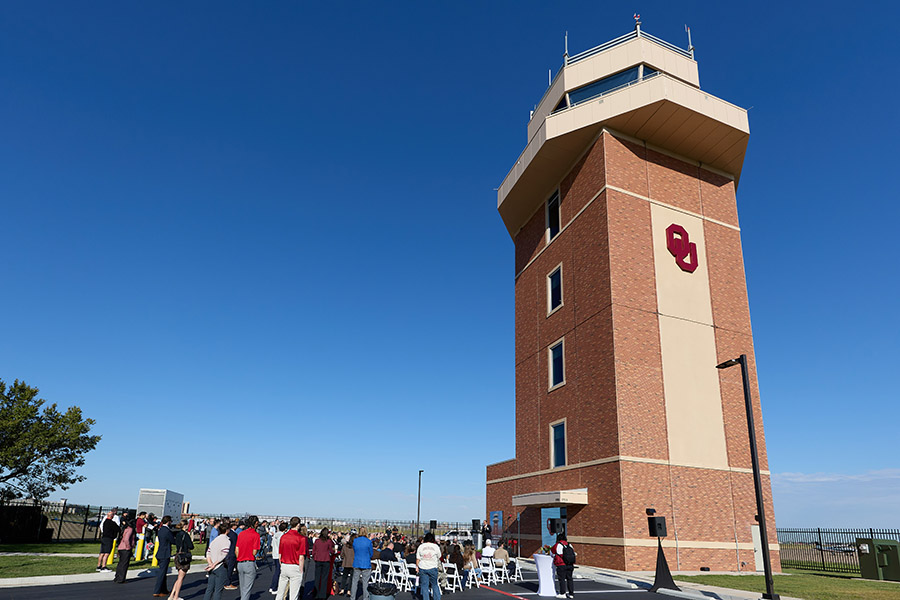
The University of Oklahoma today celebrated the opening of a new air traffic control tower at the OU Max Westheimer Airport. Standing 106 feet tall, more than double the current 52-foot facility, the new tower will modernize air traffic control operations and improve safety for pilots and students operating in the airspace.
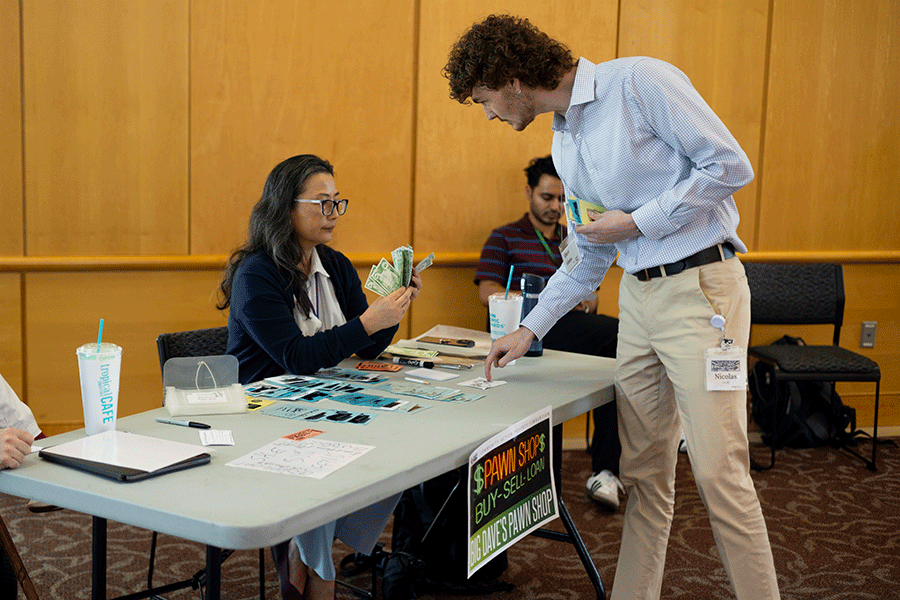
Do I buy groceries or pay the electric bill? Should I pawn some of my belongings to afford my prescription? My child is sick, so I will have to miss work to take care of him. Those are just a few of the difficult choices that OU-Tulsa health professional students confronted during the Community Access to Resources Experience. The role-playing activity challenged students to navigate the financial, family and other pressures that can affect a person’s health and ability to follow medical advice. Held annually during the SCM Institute orientation week, the experience is designed to generate understanding and build empathy.