NEWS

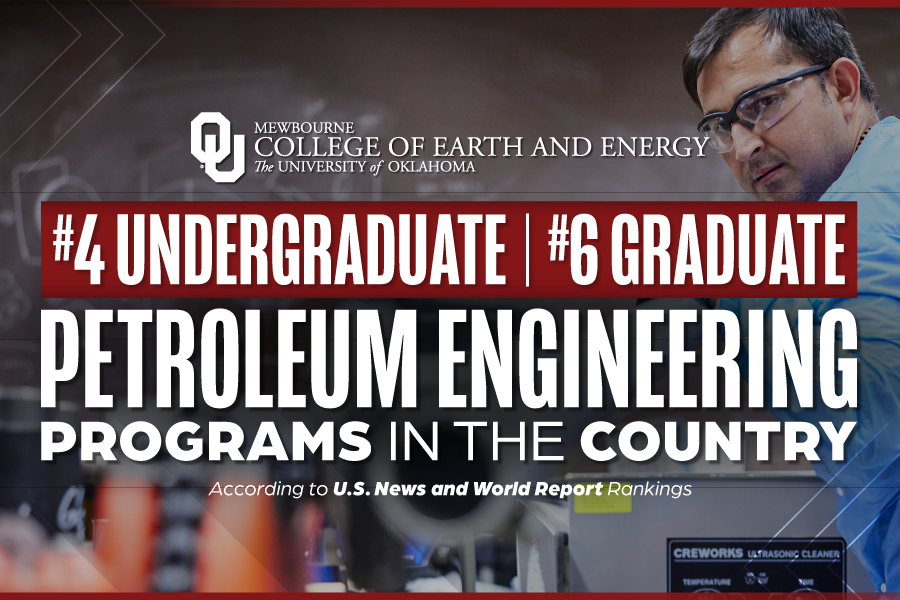
NORMAN, Okla. – The University of Oklahoma’s petroleum engineering programs are among the top six programs nationwide, according to U.S. News and World Report. The university’s undergraduate petroleum engineering program is ranked No. 4 nationally and No. 3 among all public schools. OU’s graduate program climbed two spots this year to No. 6 in the nation and No. 5 among public institutions.
“Oklahoma is an energy state, and OU is where that industry comes to solve its hardest problems,” said John Antonio, dean of the Mewbourne College of Earth and Energy. “When students choose OU for petroleum engineering, they’re choosing one of the best programs in the country, where researchers are working on the full spectrum of what energy security looks like in the 21st century.”
The rankings reflect the strength of the Mewbourne School of Petroleum and Geological Engineering’s research enterprise. The school’s work is central to OU’s Project 200, the university’s strategic initiative to expand research capacity in areas uniquely suited to Oklahoma’s strengths, including secure and resilient energy systems.
Overall, the university is ranked in the top 100 nationally for Best Engineering Schools for both its undergraduate and graduate programs. The petroleum engineering programs’ rankings were recently featured in Business Insider for being among the top in the U.S.
Complete rankings are available at usnews.com.
About the University of Oklahoma
Founded in 1890, the University of Oklahoma is a public research university located in Norman, Oklahoma. As the state’s flagship university, OU serves the educational, cultural, economic and health care needs of the state, region and nation. For more information about the university, visit www.ou.edu.
The University of Oklahoma Foundation is investing $6 million in support of OU Onward, a new scholarship initiative designed to make an OU education more affordable for Oklahoma families. Building on the Foundation's investment, OU Onward has a philanthropic goal of raising an additional $6 million in private support, bringing the total investment in Oklahoma students to $12 million.
Pancreatic cancer, one of the most difficult cancers to treat, is closely associated with obesity, which can be influenced by diet. With a five-year, $2.6 million grant from the National Cancer Institute, a University of Oklahoma researcher will investigate how a diet high in saturated fats may contribute to tumor growth by weakening the body’s anti-tumor immune response and changing how cancer cells use fats.
The Department of Medical Informatics at the University of Oklahoma-Tulsa is teaching students how to approach patient care in an increasingly digital age.