NEWS


NORMAN, Okla. – Pejman Kazempoor, an associate professor at the University of Oklahoma’s School of Aerospace and Mechanical Engineering, has received the Methane Reduction Leadership Award at the 4th Annual Methane Mitigation: Technology & Innovation World Summit. The award recognizes his commitment to addressing emissions and providing a cleaner world.
Kazempoor is the director of the university’s Sustainable Energy and Carbon Management Center (SECM). His team’s research ranges from fundamental catalytic reactions for methane conversion to advanced technologies for detecting and mitigating methane emissions, helping develop cleaner and more sustainable energy solutions.
He said receiving the honor was more than an individual accomplishment and credited it to the combined work of the SECM team, industry partners and stakeholders toward a unified goal of clean energy. Kazempoor also emphasized that these efforts enhance production, improve system performance and efficiency, and develop advanced predictive and preventive maintenance technologies that strengthen the reliability and sustainability of energy infrastructure.
“This award generally recognizes industry leaders because they have the greatest opportunity to implement technologies across large operations,” said Kazempoor. “Receiving it as a university sends a powerful message. It shows that OU is leading the development of innovative solutions that industry values and adopts. This recognition reflects years of collaboration among our researchers, students and industry partners, and it establishes OU as a leader in methane emissions mitigation and sustainable energy technologies.”
Methane is the primary component of natural gas and a valuable energy resource. When released through incomplete combustion or unintentional leaks, it not only contributes to greenhouse gas emissions but also represents product loss, reduced operational efficiency, lower production and increased safety risks.
SECM is addressing these challenges through innovative research, including aerial- and ground-based sensors and predictive models that utilize artificial intelligence. The team has also created more affordable emissions-reducing technology than is typically available for combustion systems, which is being used through an ongoing, federally funded project.
Recently, the U.S. Department of Energy and the U.S. Environmental Protection Agency awarded the center a nearly $4.9 million project to implement affordable methane emission-reduction technology throughout the country. By retrofitting dozens of integral reciprocating compressors, Kazempoor and his team aim to improve atmospheric health while making the machines more efficient and longer lasting.
“We believe this initiative will have a meaningful impact on methane emissions reduction while helping maintain reliable energy infrastructure and supporting jobs, particularly among small operators and underserved communities,” he said.
Kazempoor also emphasized that his center’s impact is strengthened by its Open Innovation Lab, which houses industrial-scale equipment. Students can gain experience with field technologies such as large-scale compression systems used in the oil and gas industry, while the entire team can pursue advancements without being limited to simulations.
“We are currently working with industry partners to develop and test a variety of technologies, including unmanned aerial vehicles, for the precise detection of gas leaks from natural gas pipelines,” Kazempoor said. “This facility presents a unique opportunity for OU to accelerate the commercialization of innovative technologies by enabling testing under realistic operating conditions that closely replicate actual field environments.”
About the University of Oklahoma
Founded in 1890, the University of Oklahoma is a public research university located in Norman, Oklahoma. As the state’s flagship university, OU serves the educational, cultural, economic and health care needs of the state, region and nation. For more information about the university, visit www.ou.edu.
The University of Oklahoma has received a transformative gift from Jon and Shannon McCartney, which will name the McCartney Family Tunnel of Champions, the McCartney Family Gate of the Gaylord Family - Oklahoma Memorial Stadium and the McCartney Family Grand Lecture Hall in the Michael F. Price College of Business. The gift will also support the Inspiring Champions and the Athletic Director’s Discretionary Fund, in addition to establishing the McCartney DFW Career Trek program at Price College.
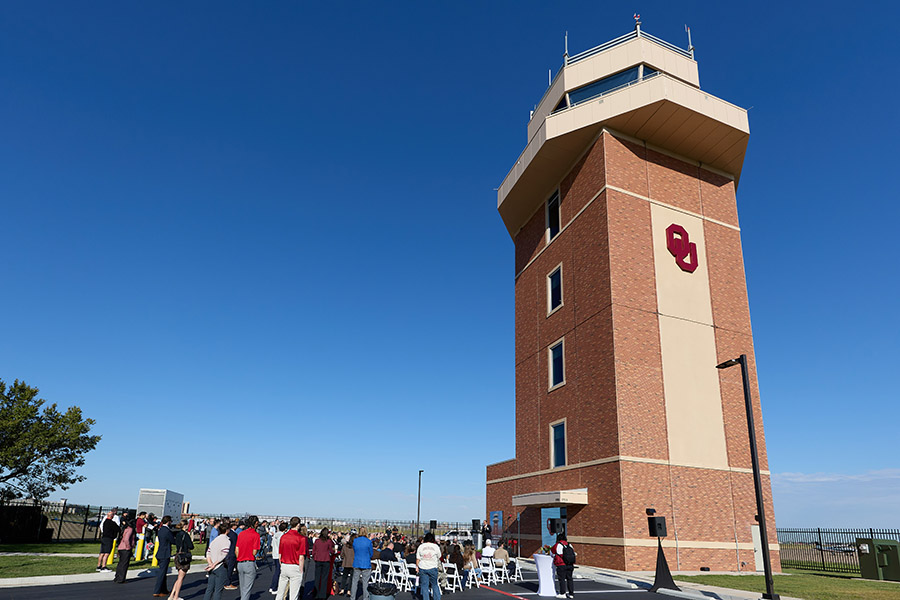
The University of Oklahoma today celebrated the opening of a new air traffic control tower at the OU Max Westheimer Airport. Standing 106 feet tall, more than double the current 52-foot facility, the new tower will modernize air traffic control operations and improve safety for pilots and students operating in the airspace.
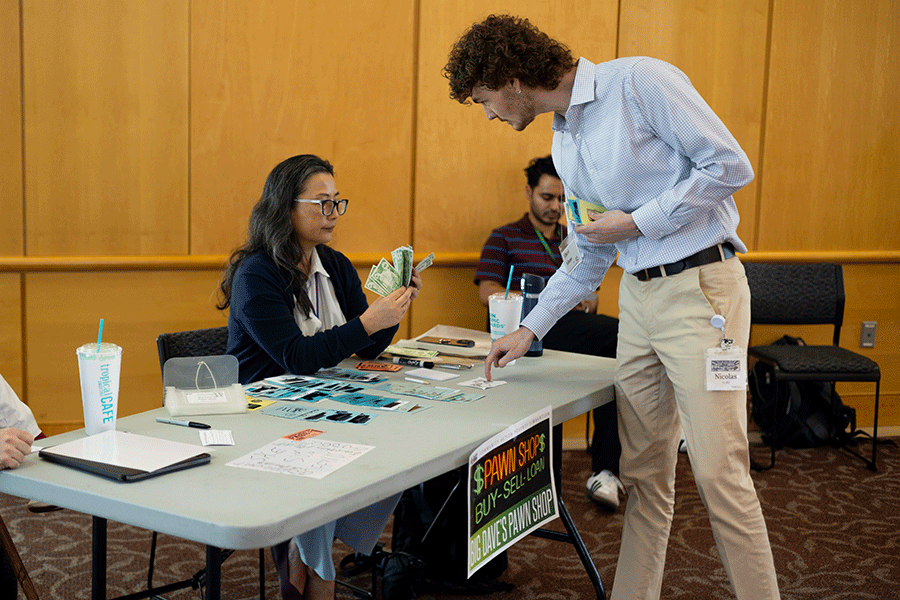
Do I buy groceries or pay the electric bill? Should I pawn some of my belongings to afford my prescription? My child is sick, so I will have to miss work to take care of him. Those are just a few of the difficult choices that OU-Tulsa health professional students confronted during the Community Access to Resources Experience. The role-playing activity challenged students to navigate the financial, family and other pressures that can affect a person’s health and ability to follow medical advice. Held annually during the SCM Institute orientation week, the experience is designed to generate understanding and build empathy.