NEWS

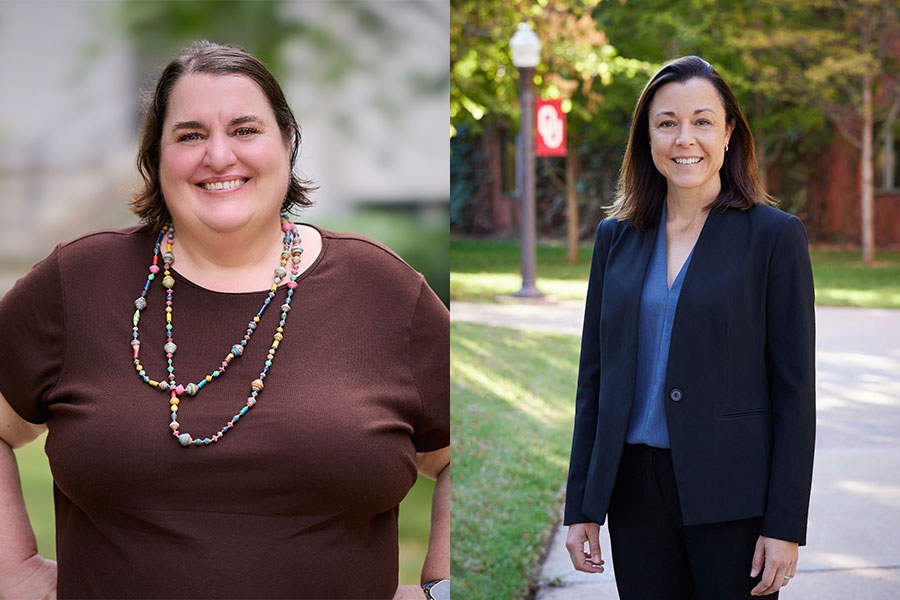
NORMAN, Okla. – Two University of Oklahoma faculty members have received prestigious fellowships that will support research and development opportunities abroad and help advance their careers. Zermarie Deacon, Ph.D., and Deonnie Moodie, Ph.D., have each been named a 2026-2027 Fulbright U.S. Scholar by the U.S. Department of State and the Fulbright Foreign Scholarship Board.
Within OU’s Dodge Family College of Arts and Sciences, Deacon is an associate professor in the Department of Human Relations, and Moodie is an associate professor and the academic chair of the Department of Religious Studies. They join more than a dozen other faculty members who have received Fulbright U.S. Scholar grants while at OU over the past decade.
The Fulbright Scholar Program awards more than 1,700 fellowships each year to professionals and postsecondary faculty to take part in educational and cultural exchange between nations. Candidates are selected based on their academic achievements and the strength of their proposed projects.
“We are thrilled that Dr. Deacon and Dr. Moodie have been honored by the Fulbright Program,” said OU Senior Vice President and Provost André-Denis Wright. “These awards recognize their scholarly accomplishments and impact, and we look forward to the contributions they will make through their transformative opportunities.”
Deacon will use her Fulbright award to travel to Sierra Leone at the start of 2027, learning about how the country’s past experiences with civil war and an Ebola outbreak — and its current reckoning with changes in climate — have intersected and impacted its people. Her previous research has heavily focused on postwar cultural contexts.
She will also spend her six months in Sierra Leone teaching students at Fourah Bay College in Freetown and looks to partner with NGOs around the area to create service projects for the students. Additionally, Deacon plans to work with one of the college’s faculty members who has done research on artisanal mining, in which local miners manually extract and sell minerals.
“Sierra Leone is resource rich, so they have a lot of artisanal mining,” said Deacon, who also received a Fulbright Student Fellowship to Mozambique in 2005. “I’m really interested in how that intersects with what happens as people lose access to agricultural production because of changes in rainfall patterns, and with the disruptions of the war and the Ebola crisis.”
Deacon expects to bring her experiences in Sierra Leone, her first trip to West Africa, to the classroom. Her OU courses include International Human Relations and Gender and War, and she looks forward to incorporating the lessons from her new research and teaching opportunity into them.
“There’s some really amazing work that’s being done and interesting things that are happening,” Deacon said. “I'm hoping to get some more people, students especially, to be interested in going to the African continent.”
Moodie’s Fulbright award will take her to the Indian Institute of Management Bangalore in India during the summers of 2027 and 2028. She plans to meet with experts in critical management studies who promote alternative uses of Hinduism in business settings. Through those connections, Moodie aims not only to bolster international collaboration among scholars but also to support an upcoming book on the history of Hinduism in business schools.
According to Moodie, Hindu ideas are used in business schools in a variety of ways. In some cases, they support the idea of hard work and profit creation. Other approaches include reimagining what economic relations might entail, such as interpreting the world as a set of relationships rather than a set of resources to be used.
“If we looked at Hinduism in a little bit of a different light, then we would think about business really differently,” Moodie said. “In religious studies, we’re really interested in how those ideas about what it means to be Christian or Muslim or Hindu change over time and how they're produced in different historical moments and in different cultural contexts.”
Along with her book, Moodie plans to publish articles and journals from her time spent in India. Her time in Bangalore will also help her provide students with further global perspectives on the intersection of religion and economics, which she teaches a course on.
She highlights opportunities such as DFCAS’s summer fellowships and the Norman Campus Research Council’s Faculty Investment Program that have helped her pursue research.
“I am appreciative of all of the support that OU gives to faculty, including the Arts and Humanities Forum that creates scholarly community and connects faculty to funding opportunities, the Center for Faculty Excellence for help with grant applications, and the Provost's Office’s new developmental editing grant,” Moodie said. “All of these things have really helped me to focus on the research and to really craft a well-developed research proposal.”
About the University of Oklahoma
Founded in 1890, the University of Oklahoma is a public research university located in Norman, Oklahoma. As the state’s flagship university, OU serves the educational, cultural, economic and health care needs of the state, region and nation. For more information about the university, visit www.ou.edu.
The University of Oklahoma has received a transformative gift from Jon and Shannon McCartney, which will name the McCartney Family Tunnel of Champions, the McCartney Family Gate of the Gaylord Family - Oklahoma Memorial Stadium and the McCartney Family Grand Lecture Hall in the Michael F. Price College of Business. The gift will also support the Inspiring Champions and the Athletic Director’s Discretionary Fund, in addition to establishing the McCartney DFW Career Trek program at Price College.
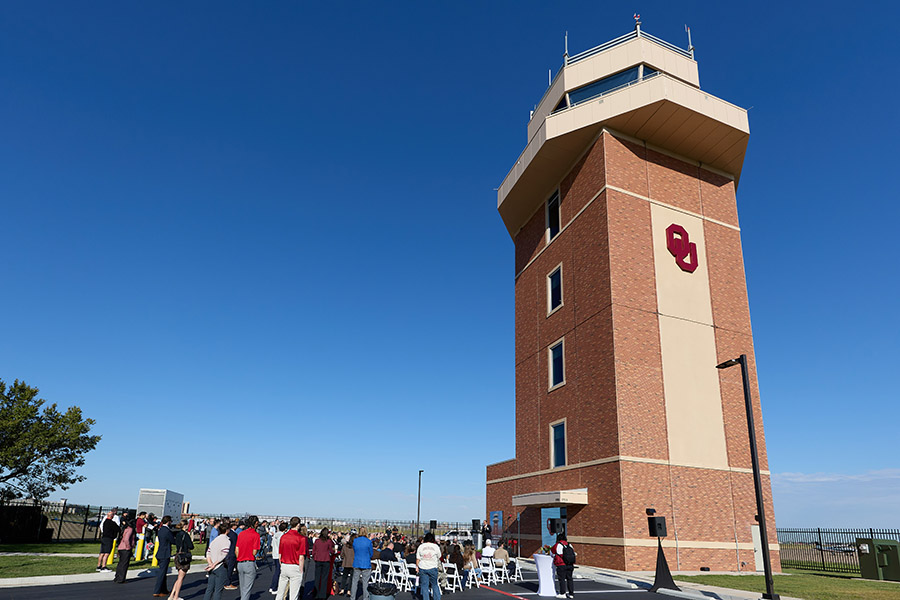
The University of Oklahoma today celebrated the opening of a new air traffic control tower at the OU Max Westheimer Airport. Standing 106 feet tall, more than double the current 52-foot facility, the new tower will modernize air traffic control operations and improve safety for pilots and students operating in the airspace.
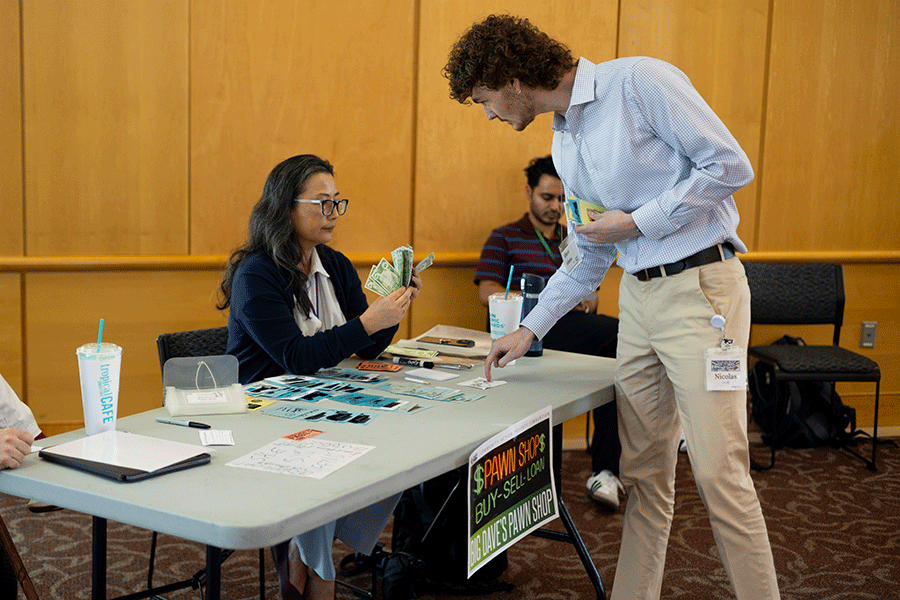
Do I buy groceries or pay the electric bill? Should I pawn some of my belongings to afford my prescription? My child is sick, so I will have to miss work to take care of him. Those are just a few of the difficult choices that OU-Tulsa health professional students confronted during the Community Access to Resources Experience. The role-playing activity challenged students to navigate the financial, family and other pressures that can affect a person’s health and ability to follow medical advice. Held annually during the SCM Institute orientation week, the experience is designed to generate understanding and build empathy.