NEWS


NORMAN, Okla. — The United States faces a critical shortage of scientists trained in data assimilation, the discipline that combines observations with numerical models to track the Earth system as it evolves and provide the starting points for weather forecasts. The University of Oklahoma is leading a national effort to address that shortage.
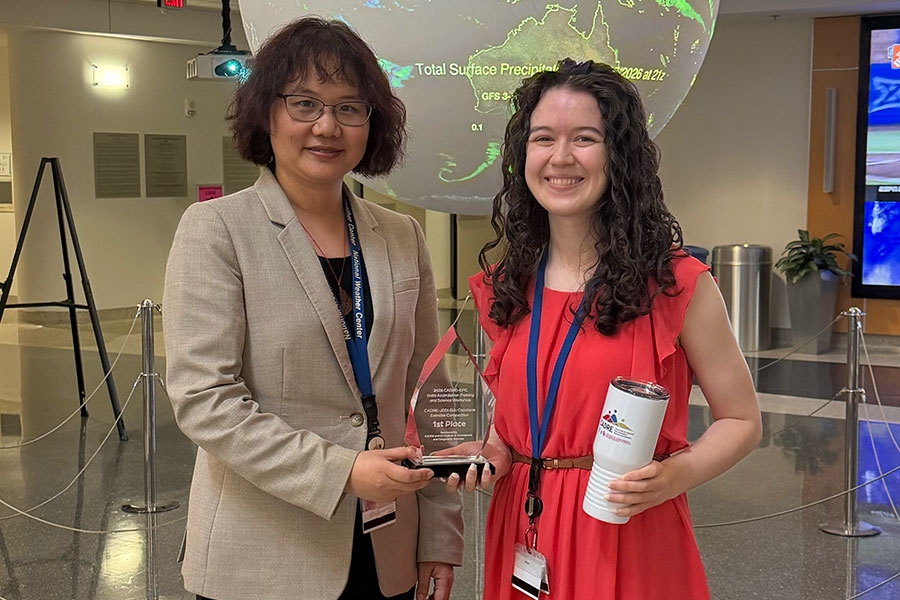
As part of that effort, more than 139 national and international scientists, graduate students and federal and private sector researchers gathered at OU's National Weather Center from June 1 – 5 for the CADRE-EPIC Data Assimilation Training and Science Workshop, a five-day event that brought together some of the field's leading researchers with students and early-career scientists working to enter it. Neil Jacobs, Under Secretary of Commerce for Oceans and Atmosphere and NOAA Administrator, attended the event.
The workshop is the latest product of the Consortium for Advanced Data Assimilation Research and Education, or CADRE, which OU has led since its establishment in 2024 with $6.6 million in NOAA funding. Xuguang Wang, Robert Lowry Chair Professor and Presidential Research Professor in OU's School of Meteorology, directs the consortium, which also includes Howard University, Pennsylvania State University, the University of Maryland, Colorado State University and the University of Utah.
“CADRE has made significant progress in advancing the data assimilation science, cultivating the next generation scientists and accelerating the transition of research to operational weather forecasts in the past 18 months”, said Xuguang Wang, Founding Director of CADRE.

Multiple federal reports — including a congressionally mandated priorities for weather research report and strategic plans from NOAA — have identified a serious shortage of scientists trained in data assimilation and a need for fundamental data assimilation research. CADRE was designed to address that gap through both cutting-edge research and a comprehensive workforce development program.
The five-day workshop reflected both aims as well as fostered further community building and partnership. Participants worked through fundamental and advanced topics, culminating in hands-on exercises using the data assimilation platform being developed for operational use at NOAA and other national forecast centers. The event also featured invited lectures, speeches, CADRE student presentations, poster sessions and a panel discussion on the future of the field. The workshop concluded with the announcement of the CADRE-JEDI-Edu capstone project winners.
The workshop expanded on a successful three-day training CADRE held in 2025 and is part of the consortium's ongoing effort to accelerate the transition of new research into operational forecasting while building the next generation of data assimilation scientists.
More information about CADRE is available at ucadre.org.
About the University of Oklahoma
Founded in 1890, the University of Oklahoma is a public research university located in Norman, Oklahoma. As the state’s flagship university, OU serves the educational, cultural, economic and health care needs of the state, region and nation. For more information about the university, visit www.ou.edu.
From strengthening severe-weather preparedness to advancing national security, MITRE and the University of Oklahoma (OU) are joining forces to tackle some of the nation’s most critical challenges.
Jensen Moore, Ph.D., an associate professor of public relations at the University of Oklahoma’s Gaylord College of Journalism and Mass Communication, has been elected to a three-year term on the Association for Education in Journalism and Mass Communication’s Standing Committee on Professional Freedom and Responsibility.
The OU Water Technologies for Emerging Regions (WaTER) Center has awarded Barbara Evans, a leader in public health engineering and urban sanitation, with the ninth International Water Prize. Her selection was announced at the 2026 OU WaTER Symoposium.