NEWS


NORMAN, Okla. – As people worldwide identify with various religious beliefs and spiritualities, many set off to spread them. A report from the Center for the Study of Global Christianity, for instance, estimated last year that there were 450,000 Christian missionaries sharing their faith traditions in foreign countries.
However, missionaries commit to significant lifestyle changes as part of their evangelism. And once they return home, they have to make another transition from full-fledged religious service to regular life.
Two communication researchers from the University of Oklahoma and the University of Connecticut set out to explore how these missionaries talk about evangelistic experiences as they readjust to their old surroundings. Alice Fanari, an assistant professor at OU’s Dodge Family College of Arts and Sciences, and R. Amanda Cooper, an assistant professor with UConn’s College of Liberal Arts and Sciences, published their study in Human Communication Research.
Fanari said that her past work on cultural transitions has found that people’s ability to reintegrate into regular life after a major change relies on support from trusted connections like family and friends. Those people, including missionaries, can make that support easier by using sense-making “devices” that help explain their experiences.
“This allows them to communicate that better, not only with people in their own community, but also to ‘outsiders’ that might have not known about the missionary experience or might not actually be religious themselves,” Fanari said.
For their study, Fanari and Cooper interviewed first-time missionaries from the U.S. who had traveled either within the country or abroad to spread their Christian faith. They found that the respondents frequently used religious language when making sense of their experiences, such as metaphors that compared diverse church members to the body of Christ.
“Missionaries were drawing from the language and stories of their groups, and the metaphors that are already provided in their groups,” Cooper said. “And they did it naturally, it wasn’t like they were trying to bring forward these religious pieces of language.”
This finding has led Fanari and Cooper to suggest updating the communicated sense-making (CSM) model, a concept that states individuals use devices like metaphors, stories and perspectives to help explain their experiences. The co-authors propose adding language based on shared social, cultural and other values, which they call “in-group vernacular,” to the model as a resource that people utilize to help with choosing devices.
During their interviews, the researchers also found that missionaries discussed God as an active figure who could guide their actions and provide them support. The two of them suggest adding personification, which can take both religious and nonreligious forms, as another device to the CSM model.
“Personification has a lot of potential as a sense-making device, particularly when things feel out of control or when you have a lot of uncertainty,” said Cooper, who has also identified its use in families dealing with a loved one’s battle with dementia.
Participants’ need to discuss certainty also varied based on their Christian background. More than half of those interviewed belonged to the Church of Jesus Christ of Latter-day Saints (LDS), where young adults typically go on mission trips for up to two years. The researchers said these missionaries used sense-making devices to talk about certainty less often, which they speculate may be because they have more clearly defined mission trip expectations.
However, the LDS participants brought up identity more often than the others, which the co-authors said may stem from lifestyle changes during service that are more drastic than in other Christian denominations.
The co-authors said that while past research into how humans make sense of major changes has mostly focused on narratives as a sense-making device, their study shows that other communication techniques – like metaphors and personification – also play a part. They added that future research could dive deeper into how people who belong to other social groups support themselves through important life transitions.
“Communication is not the medicine to all things,” Fanari said. “But when it is intentional, especially depending on the context, it can be such a powerful way of connecting people.”
About the research
The study, “Extending communicated sense-making theorizing to social groups: missionaries’ use of metaphor, personification, and in-group vernacular,” can be found in Human Communication Research at https://doi.org/10.1093/hcr/hqaf028.
About the University of Oklahoma
Founded in 1890, the University of Oklahoma is a public research university located in Norman, Oklahoma. As the state’s flagship university, OU serves the educational, cultural, economic and health care needs of the state, region and nation. For more information about the university, visit www.ou.edu.
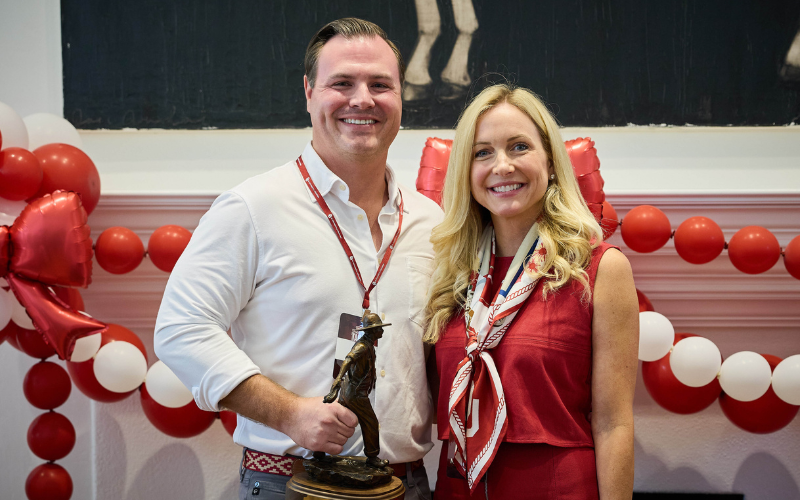
The University of Oklahoma has received a transformative gift from Jon and Shannon McCartney, which will name the McCartney Family Tunnel of Champions, the McCartney Family Gate of the Gaylord Family - Oklahoma Memorial Stadium and the McCartney Family Grand Lecture Hall in the Michael F. Price College of Business. The gift will also support the Inspiring Champions and the Athletic Director’s Discretionary Fund, in addition to establishing the McCartney DFW Career Trek program at Price College.
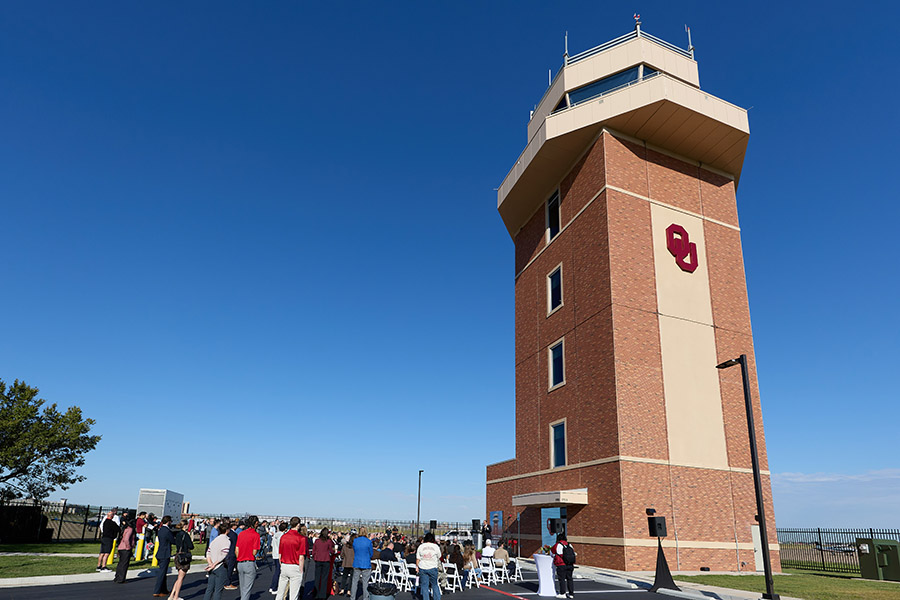
The University of Oklahoma today celebrated the opening of a new air traffic control tower at the OU Max Westheimer Airport. Standing 106 feet tall, more than double the current 52-foot facility, the new tower will modernize air traffic control operations and improve safety for pilots and students operating in the airspace.
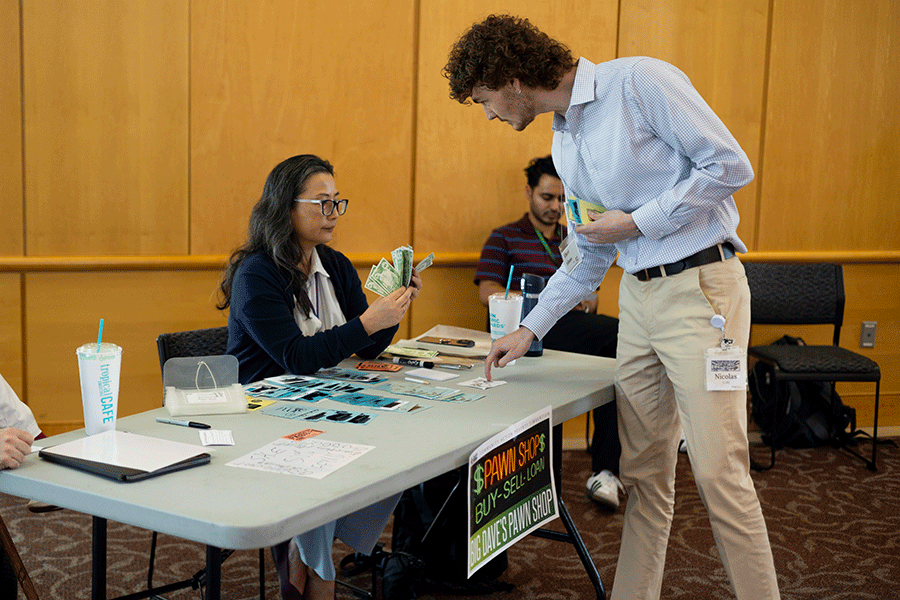
Do I buy groceries or pay the electric bill? Should I pawn some of my belongings to afford my prescription? My child is sick, so I will have to miss work to take care of him. Those are just a few of the difficult choices that OU-Tulsa health professional students confronted during the Community Access to Resources Experience. The role-playing activity challenged students to navigate the financial, family and other pressures that can affect a person’s health and ability to follow medical advice. Held annually during the SCM Institute orientation week, the experience is designed to generate understanding and build empathy.