NEWS

OKLAHOMA CITY – At OU Health Stephenson Cancer Center at the University of Oklahoma, enrollment is underway for the Vanguard Study, which is evaluating whether multi-cancer detection tests can find cancer at an earlier stage than is currently possible.
Multi-cancer detection tests are an innovative tool designed to detect several types of cancers through a blood draw. The tests look for biological substances released into the bloodstream by cancer cells. The goal is to determine whether these tests can help find cancer earlier and ultimately reduce deaths from cancer.
“It is important to study this technology because we need to know whether it can detect cancer early enough to make a difference in survival. We also want to know which types of cancer the tests might be particularly effective in finding,” said lead investigator Mark Doescher, M.D., associate director for Community Outreach and Engagement at Stephenson Cancer Center and a professor of family medicine at the OU College of Medicine.
Stephenson Cancer Center is among nine hubs across the United States that are enrolling people ages 45 to 75 in the Vanguard Study. The tests in this study will screen for 10 types of cancer: bladder, breast, colorectal, esophageal, stomach, liver, lung, ovarian, pancreatic and prostate. Researchers are especially interested in whether the tests can detect cancers for which there are no standard screening methods.
“Currently, we only have a handful of evidence-based cancer screening tests, such as mammography, colonoscopy, cervical cancer screening, lung cancer screening and prostate cancer screening,” Doescher said. “But there are no screening tests for highly lethal cancers like pancreatic, ovarian and some blood-based cancers, which are often discovered at later stages. It is promising that these multi-cancer detection tests might be able to find some of these cancers early, when we have a better chance of successful treatment.”
If a test detects a signal indicating possible cancer, it will indicate the likely location of the cancer in the body. The participant would then undergo additional testing, such as an MRI, CT scan or biopsy, depending on the suspected location. However, the tests are not intended to be a substitute for current screening tests, Doescher said.
“Even if you enroll in the study, it’s important that you continue to undergo the evidence-based cancer screens that we currently have,” he said.
Thus far, Stephenson Cancer Center has enrolled about 1,000 people toward a goal of 2,000-2,400. The national enrollment goal is 20,000 people. Oklahoma testing sites are located in Oklahoma City, Tulsa, Eufaula and Stigler.
Funded by a grant from the National Cancer Institute, the Vanguard Study is a prelude to a larger study that will provide more robust evidence about the tests’ effectiveness.
“Although we are in the early days of studying this technology, its potential is very exciting,” Doescher said. “We are making dramatic advances in cancer treatment, but outcomes are much better if we can start treating cancer early. Multi-cancer detection tests might help us do that.”
People interested in learning more about participating in the Vanguard Study can call (405) 271-2967; email OKTRUST@ou.edu; or visit the website www.ouhealth.com/oktrust.
About the project
Research reported in this news release is supported by the National Cancer Institute, a component of the National Institutes of Health, under award number UG1CA287044.
About the University of Oklahoma
Founded in 1890, the University of Oklahoma is a public research university located in Norman, Oklahoma. As the state’s flagship university, OU serves the educational, cultural, economic and healthcare needs of the state, region and nation. For more information about the university, visit www.ou.edu.
The University of Oklahoma has received a transformative gift from Jon and Shannon McCartney, which will name the McCartney Family Tunnel of Champions, the McCartney Family Gate of the Gaylord Family - Oklahoma Memorial Stadium and the McCartney Family Grand Lecture Hall in the Michael F. Price College of Business. The gift will also support the Inspiring Champions and the Athletic Director’s Discretionary Fund, in addition to establishing the McCartney DFW Career Trek program at Price College.
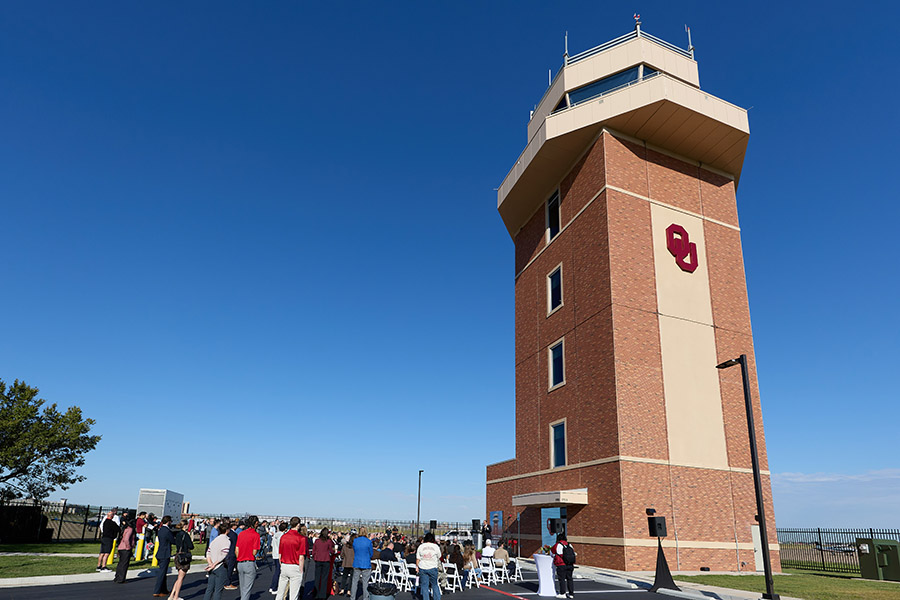
The University of Oklahoma today celebrated the opening of a new air traffic control tower at the OU Max Westheimer Airport. Standing 106 feet tall, more than double the current 52-foot facility, the new tower will modernize air traffic control operations and improve safety for pilots and students operating in the airspace.
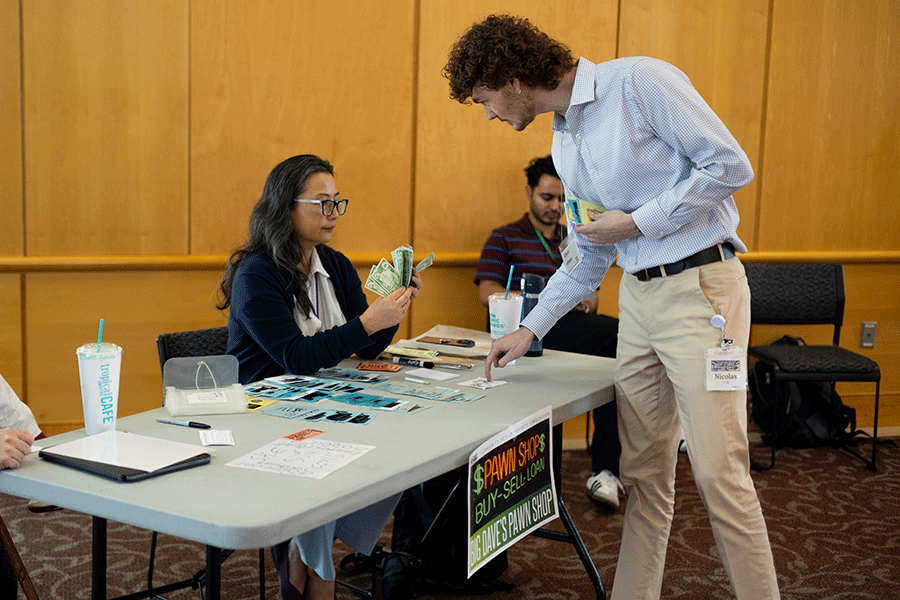
Do I buy groceries or pay the electric bill? Should I pawn some of my belongings to afford my prescription? My child is sick, so I will have to miss work to take care of him. Those are just a few of the difficult choices that OU-Tulsa health professional students confronted during the Community Access to Resources Experience. The role-playing activity challenged students to navigate the financial, family and other pressures that can affect a person’s health and ability to follow medical advice. Held annually during the SCM Institute orientation week, the experience is designed to generate understanding and build empathy.