NEWS

NORMAN, Okla. — Chenghao Wang, Ph.D., an assistant professor in the School of Meteorology and the Department of Geography and Environmental Sustainability, is a co-author of the commentary "Research priorities for robust climate assessments in the United States," published in Earth's Future and Bulletin of the American Meteorological Society. The paper brings together 175 authors, including researchers formerly involved in producing the Sixth National Climate Assessment and authors of other national and sub-national climate assessments, to outline research priorities that can inform future national, regional, local, sectoral and topical climate assessments.
The commentary is the first paper in the U.S. Climate Collection: Informing Assessment of Risks and Solutions, a joint special collection of the American Geophysical Union and the American Meteorological Society that will publish U.S.-focused climate assessment science and research synthesis papers that can inform future national and sub-national assessments.

Wang contributed expertise on climate risks and research priorities in the Southern Great Plains and helped develop graphical illustrations for this work. He also provided input on topics related to urban environments and energy systems.
“Climate risks do not occur in isolation. They interact across regions, cities and infrastructure. The Southern Great Plains illustrates why climate assessments need to connect advances in climate science with the places and systems where people experience these risks,” Wang said. “Improving our understanding of regional extremes and their interactions with urban environments, infrastructure and energy systems can help future assessments provide more useful information for communities and decision-makers.”
The commentary identifies assessment opportunities and research needs across planetary-scale systems, environmental settings, economic sectors, U.S. regions and U.S. international interests. Across these areas, the authors identify several cross-cutting priorities for research synthesis, including how greenhouse gas emissions continue to alter and amplify climate hazards; how compounding extremes and cascading risks are straining legacy policies, infrastructure, and institutions; how social systems shape both climate impacts and responses; and how future assessments should evaluate mitigation, adaptation, disaster management, climate interventions and resilience planning and implementation decisions as a climate action portfolio.
Scientific assessments synthesize complex bodies of evidence so households, communities, businesses, institutions and governments can make informed decisions as climate hazards intensify. The most recent U.S. National Climate Assessment was published in 2023; scientific understanding has advanced since then, and climate assessments are continuing by states, localities and businesses. The commentary argues that the pace of assessment and the integration of science with decision-making must accelerate as climate impacts continue to grow. A coordinated network of U.S. assessment efforts could more rapidly translate the latest science and real-world case studies into practical strategies for responding to climate change. Rather than a finished assessment, the commentary is designed as a catalyst, identifying gaps and opportunities that can guide new research, future collaborations, and eventual assessment products such as the next National Climate Assessment, regional assessments, and sector-specific reports.
About the project
“Research Priorities for Robust Climate Assessments in the United States” can be found at both https://doi.org/10.1029/2025EF007336 and https://doi.org/10.1175/BAMS-D-26-0305.1
About the University of Oklahoma
Founded in 1890, the University of Oklahoma is a public research university located in Norman, Oklahoma. As the state’s flagship university, OU serves the educational, cultural, economic and healthcare needs of the state, region and nation. For more information about the university, visit www.ou.edu.
The University of Oklahoma has received a transformative gift from Jon and Shannon McCartney, which will name the McCartney Family Tunnel of Champions, the McCartney Family Gate of the Gaylord Family - Oklahoma Memorial Stadium and the McCartney Family Grand Lecture Hall in the Michael F. Price College of Business. The gift will also support the Inspiring Champions and the Athletic Director’s Discretionary Fund, in addition to establishing the McCartney DFW Career Trek program at Price College.
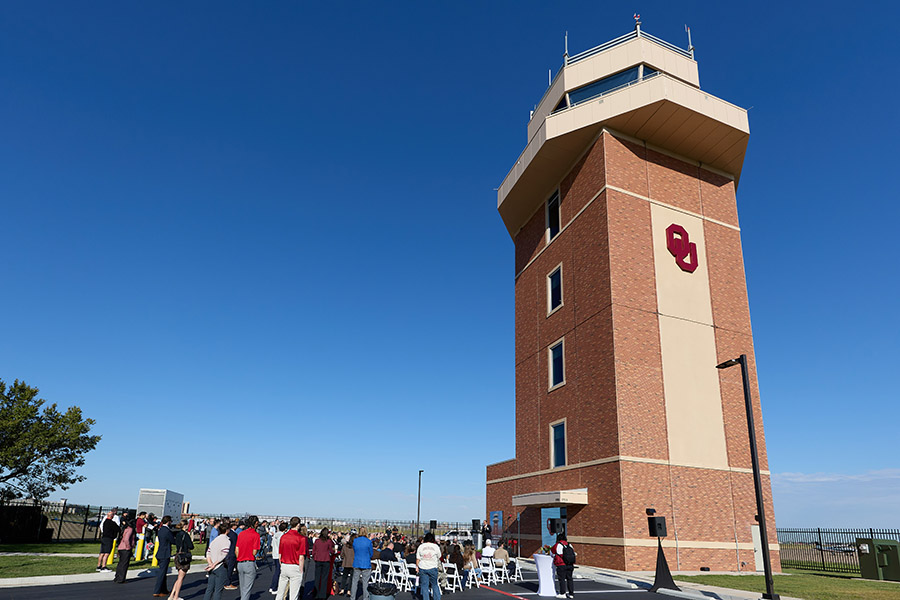
The University of Oklahoma today celebrated the opening of a new air traffic control tower at the OU Max Westheimer Airport. Standing 106 feet tall, more than double the current 52-foot facility, the new tower will modernize air traffic control operations and improve safety for pilots and students operating in the airspace.
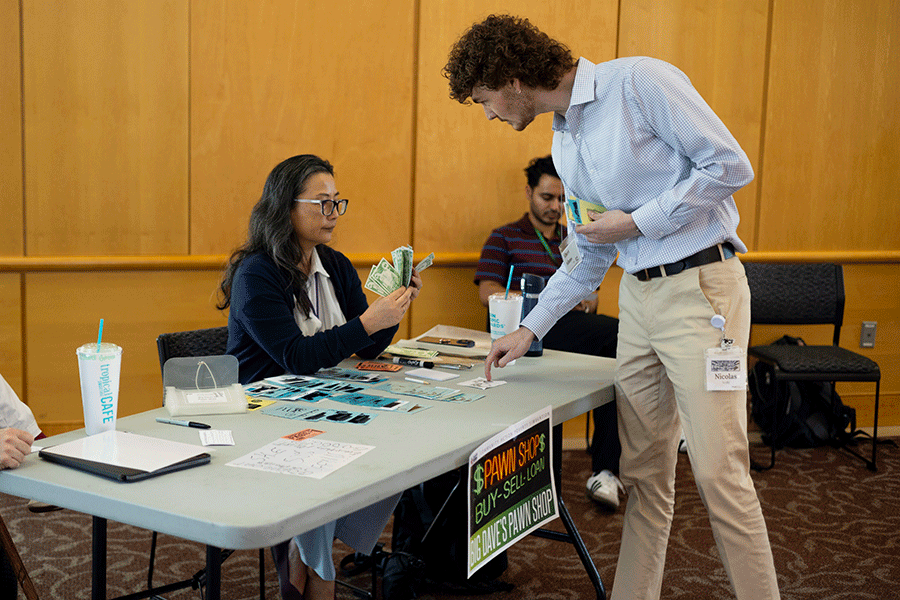
Do I buy groceries or pay the electric bill? Should I pawn some of my belongings to afford my prescription? My child is sick, so I will have to miss work to take care of him. Those are just a few of the difficult choices that OU-Tulsa health professional students confronted during the Community Access to Resources Experience. The role-playing activity challenged students to navigate the financial, family and other pressures that can affect a person’s health and ability to follow medical advice. Held annually during the SCM Institute orientation week, the experience is designed to generate understanding and build empathy.