NEWS


NORMAN, Okla. – Researchers at the University of Oklahoma’s Advanced Radar Research Center (ARRC) continue to lead the way in radar innovation. A $19.9 million award from the U.S. National Science Foundation’s Mid-scale Research Infrastructure-1 program will fund the development of two groundbreaking KaRVIR systems (Dual-Doppler 3D Mobile Ka-band Rapid-Scanning Volume Imaging Radars for Earth System Science). These state-of-the-art radars will provide unique capabilities to close critical observational gaps in the atmospheric science community.
“The development of KaRVIR represents a remarkable leap in radar technology that will significantly enhance our ability to study atmospheric phenomena,” said Robert Palmer, dean of the College of Atmospheric and Geographic Sciences, and co-principal investigator on the project. “This innovative platform not only advances our research capabilities but also plays a crucial role in training the next generation of scientists and engineers to tackle the challenges of weather observation.”
John Klier, dean of the Gallogly College of Engineering, said that “The synergy between science and engineering exemplified in this project is profound.”
KaRVIR will be a first-of-its-kind platform, the only mobile, dual-Doppler Ka-band imaging radar system in the United States. The mobile nature of the platform will support field campaigns, helping scientists to better understand cloud science, study complex atmospheric flows and visualize the dynamics and structure of smoke plumes and wildfires.
Ka-band radar emits at a higher frequency than many other weather radars. Operating at this higher frequency enables the detection of a wide range of particle sizes, which is not always possible when using mid- and low-frequency radars. That level of detail is a significant innovation for studying topics such as cloud development and fire behavior and spread.
The project will build directly on the cutting-edge radar development happening at the ARRC. KaRVIR will combine both OU’s engineering and meteorological expertise to develop a radar system that can observe these fine-scale details of the atmosphere in twenty seconds or less.
“KaRVIR is a scientific game-changer,” said Jorge Salazar, professor in the School of Electrical and Computer Engineering and principal investigator on the project. “KaRVIR will provide four-dimensional observation of clouds, precipitations and winds, unlocking new understanding of weather systems, cloud microphysics, boundary layer dynamics and even wildfire behavior.”
KaRVIR will provide groundbreaking high-resolution measurements of cloud microphysics, turbulence and 3D air motions, offering critical insights into rainfall initiation and serving as a benchmark for cloud-resolving weather models. Its ability to detect particles ranging from fine ash to large cloud formations at millimeter wavelengths will significantly enhance wildfire monitoring, forecasting and predictions of long-range smoke transport, improving air quality preparedness for distant communities. Beyond advancing scientific understanding, KaRVIR will strengthen public safety through faster, more accurate severe weather warnings and disaster response, while also training the next generation of scientists and engineers through hands-on research and education.
The KaRVIR project unites faculty experts from the Gallogly College of Engineering and the College of Atmospheric and Geographic Sciences with highly skilled radar engineers from the ARRC. Alongside Salazar, the project’s co-principal investigators are Robert Palmer, David Bodine, Marcela Loría-Salazar and Cameron Homeyer from the College of Atmospheric and Geographic Sciences. Matt McCord, Redmond Kelly, Ralph McKenzie, Mark Yeary, Tian Yu and David Schvartzman from the ARRC are also part of the project.
The ARRC team brings decades of experience in phased array radar development, having led the design of pioneering systems such as Horus and CPPAR (both S-band), PAIR (C-band) and AIR (X-band). Each of these platforms incorporates the latest generation of phased array radar technology, positioning the team to deliver another breakthrough with KaRVIR. This uniquely interdisciplinary collaboration ensures the expertise and innovation needed to drive the project forward.
KaRVIR’s research will generate multiple public benefits, including advancing scientific knowledge, strengthening U.S. economic competitiveness, fostering collaborations between academia and industry and cultivating a robust American STEM workforce through enhanced PreK–12 STEM education. Additionally, KaRVIR will promote public science literacy via community engagement and outreach events. KaRVIR brings together leading academic collaborators — including the University of Massachusetts, the National Center for Atmospheric Research, NASA and the University of Puerto Rico Mayaguez — alongside industry partners such as Blue Origin.

About the project
“Dual-Doppler 3D Mobile Ka-band Rapid-Scanning Volume Imaging Radar for Earth System Science” is funded by a $19,982,836 award from the U.S. National Science Foundation, 2535635. It began in October 2025 and is expected to end September 2030.
About NSF
“The U.S. National Science Foundation (NSF) is an independent federal agency that promotes the progress of science by investing in research to expand knowledge in science, engineering and education across all 50 states and territories. NSF supports nearly 2,000 colleges, universities and other institutions through competitive grants aimed at advancing science with broad impacts across the nation and its people. Learn more at nsf.gov.”
About the University of Oklahoma
Founded in 1890, the University of Oklahoma is a public research university located in Norman, Oklahoma. As the state’s flagship university, OU serves the educational, cultural, economic and health care needs of the state, region and nation. For more information about the university, visit www.ou.edu.
The University of Oklahoma College of Medicine has honored two residents with the Lloyd Rader Award, which recognizes outstanding clinical and research achievements in residency.
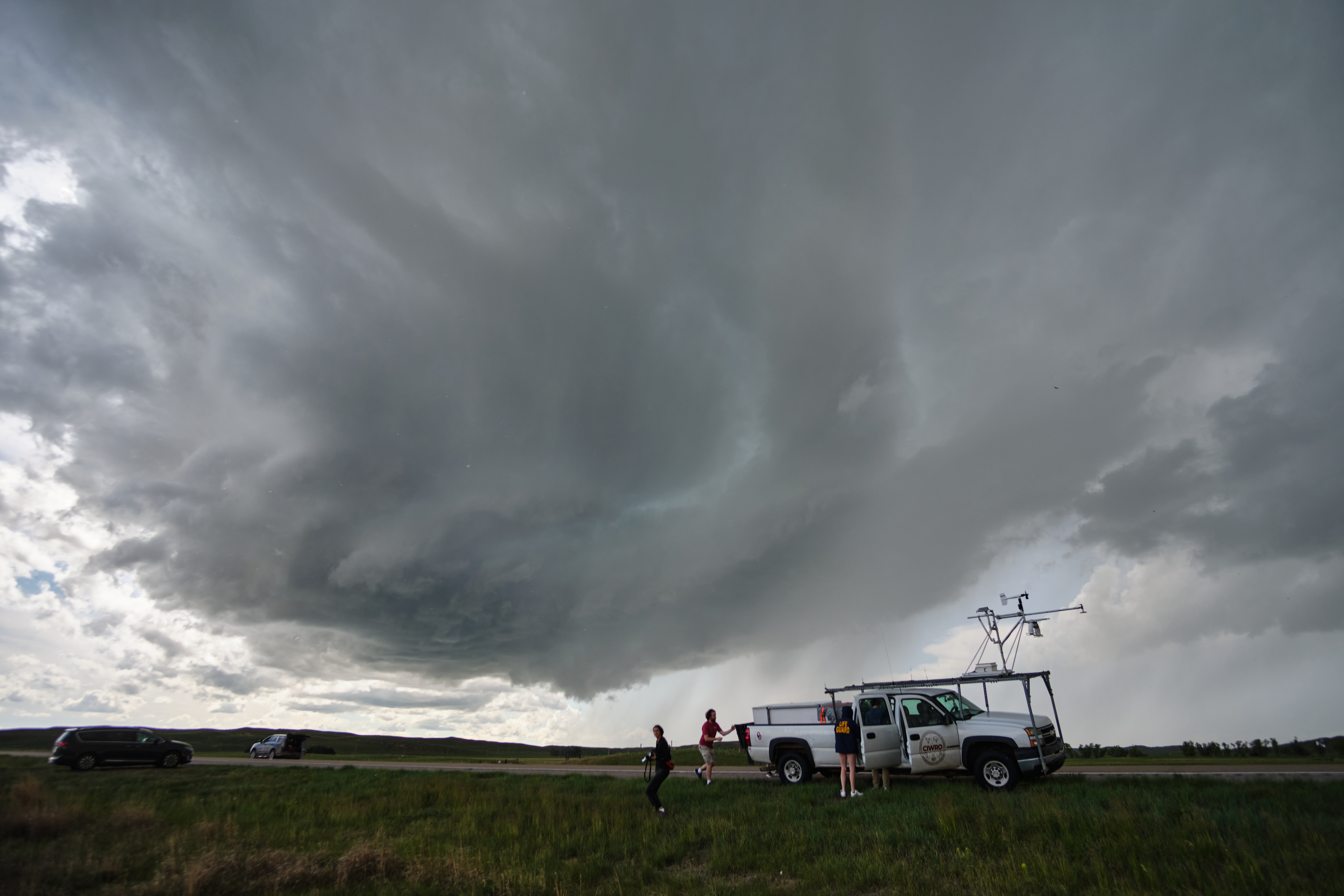
The University of Oklahoma will receive up to $220 million over five years from the U.S. Department of Commerce and the National Oceanic and Atmospheric Administration to continue the life-saving weather research led by the OU-NOAA Cooperative Institute for Severe and High-Impact Weather Research and Operations, extending a nearly 50-year partnership that has helped give Americans earlier, more accurate weather warnings
The OU Food Pantry won the annual Red River Food Fight, collecting 31,815.9 pounds of shelf-stable food and drinks to top UT Outpost’s 22,567 pounds. OU has won the competition four years in a row.