NEWS

NORMAN, Okla. – As global supply chains face historic levels of disruption, a pair of University of Oklahoma Price College of Business professors have co-authored a study examining how suppliers can restore buyers’ trust once it’s been broken. Their new study offers supply managers a roadmap for repairing damaged relationships, identifying which recovery strategies are most effective in restoring confidence and fostering long-term collaboration.
In recent years, supply chain disruptions have dominated headlines: from pandemic shutdowns to geopolitical conflict and labor unrest. But a major cause of disruptions comes from suppliers themselves, ranging from competency-based errors to uneven treatment of clients. According to supply chain risk-monitoring firm Resilinc, supply chain disruptions surged 38% in 2024 compared with the previous year, underscoring the need for smarter relationship repair strategies.
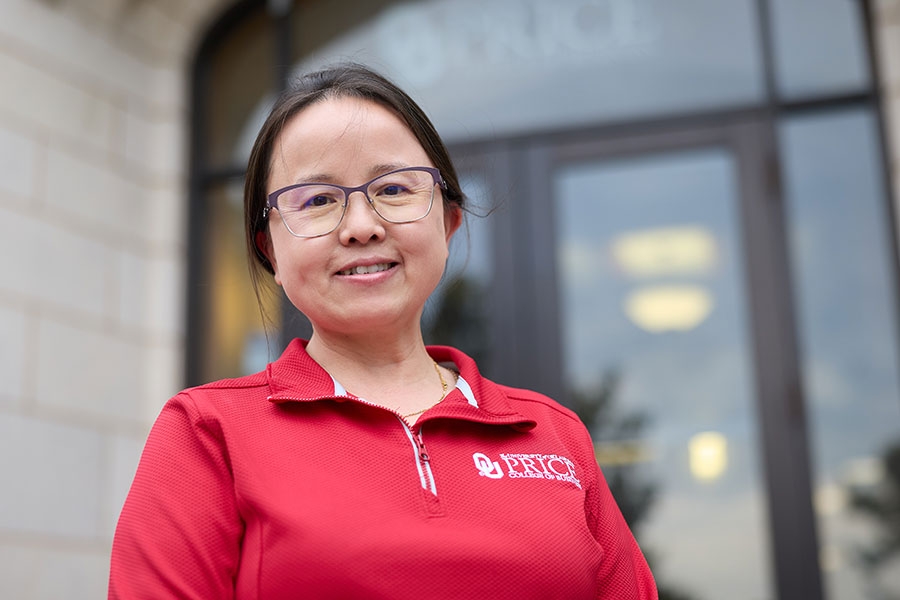
OU’s Qiong Wang, Ph.D., and Matthew Jensen, Ph.D., aim to give supply managers new insights into how suppliers can recover from trust breaches and turn moments of failure into opportunities for rebuilding stronger partnerships. They’re two of the co-authors for “Resolution Tactics of Supplier-Induced Disruptions: A Configurational Approach,” published in The Journal of Supply Chain Management.
Wang is Price College’s Ruby K. Powell Professor of Marketing and Associate Professor of Marketing and Supply Chain Management, while Jensen is the W. P. Wood Presidential Professor of Management Information Systems.
Together, the researchers conducted a series of experiments and in-depth interviews with purchasing managers to understand how they respond when suppliers cause disruptions. Participants were presented with realistic supply chain scenarios and asked how they would react, depending on the cause of the disruption and their own natural tendencies, such as their level of trust in suppliers or their comfort with uncertainty.
The researchers then tested how these managers evaluated different supplier recovery strategies designed to rebuild trust. These strategies varied in levels of distributive justice — for example, compensating the buyer for losses — and procedural justice, such as improving transparency and business processes.
“We wanted to know what the best strategy was for trust repair,” said Wang. “Most past studies only looked at one dimension of fairness at a time. We wanted to see how these strategies interact in practice.”
The researchers revealed that, while some combinations of trust-repair tactics consistently succeeded and others reliably failed, outcomes largely depended on two factors: how the disruption occurred and the individual traits of the buyer. Though no single approach worked in every situation, one pattern stood out: every successful strategy involved high procedural justice, emphasizing fair processes, open communication and accountability.
“This study provides practical guidance for real-world supply managers,” said Wang, who is particularly invested in the psychological aspect of supplier-buyer relations. “It helps them understand not just what to do after a disruption, but how to tailor their response based on the situation and the people involved.”
The research also connects to Wang’s broader work on how business contracts and relationship design can encourage suppliers to honor commitments and maintain trust.
“It’s important to look at the operational side — the costs, the logistics,” she explained. “But I’m most interested in how we can create value and even stronger bonds after disruptions happen.”
Wang, who is also the director of Price’s Marketing and Supply Chain Management Division, said the team’s research will help supplement her OU classes.
“Through interviews with managers and real-world case studies, I’ve learned how complex and nuanced these decisions can be,” Wang said. “Bringing those experiences into the classroom helps students think critically about how to respond when disruptions happen — not just to fix problems, but to understand the people and relationships involved.”
Wang and Jensen’s recently published study comes after SupplyChainGuide.org honored the Price College of Business in its 2025 national rankings of graduate supply chain management programs. OU ranked No. 17 in Best Online MBA Programs in Supply Chain Management and No. 15 in Best Online Master’s Programs in Supply Chain Management.
The study’s additional co-authors are Li Cheng at Michigan State University, Christopher Craighead at the University of Tennessee and Julie Juan Li at the City University of Hong Kong.
About the project
The study, “Resolution Tactics of Supplier-Induced Disruptions: A Configurational Approach,” can be found in The Journal of Supply Chain Management at https://onlinelibrary.wiley.com/doi/10.1111/jscm.70006. This work was supported by National Natural Science Foundation of China (71872159).
About the University of Oklahoma
Founded in 1890, the University of Oklahoma is a public research university located in Norman, Oklahoma. As the state’s flagship university, OU serves the educational, cultural, economic and health care needs of the state, region and nation. For more information about the university, visit www.ou.edu.
The University of Oklahoma has received a transformative gift from Jon and Shannon McCartney, which will name the McCartney Family Tunnel of Champions, the McCartney Family Gate of the Gaylord Family - Oklahoma Memorial Stadium and the McCartney Family Grand Lecture Hall in the Michael F. Price College of Business. The gift will also support the Inspiring Champions and the Athletic Director’s Discretionary Fund, in addition to establishing the McCartney DFW Career Trek program at Price College.
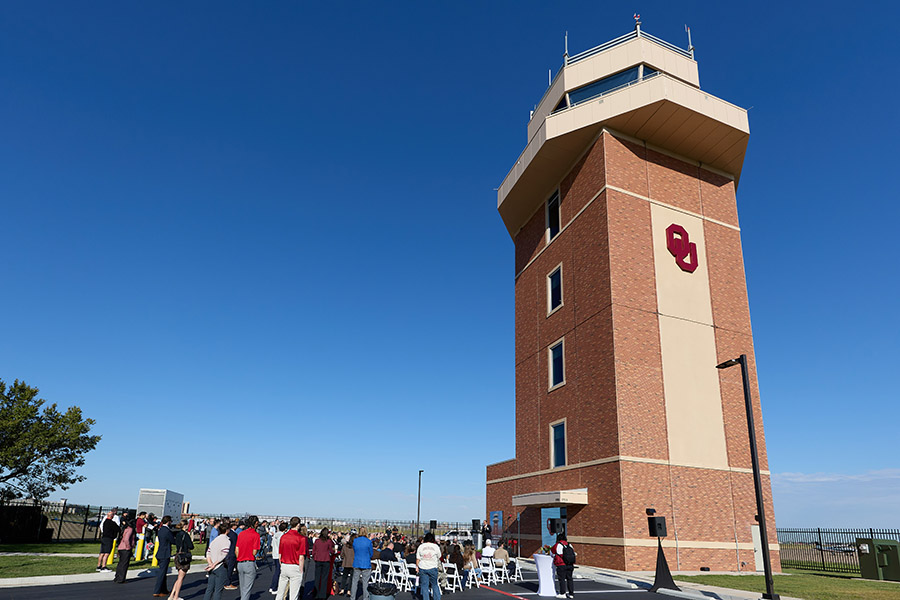
The University of Oklahoma today celebrated the opening of a new air traffic control tower at the OU Max Westheimer Airport. Standing 106 feet tall, more than double the current 52-foot facility, the new tower will modernize air traffic control operations and improve safety for pilots and students operating in the airspace.
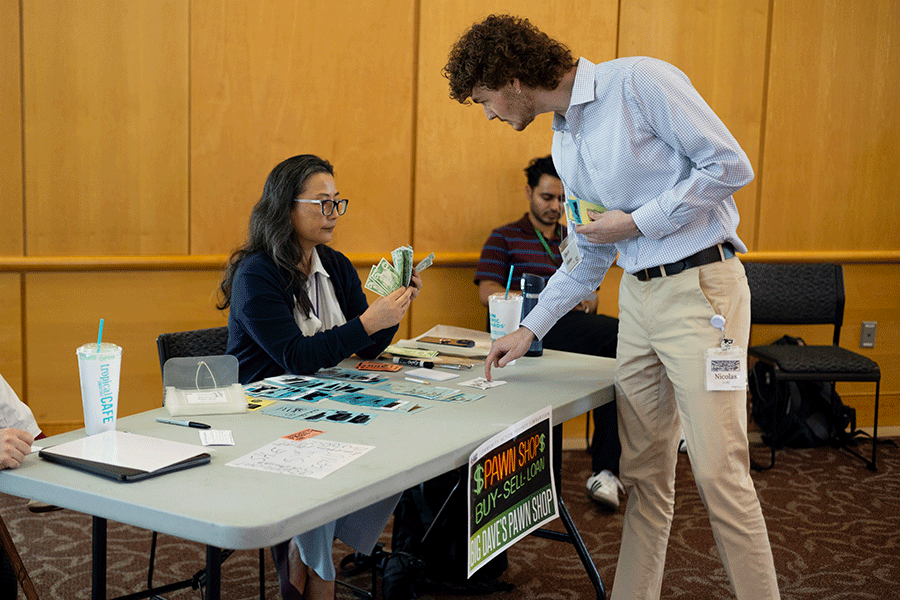
Do I buy groceries or pay the electric bill? Should I pawn some of my belongings to afford my prescription? My child is sick, so I will have to miss work to take care of him. Those are just a few of the difficult choices that OU-Tulsa health professional students confronted during the Community Access to Resources Experience. The role-playing activity challenged students to navigate the financial, family and other pressures that can affect a person’s health and ability to follow medical advice. Held annually during the SCM Institute orientation week, the experience is designed to generate understanding and build empathy.