NEWS


OKLAHOMA CITY – An international study published today in the New England Journal of Medicine sheds light on acute normovolemic hemodilution, also known as ANH, a blood conservation technique. ANH involves removing a patient’s blood before the patient goes on heart-lung bypass, and then reinfusing it toward the end of heart surgery. Long debated for its effectiveness, ANH does not appear to reduce the need for red blood cell transfusion, according to results of the global clinical trial.
However, study co-author Kenichi Tanaka, M.D., professor and chair of the Department of Anesthesiology at the University of Oklahoma College of Medicine, said the outcomes necessitate further scrutiny and may not be applicable to U.S. patients.
More than 2 million patients worldwide undergo heart surgery annually, and approximately 35% require at least one unit of red blood cells. However, blood transfusions can lead to complications, are costly, and are sometimes affected by shortages. Previous retrospective studies and meta-analyses have shown mixed results about whether ANH reduces the need for blood transfusions in heart surgery.
Although the study did not show that ANH decreased infusions, several factors should be taken into consideration, said Kenichi Tanaka, M.D., who co-led the United States’ participation in the trial along with researchers from the University of Virginia. Altogether, the study recruited 2,010 patients from 11 countries in Europe, Asia, South America and North America.
“This trial may reduce the interest in doing another large, randomized study, but I think it does not exclude the possibility that ANH could help some patients,” he said.
Tanaka pointed to several aspects that may make the study less applicable to the U.S., where about 20% of medical centers use ANH:
Tanaka is preparing to publish a retrospective study showing that ANH reduced the need for transfusions in a U.S. population.
“I plan to continue practicing ANH,” he said. “It is also an option for Jehovah’s Witness patients whose beliefs stipulate they cannot receive blood transfusions (from donor blood). At the least, the study proved that there is no downside for ANH. I believe ANH can be part of a multi-pronged blood conservation strategy in the U.S., where blood product costs are very high.”
About the project
The study, “A Randomized Trial of Acute Normovolemic Hemodilution in Cardiac Surgery,” can be found at https://www.nejm.org/doi/full/10.1056/NEJMoa2504948.
About the University of Oklahoma
Founded in 1890, the University of Oklahoma is a public research university with campuses in Norman, Oklahoma City and Tulsa. As the state’s flagship university, OU serves the educational, cultural, economic and health care needs of the state, region and nation. In Oklahoma City, OU Health Sciences is one of the nation’s few academic health centers with seven health profession colleges located on the same campus. OU Health Sciences serves approximately 4,000 students in more than 70 undergraduate and graduate degree programs spanning Oklahoma City and Tulsa and is the leading research institution in Oklahoma. For more information about OU Health Sciences, visit www.ouhsc.edu.
The University of Oklahoma has received a transformative gift from Jon and Shannon McCartney, which will name the McCartney Family Tunnel of Champions, the McCartney Family Gate of the Gaylord Family - Oklahoma Memorial Stadium and the McCartney Family Grand Lecture Hall in the Michael F. Price College of Business. The gift will also support the Inspiring Champions and the Athletic Director’s Discretionary Fund, in addition to establishing the McCartney DFW Career Trek program at Price College.
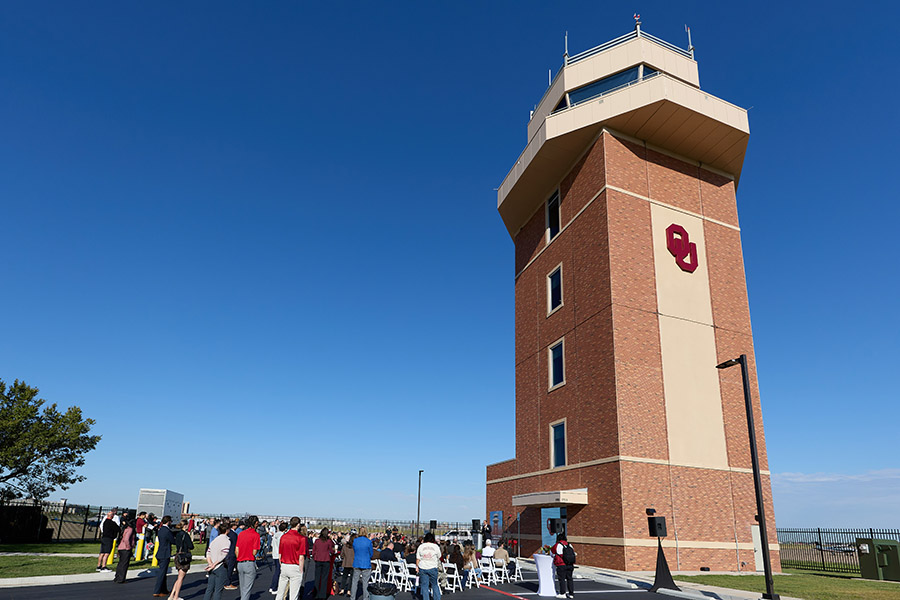
The University of Oklahoma today celebrated the opening of a new air traffic control tower at the OU Max Westheimer Airport. Standing 106 feet tall, more than double the current 52-foot facility, the new tower will modernize air traffic control operations and improve safety for pilots and students operating in the airspace.
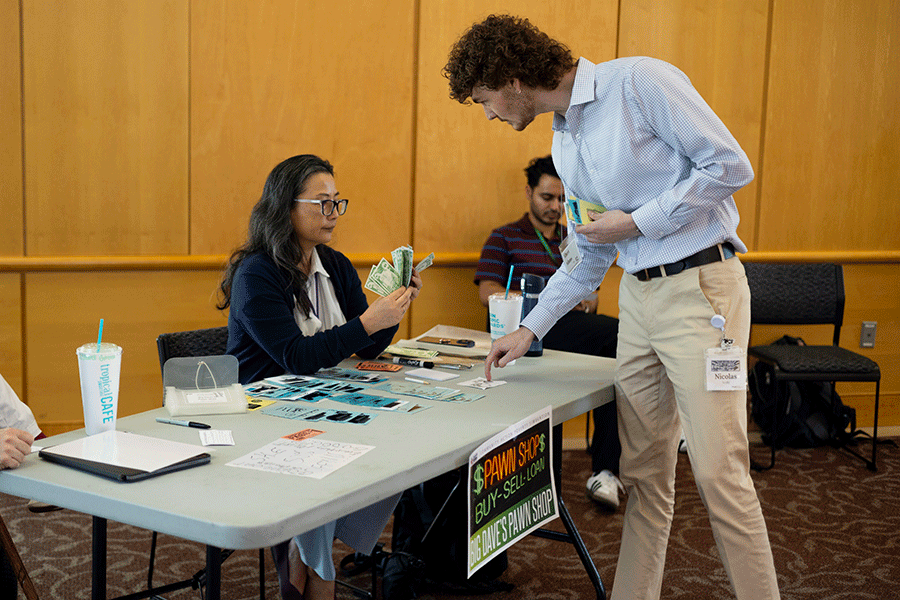
Do I buy groceries or pay the electric bill? Should I pawn some of my belongings to afford my prescription? My child is sick, so I will have to miss work to take care of him. Those are just a few of the difficult choices that OU-Tulsa health professional students confronted during the Community Access to Resources Experience. The role-playing activity challenged students to navigate the financial, family and other pressures that can affect a person’s health and ability to follow medical advice. Held annually during the SCM Institute orientation week, the experience is designed to generate understanding and build empathy.