NEWS


NORMAN, OKLA. – In a rare achievement, two University of Oklahoma undergraduate physics and astronomy students were awarded time to observe distant stars at the International Gemini Observatory. Their combined time represents approximately 4.5% of all available time allotted to U.S. astronomers from Aug. 2025 through Jan. 2026.
Alex Gleason and Alex Albright, both seniors in the Homer L. Dodge Department of Physics and Astronomy, are mentored by Mukremin Kilic, professor of astrophysics and cosmology. Their projects will utilize the Gemini North telescope in Maunakea, HI, and the Gemini South telescope in Cerro Pachón, Chile, depending on the time of year. Albright received eight hours on Gemini South and eight hours 24 minutes on Gemini North, while Gleason received 30.5 hours on Gemini South. In addition to high demand from astronomers, telescope time is often limited by weather conditions and the necessity of observing specific celestial objects at particular times. At an estimated cost of $1 per second to operate each telescope, these observations are valued at nearly $170,000.
“It’s very uncommon for undergrads to apply for Gemini time because it’s such a competitive process. In fact, OU has only ever had one other undergraduate student receive observation time on the Gemini telescopes,” Kilic said. “This is an incredible privilege because these students are taking the lead on the project, analyzing the data and writing the resulting publications.”
Albright’s project will measure the ages of binary systems that involve white dwarf stars located hundreds of light years away. As these stars die, they release latent energy that makes them appear younger than they actually are.
“By measuring the ages of their companion stars in the binary system, Albright will be able to determine if there’s any actual age difference and see how they have evolved over billions of years,” Kilic said. “Given the enormous size of the galaxy, these stars are relatively close, which makes them easier to observe.”
Gleason will spend his time trying to find the most massive white dwarf star. He will search for white dwarf stars with a mass larger than 1.3 times that of the sun. Using spectroscopy, he will then determine the composition of these stars and model their temperature, surface gravity and mass.
“These stars have cores that are so dense that it prevents them from collapsing. But, according to theory, if a star gets to about 1.4 times the mass of the sun, the pressure from its core isn’t enough to hold the star together. If that happens, it explodes and creates a supernova,” Kilic said. “By determining the mass of the white dwarf stars that haven’t exploded, we can establish the maximum possible mass of these stars.”
These opportunities highlight the caliber of undergraduate research at the University of Oklahoma. By securing valuable time on two of the world’s most advanced telescopes, Albright and Gleason are poised to deepen our understanding of stellar evolution and the limits of cosmic phenomena and kickstart their future careers.
About the University of Oklahoma
Founded in 1890, the University of Oklahoma is a public research university located in Norman, Oklahoma. As the state’s flagship university, OU serves the educational, cultural, economic and health care needs of the state, region and nation. For more information about the university, visit www.ou.edu.
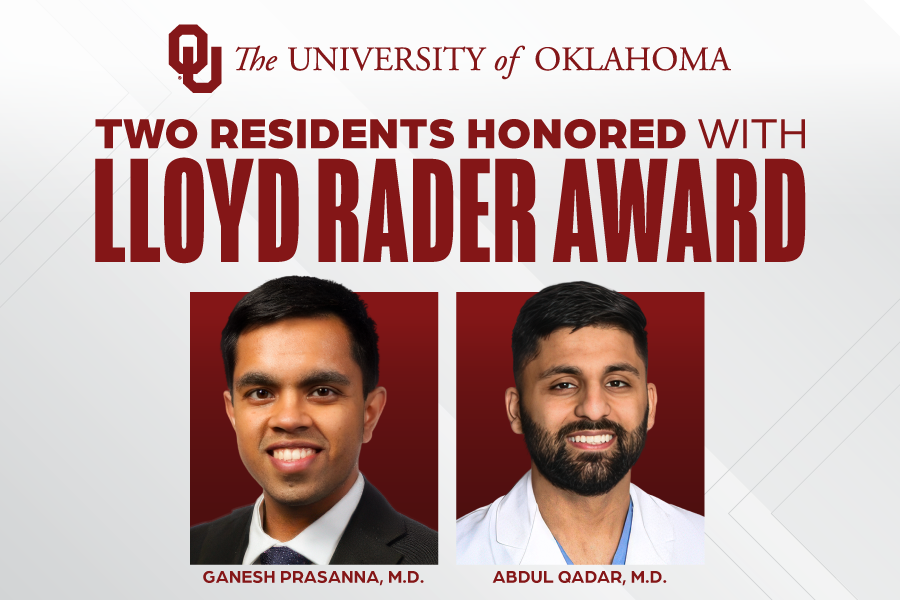
The University of Oklahoma College of Medicine has honored two residents with the Lloyd Rader Award, which recognizes outstanding clinical and research achievements in residency.
The University of Oklahoma will receive up to $220 million over five years from the U.S. Department of Commerce and the National Oceanic and Atmospheric Administration to continue the life-saving weather research led by the OU-NOAA Cooperative Institute for Severe and High-Impact Weather Research and Operations, extending a nearly 50-year partnership that has helped give Americans earlier, more accurate weather warnings
The OU Food Pantry won the annual Red River Food Fight, collecting 31,815.9 pounds of shelf-stable food and drinks to top UT Outpost’s 22,567 pounds. OU has won the competition four years in a row.