NEWS


OKLAHOMA CITY – A new study from the University of Oklahoma suggests that small genetic differences in two proteins – previously known for their role in premature infants’ lungs – may also influence how their eyes develop, potentially affecting the risk of retinopathy of prematurity (ROP).
ROP is a serious eye disease that affects premature infants, whose retinas – the light-sensitive tissue at the back of the eye – are still developing when they are born. In some babies, the blood vessels in the retina grow abnormally, which can lead to vision problems or even blindness. ROP is the leading cause of acquired childhood blindness and can have lifelong effects on vision and quality of life even after treatment.
In this new study, published in the journal Pediatric Research, researchers wanted to know if genetic differences in two proteins, called surfactant protein A and surfactant protein D, affect the risk of ROP in premature babies. The proteins are better known for their presence in the lungs, where they protect premature babies’ lungs from infection and inflammation or predispose them to lung disease, depending on the genetic makeup. The researchers hypothesized that the genetic variants (called single-nucleotide polymorphisms, or SNPs) would act similarly in the eye.
“In looking at the DNA of human babies, we found four genetic variants that are specific to eye disease, two that are protective against ROP and two that increase the risk. But what makes the study unique is that they were the opposite of what occurs in the lung,” said the lead author, neonatologist Faizah Bhatti, M.D., a professor of pediatrics in the OU College of Medicine.
Importantly, the researchers carefully controlled for other factors that may influence lung disease, such as gestational age and the high amount of oxygen that is sometimes necessary to keep premature babies alive. This suggests that early genetic testing could one day help identify which premature babies face the highest risk of ROP. Bhatti and her team are now working to understand how these genetic differences influence the structure of these proteins and the resulting interactions with developing blood vessels in the retina.
“As neonatologists, we have greatly improved the way we care for premature babies,” Bhatti said. “We use far less oxygen than we used to, and we try to minimize the number of infections they get. And while that has made a positive difference in outcomes for babies, ROP has continued to rise, which comes down to a baby’s genetic makeup. We have to get better at identifying which babies are at greatest risk of ROP because one size doesn’t fit all.”
Bhatti was the first researcher to discover the presence of surfactant protein A in the eye, using animal models of ROP. This study is believed to be the first to demonstrate the association of surfactant proteins A and D with human retinal disease.
While the study was limited to babies in one NICU and analyzed only a subset of known variants, the findings are crucial not just for ROP but also for understanding how blood vessel development is disrupted by preterm birth. Bhatti’s laboratory focuses more broadly on how inflammation, infections and oxygen stress affect normal and abnormal blood vessel growth.
“Ultimately, we hope to apply this knowledge to blood vessels that are abnormally developing in other parts of the preterm baby,” she said. “So many of the complications affecting preterm babies occur because much of the development that was supposed to happen in the uterus has been lost, including normal blood vessel growth. Many interventions necessary to keep these babies alive can add additional stressors and increase the risk of complications, such as ROP, to an already fragile system. Studying eye disease is very important, but this study will help us understand blood vessel development in preterm babies as a whole.”
About the project
The study, “Surfactant proteins A and D nucleotide variants: association with retinal vascular disease,” is at https://doi.org/10.1038/s41390-025-04435-w. Collaborating with Bhatti’s team were Dustin Rousselle, Keishla Colón Montañez and Patricia Silveyra of Indiana University School of Public Health.
About the University of Oklahoma
Founded in 1890, the University of Oklahoma is a public research university with campuses in Norman, Oklahoma City and Tulsa. As the state’s flagship university, OU serves the educational, cultural, economic and health care needs of the state, region and nation. In Oklahoma City, the OU Health Campus is one of the nation’s few academic health centers with seven health profession colleges located on the same campus. The OU Health Campus serves approximately 4,000 students in more than 70 undergraduate and graduate degree programs spanning Oklahoma City and Tulsa and is the leading research institution in Oklahoma. For more information about the OU Health Campus, visit www.ouhsc.edu.
The University of Oklahoma has received a transformative gift from Jon and Shannon McCartney, which will name the McCartney Family Tunnel of Champions, the McCartney Family Gate of the Gaylord Family - Oklahoma Memorial Stadium and the McCartney Family Grand Lecture Hall in the Michael F. Price College of Business. The gift will also support the Inspiring Champions and the Athletic Director’s Discretionary Fund, in addition to establishing the McCartney DFW Career Trek program at Price College.
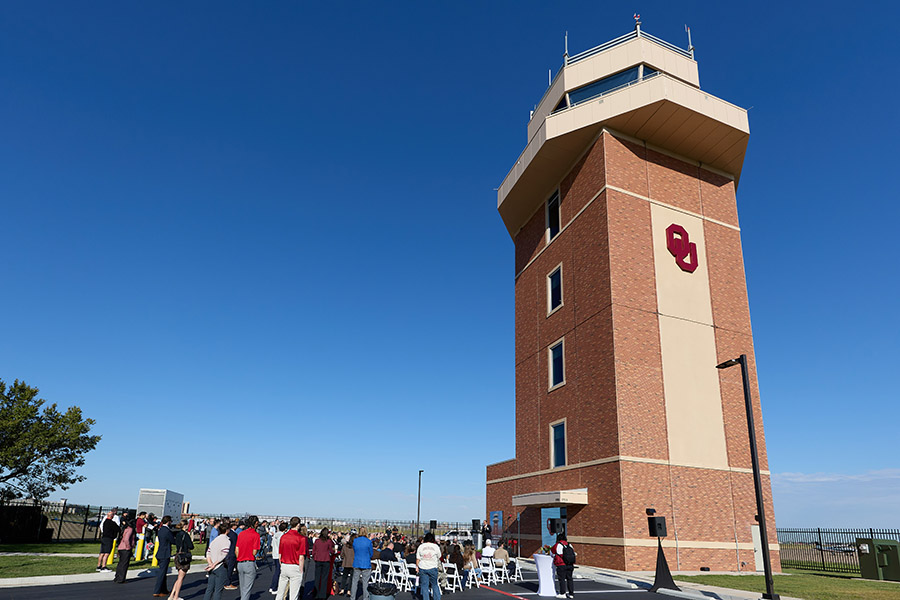
The University of Oklahoma today celebrated the opening of a new air traffic control tower at the OU Max Westheimer Airport. Standing 106 feet tall, more than double the current 52-foot facility, the new tower will modernize air traffic control operations and improve safety for pilots and students operating in the airspace.
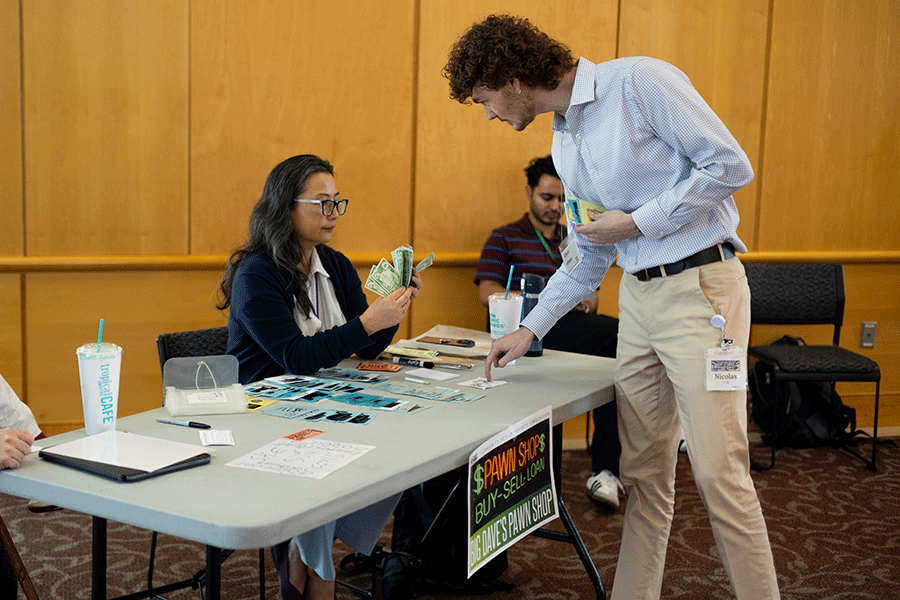
Do I buy groceries or pay the electric bill? Should I pawn some of my belongings to afford my prescription? My child is sick, so I will have to miss work to take care of him. Those are just a few of the difficult choices that OU-Tulsa health professional students confronted during the Community Access to Resources Experience. The role-playing activity challenged students to navigate the financial, family and other pressures that can affect a person’s health and ability to follow medical advice. Held annually during the SCM Institute orientation week, the experience is designed to generate understanding and build empathy.