NEWS

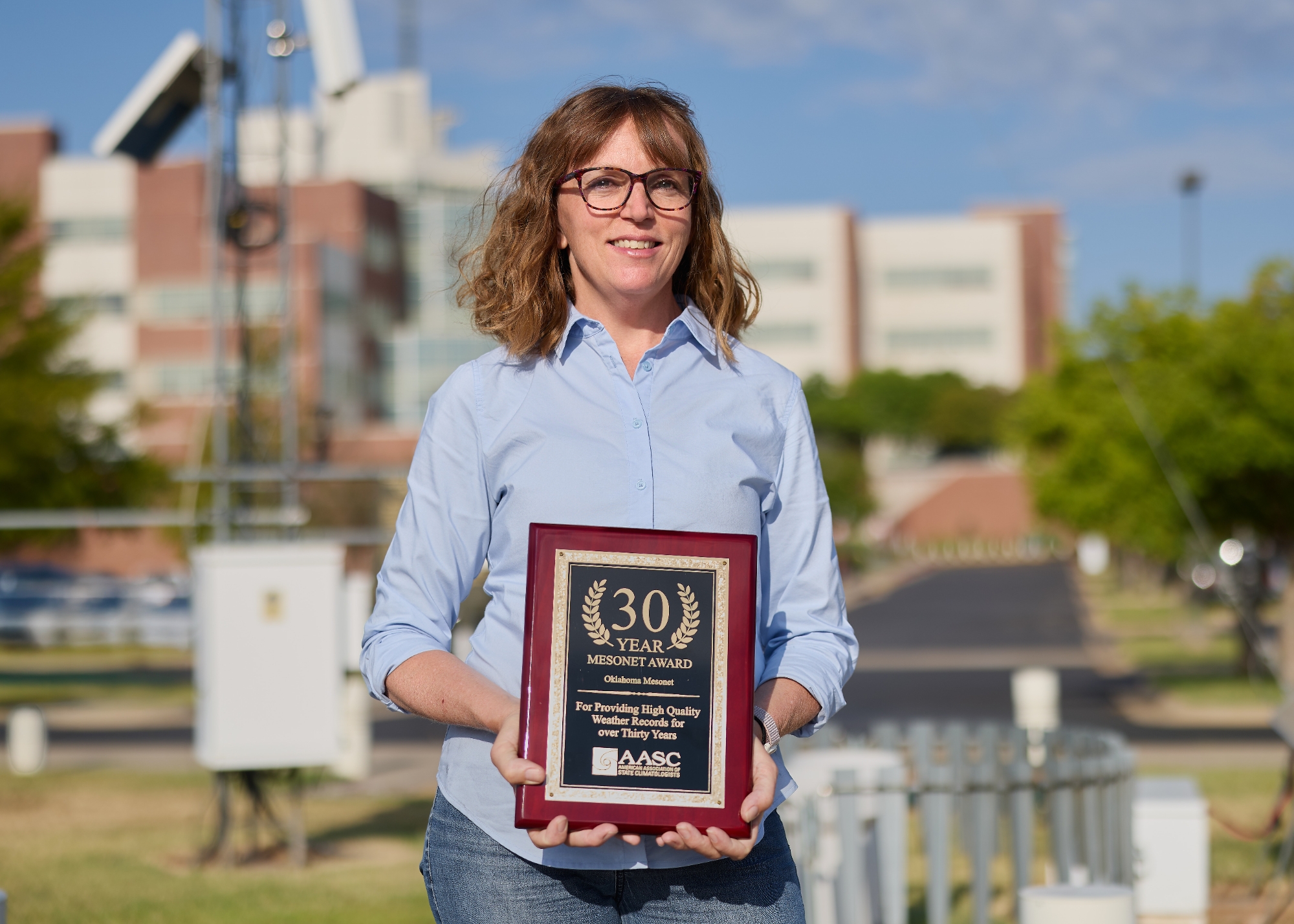
NORMAN, OKLA. – The Oklahoma Mesonet, a world-class network of environmental monitoring stations operated by the Oklahoma Climatological Survey, was awarded the AASC 30-Year Mesonet Award by the American Association of State Climatologists for contributing over thirty years of quality weather records of the state. The Mesonet is a joint program of the University of Oklahoma and Oklahoma State University.
A mesonet is a network of closely spaced weather stations reporting multiple times an hour to capture what meteorologists call “mesoscale” weather – behavior that is too small in scale or too dynamic for typical weather networks. The ability of mesonets to report weather conditions in near real-time and to fill coverage gaps makes them vital for forecasters, emergency managers, growers and producers, and the general public.
From Vision to “Gold Standard”
What began as separate university initiatives in the 1980s has evolved into what the National Research Council has described as the "gold standard" for statewide weather and climate networks. Today, the Oklahoma Mesonet operates 120 stations.
"One of our fundamental core values is that we have at least one Mesonet station in every county so that every county in the state of Oklahoma is fully represented," said Mesonet Director Cindy Luttrell.
Each station features sophisticated instrumentation mounted on or near 10-meter towers, measuring critical environmental variables every few minutes around the clock.
Keeping such a robust system functioning requires dedicated maintenance. Each site is visited roughly five times a year to ensure that sensors are in good condition and that vegetation does not become overgrown.
Another important piece is community buy-in at all levels within the state.
“We’ve been fortunate enough to be supported by our state legislature. There are a lot of other states across the country that have something like this, but they don’t have the proper funding to support it in a way to allow the network to be a high-quality network like we provide here,” said Luttrell.
A Milestone Achievement
From its origins as separate university initiatives to becoming a unified statewide resource, the Oklahoma Mesonet represents the power of collaboration and sustained commitment to scientific excellence.
“From the very beginning, we fully intended that the data from this network would be timely, it would be spatially representative, and the data would be collected in a manner that whoever used the data would have their needs met,” Luttrell said.
Communication with those users and stakeholders has evolved significantly in the time the Mesonet has been operating. “From the very beginning, we got our weather data onto local TV channels. People didn’t necessarily know it, but they were actually consuming our data and they still do so today,” said Luttrell.
Now, TV meteorologists and emergency managers alike communicate directly with Mesonet staff, getting immediate responses to their inquiries about Mesonet data. The Mesonet also has an app that allows anyone to access their data, from current weather to seasonal maps.
The Mesonet’s 30-year history of continuous operation has provided invaluable data for weather forecasting, agricultural decision-making, emergency management and countless other applications that protect lives and support Oklahoma's economy. That accomplishment is more than just a testament to the Mesonet’s success; it is also an important milestone for the data itself.
“In the climatology community, if you have 30 years of data that’s considered a ‘reference.’ Those 30 years help account for decadal variability in the extremes that we see. For our network now being around so long, we can tell people on average what we’ve observed in Oklahoma,” said Luttrell. “Our team is very excited to be acknowledged for this ongoing work.”
To learn more about the Oklahoma Mesonet, visit Mesonet.org.
About the University of Oklahoma
Founded in 1890, the University of Oklahoma is a public research university located in Norman, Oklahoma. As the state’s flagship university, OU serves the educational, cultural, economic and health care needs of the state, region and nation. For more information about the university, visit www.ou.edu.
The University of Oklahoma has received a transformative gift from Jon and Shannon McCartney, which will name the McCartney Family Tunnel of Champions, the McCartney Family Gate of the Gaylord Family - Oklahoma Memorial Stadium and the McCartney Family Grand Lecture Hall in the Michael F. Price College of Business. The gift will also support the Inspiring Champions and the Athletic Director’s Discretionary Fund, in addition to establishing the McCartney DFW Career Trek program at Price College.
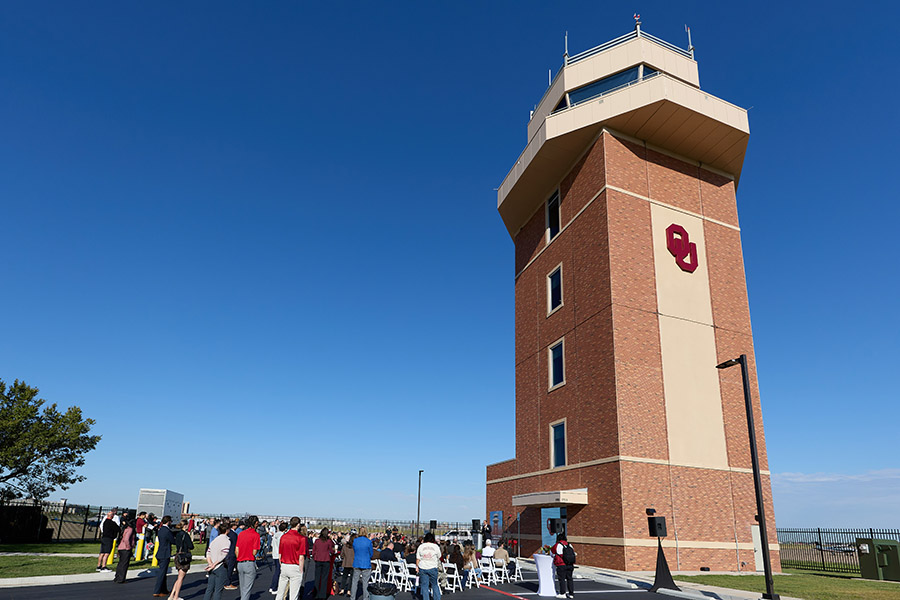
The University of Oklahoma today celebrated the opening of a new air traffic control tower at the OU Max Westheimer Airport. Standing 106 feet tall, more than double the current 52-foot facility, the new tower will modernize air traffic control operations and improve safety for pilots and students operating in the airspace.
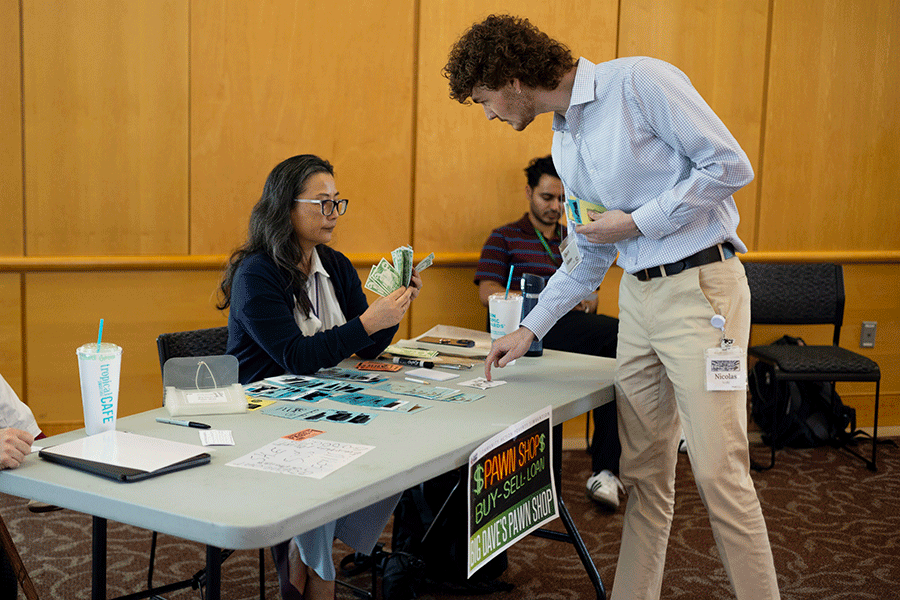
Do I buy groceries or pay the electric bill? Should I pawn some of my belongings to afford my prescription? My child is sick, so I will have to miss work to take care of him. Those are just a few of the difficult choices that OU-Tulsa health professional students confronted during the Community Access to Resources Experience. The role-playing activity challenged students to navigate the financial, family and other pressures that can affect a person’s health and ability to follow medical advice. Held annually during the SCM Institute orientation week, the experience is designed to generate understanding and build empathy.