NEWS


NORMAN, OKLA. – The University of Oklahoma Gallogly College of Engineering has broken ground on a new Infrastructure Innovation Building called I2B. This new facility will house transformative infrastructure research and education.
“We aim to bring together brilliant minds in engineering and artificial intelligence to collaborate on projects with the potential to transform transportation, enhancing safety and efficiency,” said Zahed Siddique, associate dean for research at the college.
The building on the south campus in Norman will also include dedicated areas for advanced mobility and energy storage, with labs focused on both research and education. The initial phase of the project will create approximately 20,000 square feet of space, with the potential for significant expansion.
According to John Klier, dean of the College of Engineering, I2B will help the college support a world-class faculty and attract exceptional students, fostering an environment that nurtures the growth of new technologies and new businesses in Oklahoma. “These research efforts will make significant contributions to student preparation and economic growth. We appreciate support from the state of Oklahoma and Dolese making these efforts possible,” Klier said.
The facility’s design will promote interdisciplinary collaboration across various sectors, with specialized labs dedicated to the research of unmanned vehicles, intelligent transportation systems and energy storage systems. As the infrastructure field evolves, I2B will provide the tools necessary to develop next-generation technologies.
Collaborations across the university, from architecture, arts and sciences, earth and energy, education, and atmospheric and geographic sciences and others, will explore finding solutions to the nation’s transportation challenges and will serve as a hub for innovative solutions for adaptive and cutting-edge infrastructure.
About the University of Oklahoma
Founded in 1890, the University of Oklahoma is a public research university located in Norman, Oklahoma. As the state’s flagship university, OU serves the educational, cultural, economic and health care needs of the state, region and nation. For more information about the university, visit www.ou.edu.
The University of Oklahoma has received a transformative gift from Jon and Shannon McCartney, which will name the McCartney Family Tunnel of Champions, the McCartney Family Gate of the Gaylord Family - Oklahoma Memorial Stadium and the McCartney Family Grand Lecture Hall in the Michael F. Price College of Business. The gift will also support the Inspiring Champions and the Athletic Director’s Discretionary Fund, in addition to establishing the McCartney DFW Career Trek program at Price College.
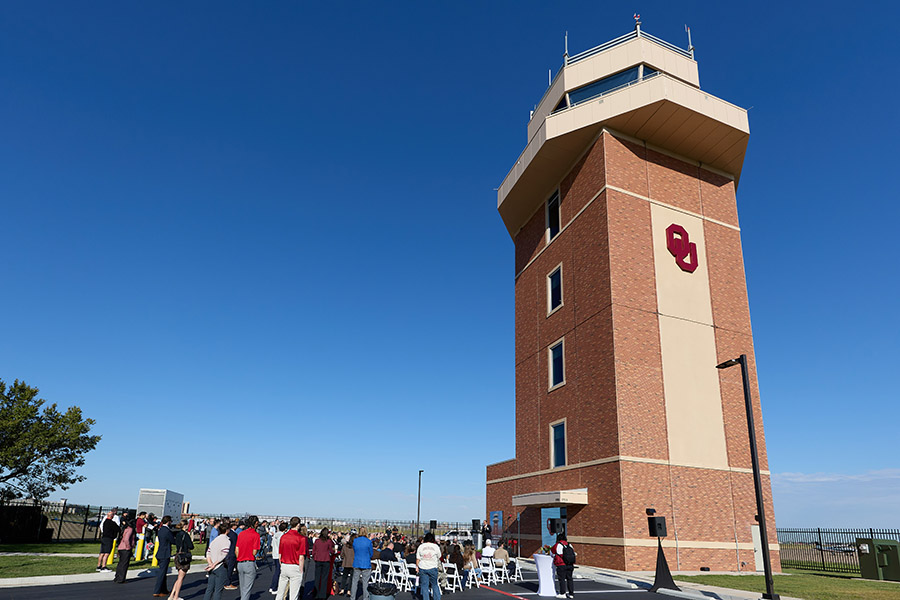
The University of Oklahoma today celebrated the opening of a new air traffic control tower at the OU Max Westheimer Airport. Standing 106 feet tall, more than double the current 52-foot facility, the new tower will modernize air traffic control operations and improve safety for pilots and students operating in the airspace.
Do I buy groceries or pay the electric bill? Should I pawn some of my belongings to afford my prescription? My child is sick, so I will have to miss work to take care of him. Those are just a few of the difficult choices that OU-Tulsa health professional students confronted during the Community Access to Resources Experience. The role-playing activity challenged students to navigate the financial, family and other pressures that can affect a person’s health and ability to follow medical advice. Held annually during the SCM Institute orientation week, the experience is designed to generate understanding and build empathy.