NEWS


NORMAN, OKLA. – People with HIV tend to use tobacco at more than twice the rate of the general population, and smoking is among the leading causes of illness and death among people with HIV. Additional data from the National Center for HIV/AIDS and STIs of Laos indicate that 61% to 80% of men with HIV in that country smoke cigarettes.
Thanh Bui, M.D., an associate professor in the Department of Family and Preventive Medicine at the University of Oklahoma College of Medicine and member of the OU Health Stephenson Cancer Center, is leading an effort to reduce rates of cancer illness and death of tobacco users with HIV in Laos. The researchers will implement a mobile health-based intervention to help HIV-positive smokers quit smoking and obtain cancer screenings.
“Reducing tobacco use is one of the most important methods to prevent cancer, cardiovascular disease and other non-communicable diseases that lead to high morbidity,” he said. “For people with HIV, their immunity is compromised and they are, therefore, more likely to develop cancer. That’s why we’re specifically targeting this population.”
The U.S. National Cancer Institute is expanding its efforts to prevent cancers worldwide, especially in low- and middle-income countries. Bui, who originally hails from Vietnam and earned a master’s degree in global health and a doctoral degree in health promotion sciences, is also working on projects in Cambodia and understands the impact this research can have on this region.

Bui’s team will deploy a smartphone application to provide a fully automated, personalized, interactive tobacco cessation treatment program for this population. According to the United Nations’ International Telecommunication Union and the Lao government’s Statistics Bureau, mobile phone ownership in Laos is between 103% and 118%. Knowing this, they will focus their efforts on implementing the AAC strategy at HIV clinics: Ask people with HIV if they smoke, advise them to quit and connect them to their mobile health intervention app.
“Here at the OU Health Stephenson Cancer Center, the Mobile Health Shared Resource offers a platform for mobile health that allows individual researchers to design studies and deploy them through their targeted app,” he said. “All the intervention messages for a six-month treatment period are pre-loaded into the app, so once it is installed, the user doesn’t even need an internet connection for the app to work.”
Through the app, users will answer questions about their feelings of distress or self-confidence along with questions about their phase of quitting. The app will then deliver daily, individualized messages and tips to help guide them through the quitting process or maintain cessation and avoid relapse.
“Our goal is to see 20% to 40% of users in Laos successfully quit with the help of our mobile intervention,” he said. “We hope that nearly all the HIV clinics in Laos implement our ACC strategy. Doing so will help a lot of people with HIV quit smoking and live longer.”
As the study continues, Bui’s team will examine the associated costs and cost effectiveness of this intervention program. Because their mobile health app functions autonomously and requires minimal human involvement, he believes that it will be both scalable and affordable for governments to implement.
“Many developing countries like Laos can target policies that reduce tobacco use. These include putting pictorial health warnings on packages or reducing mass marketing of tobacco products,” he said. “But they have a harder time providing widely available tobacco treatment programs at a national level due to the required human resources and associated costs. Hopefully, mobile health options like ours can help reduce tobacco use and save lives.”
About the project
The project, “Implementing Sustainable mobile health Technology to Optimize smoking cessation Program for Lao people with HIV (I-STOP),” is funded by an expected $3,187,275 million grant from the National Cancer Institute of the U.S. National Institutes of Health, award no. U01CA294811, with additional support from the Oklahoma Tobacco Settlement Endowment Trust. Bui, DrPH, also received a Presbyterian Health Foundation Research Support Award that provides stipend support for a senior doctoral graduate student. The project began in Aug. 2024 and is expected to conclude in July 2029.
About the University of Oklahoma
Founded in 1890, the University of Oklahoma is a public research university located in Norman, Oklahoma. As the state’s flagship university, OU serves the educational, cultural, economic and health care needs of the state, region and nation. For more information about the university, visit www.ou.edu.
The University of Oklahoma has received a transformative gift from Jon and Shannon McCartney, which will name the McCartney Family Tunnel of Champions, the McCartney Family Gate of the Gaylord Family - Oklahoma Memorial Stadium and the McCartney Family Grand Lecture Hall in the Michael F. Price College of Business. The gift will also support the Inspiring Champions and the Athletic Director’s Discretionary Fund, in addition to establishing the McCartney DFW Career Trek program at Price College.
The University of Oklahoma today celebrated the opening of a new air traffic control tower at the OU Max Westheimer Airport. Standing 106 feet tall, more than double the current 52-foot facility, the new tower will modernize air traffic control operations and improve safety for pilots and students operating in the airspace.
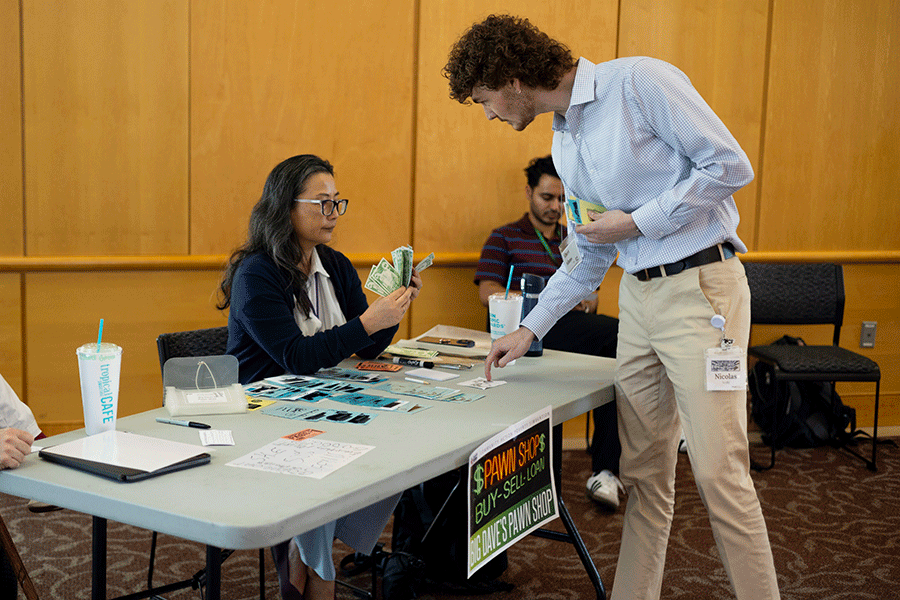
Do I buy groceries or pay the electric bill? Should I pawn some of my belongings to afford my prescription? My child is sick, so I will have to miss work to take care of him. Those are just a few of the difficult choices that OU-Tulsa health professional students confronted during the Community Access to Resources Experience. The role-playing activity challenged students to navigate the financial, family and other pressures that can affect a person’s health and ability to follow medical advice. Held annually during the SCM Institute orientation week, the experience is designed to generate understanding and build empathy.