NEWS


OKLAHOMA CITY, OKLA. – The Hudson College of Public Health on the University of Oklahoma’s Health Sciences campus has earned reaccreditation from the Council on Education for Public Health. This achievement reflects the college’s ongoing commitment to high standards in public health education.
The OU College of Public Health is the only CEPH-accredited school of public health in Oklahoma and has been continuously accredited since 1969. The U.S. Department of Education recognizes CEPH for accrediting public health education programs at various levels, ensuring quality education and adherence to national standards.
In November 2023, the OU College of Public Health underwent a comprehensive site visit and review by a CEPH peer team to assess its reaccreditation status. Of the 43 criteria evaluated in the college’s degree programs, all were met with no actions needed. The reaccreditation is effective for seven years.
“Our successful CEPH reaccreditation represents the commitment of our faculty, staff, students and leadership and their passion for public health education,” said Dale Bratzler, D.O., MPH, dean of the OU College of Public Health. “The college received consistently high marks across a multi-level review, which reflects our dedication to educating future public health professionals.”
CEPH accreditation benefits students in several ways. Graduates of CEPH-accredited programs have access to employment opportunities that may not be open to those from unaccredited institutions. This includes roles in the U.S. Public Health Service, certain U.S. military public health positions, and various state and local government agencies.
Some fellowships are exclusively available to students from CEPH-accredited schools that are also members of the Association of Schools and Programs of Public Health. In addition, CEPH accreditation provides a pathway to eligibility for the Certified in Public Health exam administered by the National Board of Public Health Examiners.
The OU College of Public Health prepares students for public health practice in several core areas: biostatistics, epidemiology, health administration and policy, health promotion sciences, occupational and environmental health, and public health preparedness and emergency response.
The college also has several centers: the Center for American Indian Health, Center for Public Health Practice, Oklahoma Nutrition Information Education Project, Oklahoma Public Health Training Center, Research Design and Analysis Center, and Sooner Survey Center. Read more about the college at publichealth.ouhsc.edu.
About the University of Oklahoma
Founded in 1890, the University of Oklahoma is a public research university located in Norman, Oklahoma. As the state’s flagship university, OU serves the educational, cultural, economic and health care needs of the state, region and nation. OU was named the state’s highest-ranking university in U.S. News & World Report’s most recent Best Colleges list. For more information about the university, visit ou.edu.
The University of Oklahoma has received a transformative gift from Jon and Shannon McCartney, which will name the McCartney Family Tunnel of Champions, the McCartney Family Gate of the Gaylord Family - Oklahoma Memorial Stadium and the McCartney Family Grand Lecture Hall in the Michael F. Price College of Business. The gift will also support the Inspiring Champions and the Athletic Director’s Discretionary Fund, in addition to establishing the McCartney DFW Career Trek program at Price College.
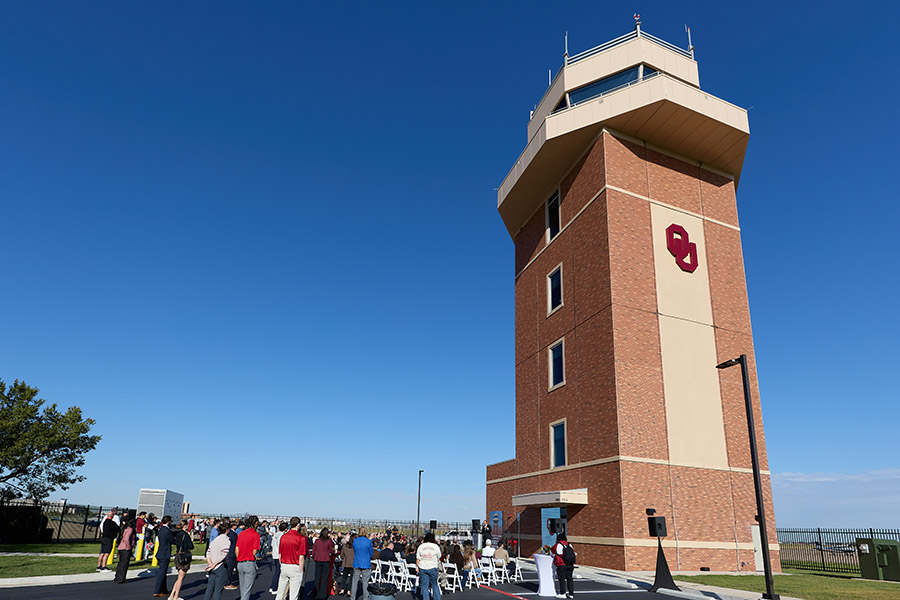
The University of Oklahoma today celebrated the opening of a new air traffic control tower at the OU Max Westheimer Airport. Standing 106 feet tall, more than double the current 52-foot facility, the new tower will modernize air traffic control operations and improve safety for pilots and students operating in the airspace.
Do I buy groceries or pay the electric bill? Should I pawn some of my belongings to afford my prescription? My child is sick, so I will have to miss work to take care of him. Those are just a few of the difficult choices that OU-Tulsa health professional students confronted during the Community Access to Resources Experience. The role-playing activity challenged students to navigate the financial, family and other pressures that can affect a person’s health and ability to follow medical advice. Held annually during the SCM Institute orientation week, the experience is designed to generate understanding and build empathy.