NEWS

NORMAN, OKLA. – Chris Fiebrich, Ph.D., has been named director of the Oklahoma Climatological Survey at the University of Oklahoma. With more than 40 staff and student employees, the Oklahoma Climatological Survey is the largest state climate office in the nation. The survey provides climatological services to the state through environmental observations, research and outreach. Fiebrich replaces Kevin Kloesel, who retired early this year after serving as director of the climatological survey for 14 years.
“Chris Fiebrich brings weather expertise and insight that reaches across the state. He has knowledge not only about our atmosphere but also about what strategical tactics are needed to cope with Oklahoma weather,” said Berrien Moore, dean of the College of Atmospheric and Geographic Sciences and director of the National Weather Center.
Fiebrich has served as the associate director of the climatological survey since 2010 and has managed the Oklahoma Mesonet since 2001.

“I started as a student at the climate survey in 1994, and since that time I’ve been able to see us hire over 200 student employees, giving them real-world experience,” said Fiebrich. “I’m excited for this opportunity to lead the organization.”
As part of this appointment, Fiebrich becomes a full professor in the School of Meteorology. His areas of research include hydrometeorology, mesoscale meteorology and measurements and instrumentation. He is a certified consulting meteorologist through the American Meteorological Society and a co-chair of the Norman Chamber of Commerce Weather Committee. In 2019, Fiebrich testified before the U.S. Congressional hearing on ‘The Future of Forecasting: Building a Stronger U.S. Weather Enterprise.” He received his bachelor’s, master’s and doctoral degrees in meteorology from the University of Oklahoma.
The Oklahoma Climatological Survey is home to two nationally recognized programs: the Oklahoma Mesonet and the Southern Climate Impacts Planning Program (SCIPP). The Mesonet, a state-wide network of environmental monitoring stations, is a joint program between OU and Oklahoma State University. SCIPP is a NOAA Climate Adaptation Partnership between OU, Louisiana State University, Texas Sea Grant at Texas A&M University and Adaptation International that assists organizations across the South-Central U.S. with climate-related decisions.
“We do everything from real-time weather observations at the Mesonet to helping communities across our entire region plan for weather and climate hazards that may impact us 20 years from now through SCIPP,” said Fiebrich. “We work with such diverse teams, from field operations to IT, outreach to research. It’s a unique academic, operational and research agency.”
Fiebrich says one of the survey's next big projects involves prototyping the three-dimensional Mesonet concept, which involves the use of uncrewed aerial systems to extend observations into the atmospheric boundary layer. Drones will also be used in two upcoming field campaigns aimed at evaluating how such data can aid National Weather Service forecasters.
About the University of Oklahoma
Founded in 1890, the University of Oklahoma is a public research university located in Norman, Oklahoma. As the state’s flagship university, OU serves the educational, cultural, economic and health care needs of the state, region and nation. OU was named the state’s highest-ranking university in U.S. News & World Report’s most recent Best Colleges list. For more information about the university, visit ou.edu.
The University of Oklahoma has received a transformative gift from Jon and Shannon McCartney, which will name the McCartney Family Tunnel of Champions, the McCartney Family Gate of the Gaylord Family - Oklahoma Memorial Stadium and the McCartney Family Grand Lecture Hall in the Michael F. Price College of Business. The gift will also support the Inspiring Champions and the Athletic Director’s Discretionary Fund, in addition to establishing the McCartney DFW Career Trek program at Price College.
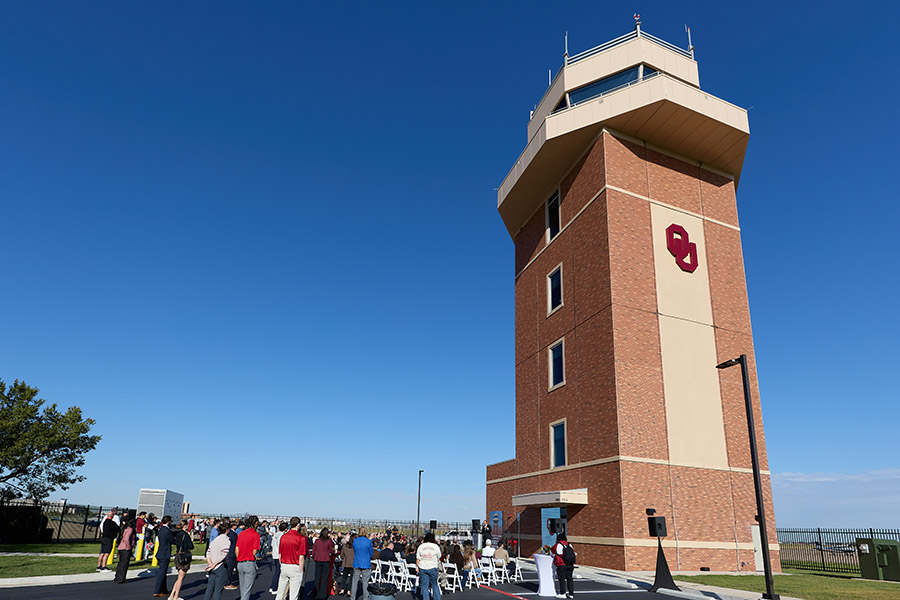
The University of Oklahoma today celebrated the opening of a new air traffic control tower at the OU Max Westheimer Airport. Standing 106 feet tall, more than double the current 52-foot facility, the new tower will modernize air traffic control operations and improve safety for pilots and students operating in the airspace.
Do I buy groceries or pay the electric bill? Should I pawn some of my belongings to afford my prescription? My child is sick, so I will have to miss work to take care of him. Those are just a few of the difficult choices that OU-Tulsa health professional students confronted during the Community Access to Resources Experience. The role-playing activity challenged students to navigate the financial, family and other pressures that can affect a person’s health and ability to follow medical advice. Held annually during the SCM Institute orientation week, the experience is designed to generate understanding and build empathy.