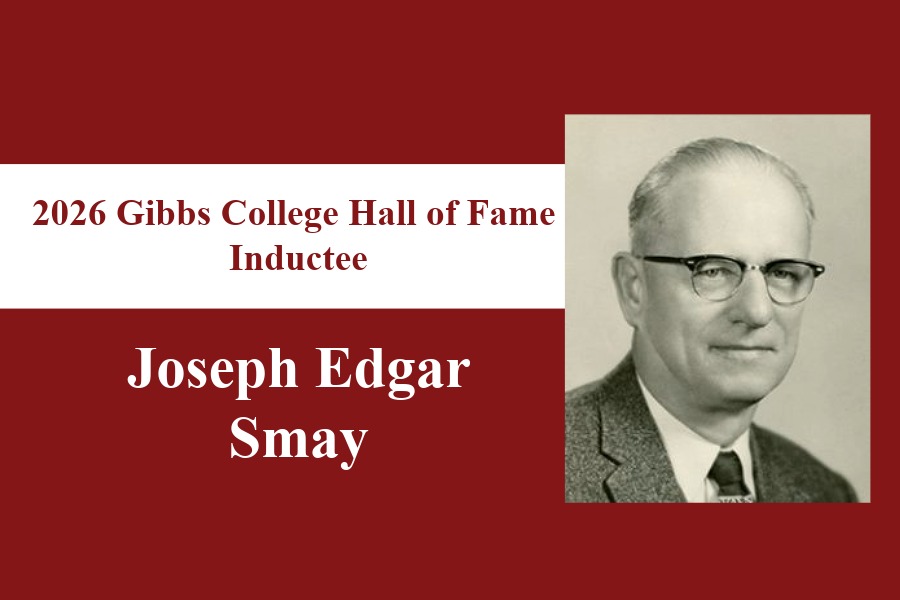
The University of Oklahoma Christopher C. Gibbs College of Architecture Hall of Fame (GCA HOF) recognizes a select number of high-character individuals who have made a significant and lasting positive impact over time to Gibbs College (GCA), its students, staff, faculty, alumni, and/or to communities across the globe. The impact may have been, or continues to be, in the form of service and mentorship, sustained professional excellence, and/or advancement and financial support. Joseph Edgar Smay is part of the 2026 Hall of Fame class.

Make a donation in honor of Joseph Edgar Smay

Joseph Edgar Smay (June 4, 1898–June 15, 1974) was an architect, educator and professional leader whose work helped establish the foundation for architectural education and professional practice at the University of Oklahoma and throughout Oklahoma. Widely regarded as a foundational figure in the history of the University of Oklahoma School of Architecture, Smay embodied the role of the teacher-architect-leader, connecting architectural education with the responsibilities and standards of professional practice.
Born in Nevada, Iowa, Smay studied architecture at Iowa State University, earning a Bachelor of Science in Architectural Engineering in 1923 and a Master of Architectural Engineering in 1929. He continued his academic development through advanced coursework and summer study at Harvard University. Earlier in his life, he served as a seaman in the U.S. Naval Reserve from 1918 to 1922.
Smay began his architectural career as a draftsman and architect in Lincoln, Nebraska, from 1924 to 1929 before relocating to Oklahoma. He established his own architectural practice and became one of the state's earliest formally licensed architects. His work included institutional and commercial projects throughout Oklahoma, as well as buildings for the University of Oklahoma. He also served as the university's official architect while teaching architecture.
Smay's most enduring contribution to OU came through his leadership of the School of Architecture. He served as the school's first director from 1926 to 1936, when architecture was part of the College of Engineering. At a time when architectural education in the United States was still establishing its identity, Smay developed a coherent pedagogical framework grounded in design rigor, professional responsibility and the integration of architectural practice with education.
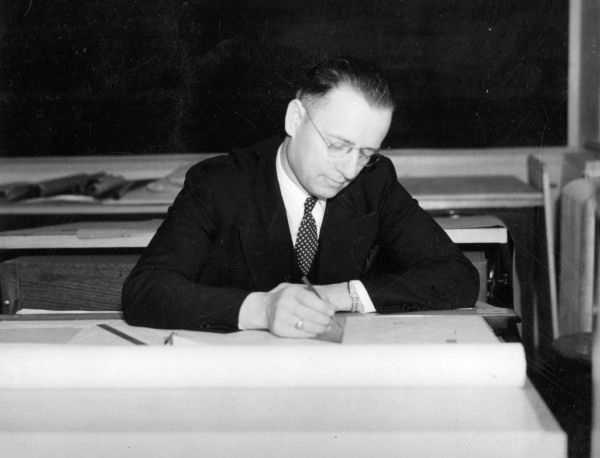
Under Smay's leadership, the School of Architecture adopted a Beaux-Arts approach that emphasized disciplined design and professional preparation, helping establish OU within the broader national conversation surrounding architectural education. His February 11, 1931, letter to the Association of Collegiate Schools of Architecture outlined the school's teaching methodology and reflected his commitment to rigorous architectural education and professional standards.
Smay's influence can also be seen in the physical campus he helped shape. As an architect, he designed several of the university's more traditional buildings, including Adams Hall and Richards Hall, which remain part of daily life at the University of Oklahoma. His work as both educator and architect gave the School of Architecture an early foundation in which academic instruction and professional practice were closely connected.
That foundation would prove significant to the evolution of architectural education at OU. The creativity, individuality and spirit of invention that later became associated with the school under architects and educators such as Bruce Goff and Herb Greene emerged from an earlier tradition of rigor and discipline. Smay's leadership established that foundation, providing a framework from which subsequent generations could develop new approaches to architectural education and design.
Smay's influence extended beyond the University of Oklahoma and into the broader architectural profession. He served as executive director of the National Council of Architectural Registration Boards in 1958–59, contributing to the evolving relationship among architectural education, professional licensure and standards of practice at the national level. His career demonstrated a sustained commitment to strengthening the profession both through education and through the organizations responsible for maintaining professional standards.
Through his leadership, teaching, architectural practice and professional service, Joseph Edgar Smay helped establish a lasting foundation for architecture at the University of Oklahoma. The buildings he designed remain part of the campus, while the educational framework he established provided a foundation for the generations of architects who followed. His legacy can be seen not only in the history of Gibbs College of Architecture, but also in the continuing relationship between architectural education, professional practice and service to the public.
The University of Oklahoma Christopher C. Gibbs College of Architecture Hall of Fame recognizes a select number of high-character individuals who have made a significant and lasting positive impact on Gibbs College, its students, staff, faculty, alumni and/or to communities across the globe. The impact may have been, or continues to be, in the form of service and mentorship, sustained professional excellence, and/or advancement and financial support. Joseph Edgar Smay is part of the 2025 Hall of Fame class.
Christopher C. Gibbs College of Architecture congratulates three architecture students who were recognized in the 2026 AIA Dallas Student Design Awards.
The University of Oklahoma Christopher C. Gibbs College of Architecture Hall of Fame recognizes a select number of high-character individuals who have made a significant and lasting positive impact on Gibbs College, its students, staff, faculty, alumni and/or to communities across the globe. The impact may have been, or continues to be, in the form of service and mentorship, sustained professional excellence, and/or advancement and financial support. Raymond W.H. Yeh is part of the 2025 Hall of Fame class.