Dr. Ladan Mozaffarian, Assistant Professor in the Division of Planning, Landscape Architecture, and Design at the OU Christopher C. Gibbs College of Architecture, has recently published her research in the prestigious journal Cities: The International Journal of Urban Policy and Planning.
Her article, “Unveiling the dynamics of innovation districts: An empirical study of key features and governance structure in fourteen U.S. cities,” explores the growing phenomenon of innovation districts (IDs)—place-based strategies designed to foster entrepreneurship, collaboration, and economic development in urban areas. Despite their prominence in planning and policy discussions, comprehensive empirical analyses of their structure and governance remain limited. This study addresses that gap through a systematic examination of 14 innovation districts across the United States.
The research adapts and extends an established framework to evaluate the economic, physical, and networking assets that underpin IDs, while introducing governance structure as a critical pillar influencing their development. Findings reveal that, although most districts emphasize industry diversity and proximity to anchor institutions, governance arrangements often determine how assets are integrated and how districts evolve over time. Importantly, many of these districts are situated near central business districts, leveraging urban centrality to enhance access, connectivity, and collaboration.
This work makes significant contributions to both theory and practice. For theory, it refines the conceptual understanding of innovation districts by systematically categorizing sub-assets across economic, physical, and networking domains, while highlighting governance as a central driver of innovation outcomes. For practice, this study also introduces a diagnostic tool and visual framework that urban planners and policymakers can use to assess existing conditions, identify opportunities, and design strategies suited to local contexts.
The paper concludes with planning implications, emphasizing the importance of governance, spatial design, and asset alignment in cultivating dynamic, sustainable, and collaborative innovation ecosystems.
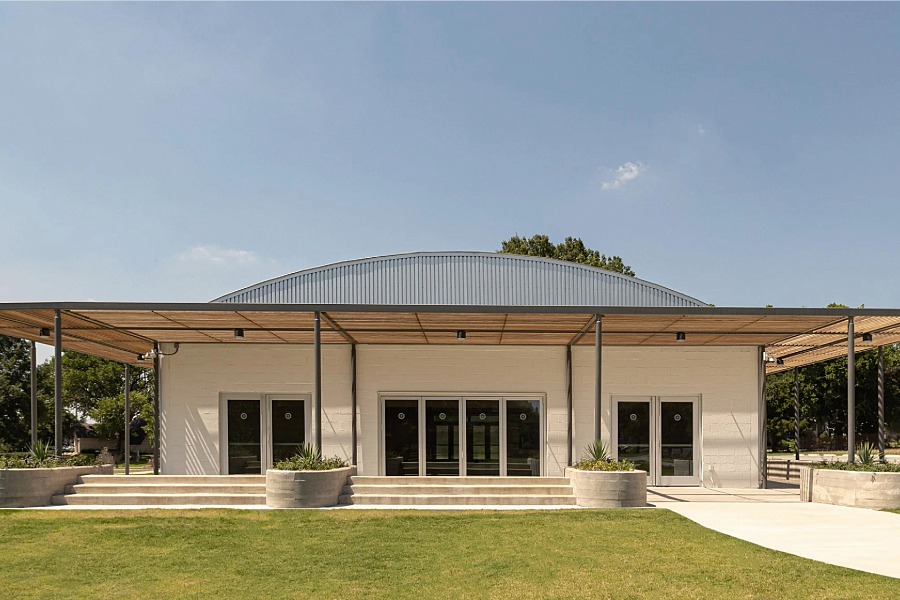
Christopher C. Gibbs College of Architecture assistant professor Amy Leveno and Mark Leveno, co-founders of OFFICIAL Design, have received a 2026 AIA Central States Region Design Award for the firm’s Granger Annex Community Center project in Garland, Texas.
Construction Industry Speaker Series welcomed Stephen Evans from the Oklahoma City National Memorial & Museum to give a lecture on better conversations and relationship building.
The University of Oklahoma Christopher C. Gibbs College of Architecture Hall of Fame recognizes a select number of high-character individuals who have made a significant and lasting positive impact on Gibbs College, its students, staff, faculty, alumni and/or to communities across the globe. The impact may have been, or continues to be, in the form of service and mentorship, sustained professional excellence, and/or advancement and financial support. Joseph Edgar Smay is part of the 2025 Hall of Fame class.