NEWS

Christopher C. Gibbs College of Architecture Dean Hans E. Butzer, FAIA, reflects on his experience as co-designer of the Oklahoma City National Memorial, recounting what it meant to him and his wife and design partner, Torrey Butzer, to be chosen to design the Memorial, the personal and cultural influences that shaped his approach, and the importance of visitor experiences in the design process.
Transcript below:
My name is Hans Butzer. I am the Dean of the Christopher C. Gibbs College of Architecture.
And also director of Butzer, Architects and Urbanism.
How did your journey with the Oklahoma City Bombing Memorial Begin?
Back in 1996, late 96, Torrey and I saw in a magazine an ad inviting people from all over the world to submit a design for a Memorial to be built in Oklahoma City that commemorates the bombing, but more importantly, that helps us remember the 168 who died as a result of that terrorist attack. And Torrey and I thought that this might be the type of competition where our skills could be of value.
So, fast forward, we submitted a design in March of 1997. Found out that we were finalists, one of five finalists, in that competition and then on June 27th, my 31st birthday, we got the call that they had selected our design.
And we were in absolute disbelief and realized then and there that architecture is real.
That these competitions, while filled with aspiration and the best of intentions, quickly turn on a dime, and you're now in a position where you have to lead. You have to perform.
And maybe more importantly, you have to learn how to listen to those around you, in order to see the project through and to see it be successful.
But never in a million years did we somehow expect that it would happen. That a design that we had created would be selected.
What were some of your influences in the design for the Memorial?
So, Torrey and I were living in Berlin, Germany at the time of the competition for the design of the Oklahoma City National Memorial. And we conceived of it, actually, over a period of about 6 or 8 weeks, from January through mid-February of 97. It was actually on the train going from the Austrian Alps back to Berlin after spending some time with some of our good friends in Austria that the concept for the design and it was a sketch, this large, all of our ideas that we've been mulling for weeks and weeks finally came together.
Oklahoma City is a long way from Berlin, Germany. I'd never really been downtown before. Torrey had been when she was a wee child. And here we were in Germany designing for
something tragic that took place in Oklahoma, but it had to be something that spoke to Oklahomans, spoke for Oklahomans, but spoke to people from across the United States and from across the world.
When we look back on our design, it's easy for us to see the influences of having been working in Germany for about 5 years by then, but also the influences of our own personal interests in, mine being landscape architecture, architecture and urban design, and then for Torrey, her interests in architecture and art and sculpture. And so, it was somewhere in that confluence of our own personal professional interests, but also in terms of our having been steeped in German place making and the way in Europe, the Europeans are so good at finding a balance between preserving their existing fabric while gently folding in new buildings. By celebrating the memory of certain events, certain periods over time, while also creating places that allow for contemporary reflection.
We really do believe that there is something about our proposal that speaks to the way Europeans create place, but in a way that was tailored to those conditions that we saw in downtown Oklahoma City.
How did your plan for visitors’ interactions with the Memorial influence the design?
What's really interesting about the difference between Europe and the United States is that Europeans generally prefer designs to be more abstract. And they are also less comfortable interacting with spaces, touching things, sitting amongst things, than we as Americans are. And so we created a design that reflected our American identity, but was still, kind of formally, influenced by German or European design sensibilities.
And so we had to anticipate how an American would want to visit the Memorial, to walk amongst the, what became, the field of 168 empty chairs, or to maybe kneel down and put their hand in the reflecting pool. These things that make place real. These were all things that we were envisioning while, at the same time, hearing from our German architect friends, “Oh, we could never do something so engaging here in Europe.” We, as Europeans, prefer things, almost more ‘standoffish.’ So, it was constantly going back and forth between the feedback we got from our European friends, and our realization, our appreciation of how we as Americans, you know, maybe are a bit more real, right? We want to touch things. We want to engage things, right? We want to experience places like a memorial in order to have a more honest understanding of what happened there and what might it mean for us today and tomorrow.
What did you want this Memorial to communicate to future generations?
For Torrey and I, we kind of had this goal that the Memorial could be about then and now and tomorrow. Right? And that sounds like a wild set of ambitions. Right? But we have done so much travel in our lives and certainly already by that time, at the ages of 30 and 31, our hope was that the Memorial design could reflect the specifics of a moment in time, right? It's one of the few memorials that's actually built on the site of the tragedy, of the event, that it seeks to commemorate. And so, it's not like a memorial to something that took place across an ocean and we're placing it in the heart of the National Mall in DC, where you can kind of work with abstractions. We were working in real time in real space. And so visitors who came here needed to be able to connect to some of the details of the place. People always ask, “where was the truck?”, “where was the building?”, “where did it sustain damage?”, “why is it that the survivor tree in its space across the street from the Murrah building, why did it survive?” And so the design had to tell some of that story, some of the facts shared, deliver the real stuff. While at the same time inviting people who came to visit, whether it's 2000 when it [was] dedicated or 2025, 30 years after the bombing. It needs to also invite people to reflect. And not to be beholden to the past and to history, a set of historical events, but just as importantly, maybe even more importantly, to develop a lesson, a takeaway. What is it that I can do today or tomorrow in my actions that prove this site meant something, that this Memorial spoke to me and said be better. Communicate in ways that people want to listen. In our democracy, we should uphold the commitment to share and listen, to do both. And to respect the viewpoints of others and treat them as being just as valid as those that I uphold and believe in.
How can the Memorial shape our behavior as American citizens, such that, we don't feel so inclined to violence when we disagree about something. That is something that is a result of a design that is a forum, a place of conversation that allows perspectives to be heard, seen, experienced and hopefully shape, reshape our own understanding of how we fit in and what obligations we have to society.
What was the building process like?
The competition for the Oklahoma City National Memorial was extremely unique in the architectural world. It was one of the few that invited the public, members of the lay community to be part of, not just the process of shaping the competition call for entries, the competition brief. But it was one of the few that invited normal people, and in this case, it was family members of somebody who died in the bombing. It was people who survived, themselves, were pulled from the wreckage of the building paired up with design professionals, so that they together could decide what might be the five finalists.
So already in the shaping of the competition, this community said, yes, design matters. Creating a cultural artifact that speaks to generations, but also to say, let's invite real people who were deeply and personally affected by the event to be part of that process. It was so nonhierarchical. It wasn't being taught by the architectural priests who come down from on high to tell the public how it needs to be, and trust us, the architects we know better. But rather, here was a message being sent by Oklahoma City. We can do this together. We can do it collaboratively. And how can the public learn from architects, landscape architects, designers about the things that matter, that transcend time in design? But also, how can the professional design community learn from the perspectives of the lay community to create places that speak to more people over time? That was such a critical lesson that Torrey and I learned from just the way the competition itself was conceived.
So fast forward, during the design and construction process, Torrey and I adapted our design process in such a way that we wanted to use more and more drawings, paintings, sketches, models, that could be used as tools to communicate to the lay public how our architectural thoughts were responding to what we thought might be perspectives of the community and trying to make connections between the two. And so, we built on that precedent that aspiration of the competition brief and try to carry it forward, to be more communicative, to be better listeners.
And it was during that process that I learned the phrase, I think it's an Oklahoma adage, right? There's a reason you have two ears and one mouth. That the power of listening is actually far more important than the need to speak. And so, as Torrey and I moved through the design process into the construction drawings, we dedicated ourselves also to being on the job site every day. We don't know any architects, designers, who are on the job site every day. To meet with the contractors, the laborers, the people setting stone, the people laying drip irrigation lines, that are putting down the turf, that are digging holes for trees, that are setting all the formwork for, what we hope is, impeccable concrete work. So that they saw we cared about the quality of their work. And so that they understood that the quality of their work will speak for generations as to how important this Memorial is and should be.
So there was so much about listening, on the behalf of architects, and engaging the community, whether, again, it's family members and survivors, or whether it's the contractors and subcontractors, to come together, to bring together all the skills and the perspectives and build something together.
As we commemorate the 30th anniversary of the bombing, is there any experience or perspective you’d like to share?
As an architect, 30 years removed from the bombing, and 28 years removed from, with my partner Torrey, winning the competition, but then also with my Dean hat on, right as an educator, trying to prepare designers, planners, contractors of the future, the perspective that the Oklahoma City National Memorial gave me was that we as professions are there to serve others, but also to lift others. And you can't lift well enough, if you haven't listened intently enough.
And there's no education that I ever had in school, and I went to great schools of architecture, none of them were able to communicate to me what I needed to know then, what Torrey and I needed to know then, that we leverage every day today, and that was how important it is to listen. That our inspiration should be fed by the perspectives of others. It's not just our context that we design from. So, to do lasting work, it needs to come from the community. It needs to come from our shared experiences and individual experiences, from physical contexts, from cultural contexts. That's how we together create great and lasting architecture. That is a lesson that we learned then, that no school education could have ever given us. But it's one that has shaped my work as a faculty member at OU, certainly as a director and now dean of the College of Architecture, to ensure that we have enough community engaged projects in our curriculum. The Memorial is one of the reasons that we do so much more community, engaged work, as we learn how to plan, design and construct. It's shaped the Gibbs College of Architecture today and it will moving forward.
Is there anything else you’d like to share?
You know, having our design selected through the Memorial competition process gave Torrey and me a tremendous amount of confidence. But it also gave us a position that we hadn't anticipated. And it was a position in which the community in Oklahoma City, and here in Norman, started to view us as people with ideas that might improve the community.
And that sense of responsibility that was placed on us and that we recognized, that we sought out, is something that we've tried to leverage and build on and to really cherish. To realize that the words that Torrey and I say have a lot of weight. And that's not something that we expected. So, we've made every attempt we could, wherever we could, in Central Oklahoma to deliver it, but also to step in and to participate more. And to be a part of this renaissance of central Oklahoma. And how our experiences could feed into the aspirations of Oklahoma City, of Norman.
And you don't know where life is going to take you, right? But what's so critical is you keep trying to put yourself in a position to where you could make a difference, no matter how big or small. But the key is make sure you're putting yourself in a position to make an impact, a positive impact, because you never know when you have to be ready.
Today Torrey and I look back, the Memorial project put us in a position to where, a year later, after the Memorial was completed in 2001, Torrey and I decided to teach a watercolor class during an intercession. Because we thought that the students needed to, there were enough students who wanted to learn how to watercolor, to communicate in a way that isn't so kind of intimidating, like a computer rendering or computer drawing, that had the softness that that made you want to move more closely and listen more carefully. And so we were thinking what project could we have the students design while learning how to watercolor? And we had just recently seen a story in the newspaper about a metal building that would be built on the Oklahoma River for $250,000 to house the boathouse for the Oklahoma Boathouse Foundation. And having just moved to Oklahoma City from Cambridge, MA, where I did my graduate degree, we were familiar with these beautiful boat houses on the Charles River. And the beautiful boat houses throughout New England, really, of these Ivy League schools. They are these iconic structures, right? And seeing people rowing, sculling on these rivers. It just has this cool feel. And here we were, Oklahoma City, on the cusp of greatness, and we were going to do a metal building.
And so we said, well, what if we have the students design a boathouse and do these beautiful watercolors? And they did. We then decided to meet with the executive director of the Oklahoma City Boathouse Foundation and presented him with visions of boathouses in watercolor. He was just stunned by the reality that, well, a metal building is fine, but why not have a boathouse represent what we as central Oklahomans are wanting to become?
Why can't that also be a great work of architecture, that it's iconic and it speaks to our aspirations?
And so a few months after seeing these student watercolors, the Oklahoma City Boathouse Foundation announced a major donation from an Oklahoma City corporation to really design something iconic that could and did become a postcard of Oklahoma City. And I share that example just simply because it was that sense of empowerment, of responsibility that Torrey and I gained from our experience working on the Oklahoma City National Memorial that allowed us to say why not? Why not just contribute, put an idea out there that says, we too can be great? It's not just the Oklahoma City National Memorial that we do well and do together, but why not every other project from there on out?
And Oklahoma City, Norman, central Oklahoma, it's like there's an ethos of Oklahoma that says, you know what? We take any and all good ideas, because we're a community and we're good at listening. And you know, when we barn raise it's because we're looking out for everyone else, and we're gonna do it together.
And so that example of the watercolor class leading to a boathouse that is now part of the United States Olympic and Paralympic rowing facility and that will be the backdrop for the 2028 LA Olympics, that all started because of the Memorial and the way it empowered us to speak up and to try and give back and to help us all collectively create something so much greater and prove there are lessons to be learned, even from the greatest of tragedies, that can give us all hope and show us the light.
People with type 2 diabetes were much more likely to achieve remission after weight-loss surgery than after intensive medical and lifestyle management, according to a long-term study. Researchers also identified patient characteristics linked to remission and to the likelihood of diabetes returning.
The University of Oklahoma College of Law has named Oklahoma Supreme Court Justice James R. Winchester as the 2026 recipient of the Eugene Kuntz Award. The annual award recognizes professionals who have made significant contributions to oil, gas and natural resources law.
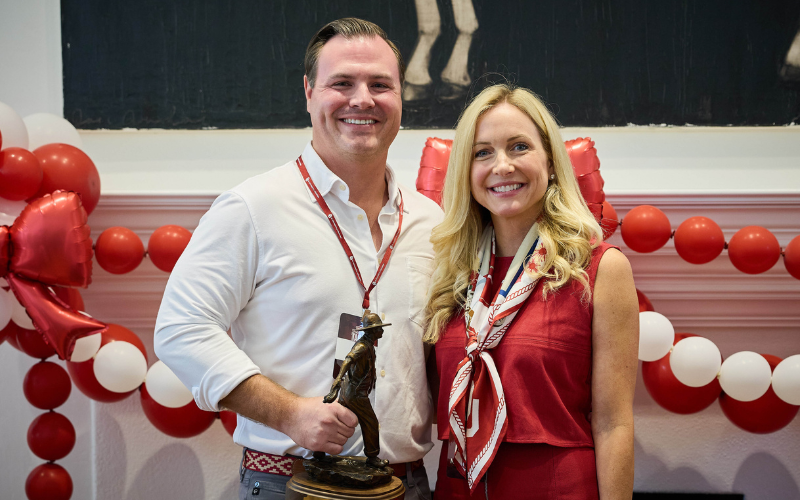
The University of Oklahoma has received a transformative gift from Jon and Shannon McCartney, which will name the McCartney Family Tunnel of Champions, the McCartney Family Gate of the Gaylord Family - Oklahoma Memorial Stadium and the McCartney Family Grand Lecture Hall in the Michael F. Price College of Business. The gift will also support the Inspiring Champions and the Athletic Director’s Discretionary Fund, in addition to establishing the McCartney DFW Career Trek program at Price College.