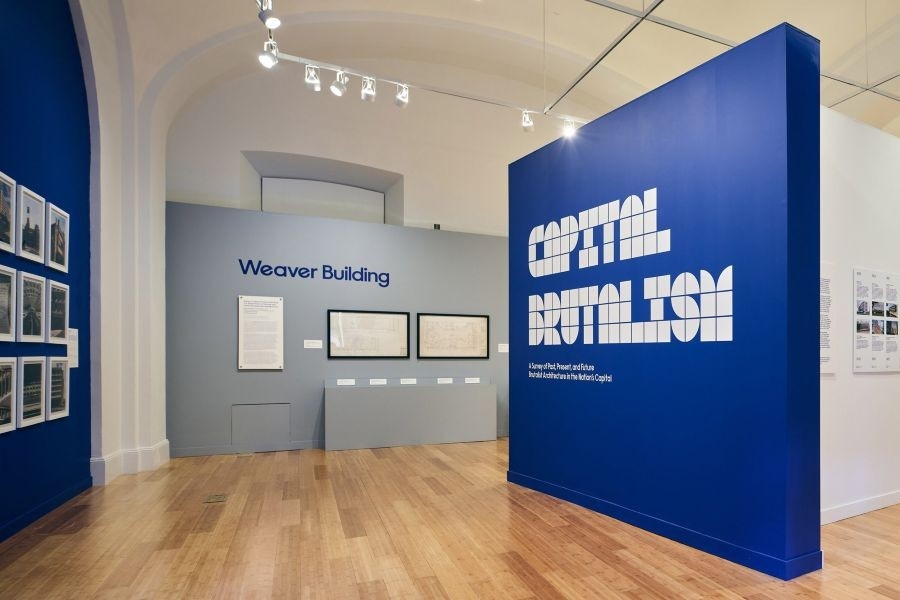
Dr. Angela Person, associate professor of Architecture at the Christopher G. Gibbs College of Architecture, and Ty Cole, an award-winning architectural photographer, have co-curated a new exhibition at the National Building Museum (NBM) in Washington, D.C., titled “Capital Brutalism.” The exhibition, which runs through February 17, 2025, is the largest-ever survey of Brutalist architecture in the U.S. capital.
“Capital Brutalism” explores the historical underpinnings, current state, and future possibilities of the sometimes-controversial Brutalist architectural style that emerged in Washington D.C. during the 1960s and ‘70s. The exhibition focuses on six Brutalist buildings, as well as the city’s Metro system, using archival documents, drawings, custom-built models, and contemporary photographs to shed light on the complex social and architectural impact of the style.
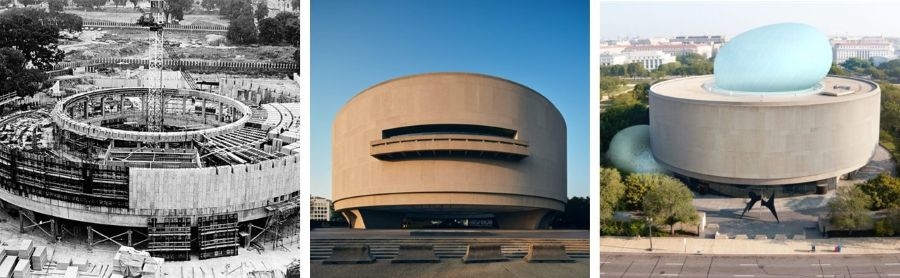
Hirshhorn Museum and Sculpture Garden: 1) Archival photograph, 1972, Smithsonian Institution Archives, Image No. SIA2011-1450. 2) Image copyright Ty Cole, 2023. 3) Reimagining courtesy of Diller Scofidio + Renfro, 2009.
“As an architectural photographer, I was drawn to the sculptural characteristics of brutalist architecture. Capital Brutalism emerged as a platform for Angela and me to narrate a story beyond its mere photographic allure. The exhibition explores its historical significance and proposes conceptual pathways for these buildings, which are often met with disdain or even animosity. We want to encourage nuanced understandings of these buildings that go beyond emotional reactions,” said Cole.
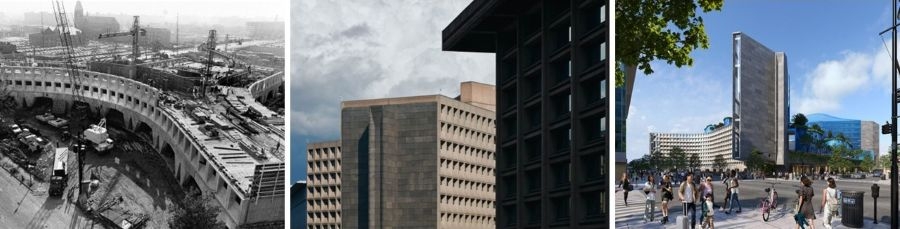
Weaver Building: 1) Archival photograph, c. 1967-1968, U.S. Department of Housing and Urban Development. 2) Image copyright Ty Cole, 2023. 3) Reimagining courtesy of Brooks +Scarpa, 2023.
“As the only U.S. cultural institution dedicated to the built environment, we could not be more excited to open an exhibition that focuses on buildings right here in our own back yard!” said Aileen Fuchs, president and executive director of the National Building Museum. “Capital Brutalism promises to be a thought-provoking exploration of the architectural history, cultural significance, and the enduring legacy of Brutalist architecture, whose beauty often goes unnoticed, in Washington, D.C.”
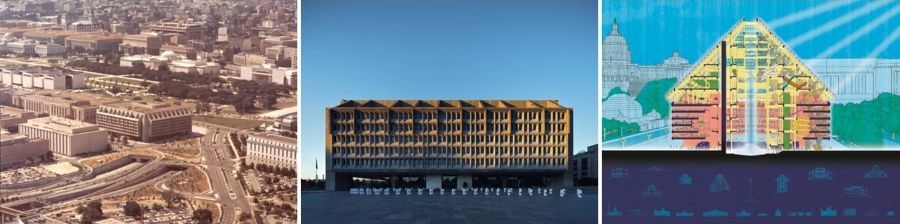
Humphrey Building: 1) Archival photograph, 1976, Marcel Breuer Papers (1920-1986), Archives of American Art, Smithsonian Institution, Record number (DSI-AAA)10612. 2) Image copyright Ty Cole, 2023. 3) Reimagining courtesy of BLDUS, 2023.
Dr. Person’s curatorial research draws upon her expertise as a cultural geographer and educator whose scholarship explores the intersections of design, community identities, and sustainability. Her award-winning work has been supported by major institutions including the Smithsonian, National Endowment for the Arts, and the Graham Foundation.
“Capital Brutalism would not have been possible without the support of dozens of architecture and preservation-focused partners,” said Dr. Person. “Ty and I are particularly grateful to the professional firms, archivists, historic preservation advocates, and university collaborators from across the U.S., including the University of Oklahoma, who generously shared their precious time, resources, and knowledge.”
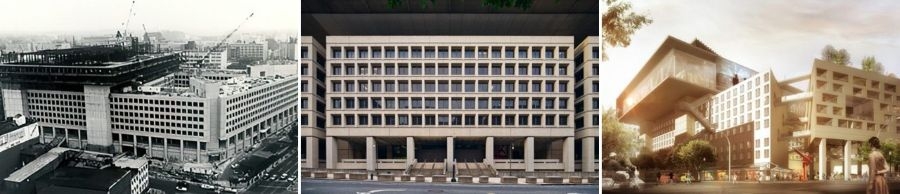
Hoover Building: 1) Archival photograph, c. 1969, Federal Bureau of Investigation. 2) Image copyright Ty Cole, 2023. 3) Reimagining courtesy of Gensler, 2012.
“Capital Brutalism” features speculative redesigns of the featured buildings by leading architecture firms, including Studio Gang, Brooks + Scarpa, Diller Scofidio + Renfro, Gensler, and BLDUS, along with students from the School of Architecture at University of Nevada, Las Vegas. These collaborative efforts invite visitors to imagine how D.C.’s Brutalist landmarks might be adapted and preserved, aligning with the National Building Museum’s focus on equity, sustainability, innovation, and inspiring wonder about the built environment.
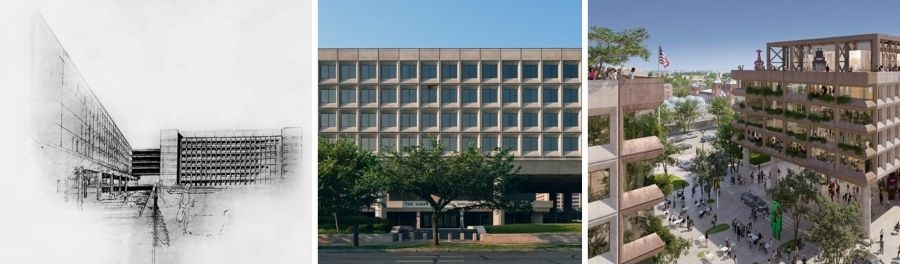
Forrestal Building: 1) Perspective drawing, c. 1965, Records of the Commission of Fine Arts, U.S. National Archives, RG66, Box 40. 2) Image copyright Ty Cole, 2023. 3) Reimagining courtesy of Studio Gang, 2024.
“Capital Brutalism” was co-organized by NBM and the Southern Utah Museum of Art, and the National Building Museum’s presentation of this exhibition was supported by the American Institute of Architects (AIA). The exhibition has been featured in Bloomberg City Lab, Architectural Record, Architect Magazine, ArchDaily, Fast Company, Domus, The Washington Post, The Washingtonian, and other news outlets.
Karen Baratz, karen@baratzpr.com, 240.497.1811
Gibbs College is pleased to present the exhibition 200 Digital Drawings by Professor Tiziana Proietti, currently on display in the Gould Hall Living Room.
Gibbs College of Architecture Professors Amber Brown and Amy Leveno led 29 students to Dallas, Texas, in September for a learning experience as part of their Design 7 Studio course.
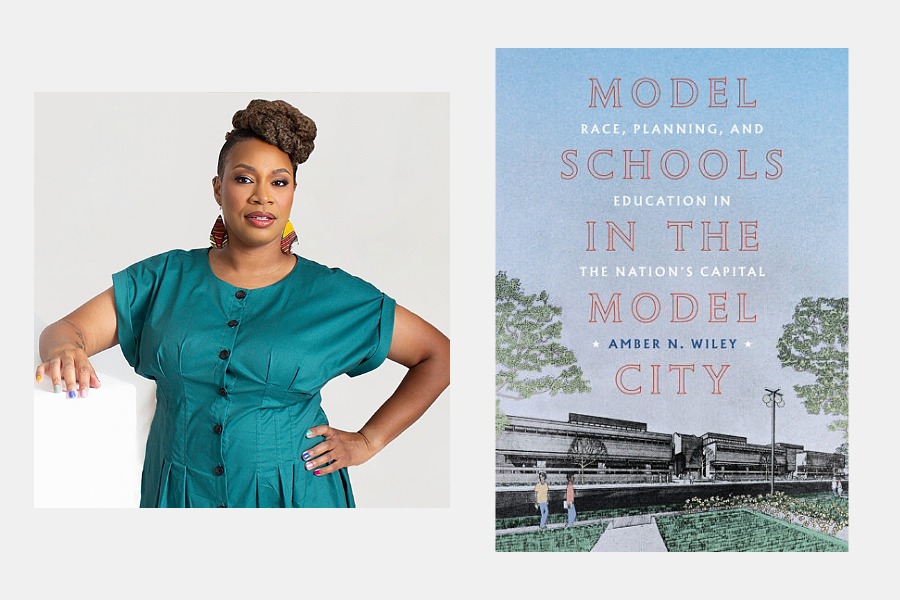
Christopher C. Gibbs College of Architecture professor and Institute for Quality Communities Director Dr. Amber N. Wiley’s book, Model Schools in the Model City: Race, Planning, and Education in the Nation’s Capital, has received two major honors from the Urban History Association.