Regional and City Planning faculty John Harris and Charlie Warnken are part of an interdisciplinary team led by the OU Institute for Resilient Environment and Energy Systems. The team was recently awarded a $599,000 Climate Pollution Reduction Grant from the Environmental Protection Agency. As a part of the Inflation Reduction Act and the Justice40 Initiative, these grants from the EPA support the development and implementation of plans to reduce harmful air pollution.
With this funding, the OU team will support the Oklahoma Department of Environmental Quality to prepare a climate action plan that will reduce emissions in communities across the state. Climate action plans are comprised of three main parts: an inventory of emission sources, a catalogue of current and future experiences of climate impacts in communities and a series of proposals to mitigate these emissions and climate impacts.
The team is led by Principal Investigator Tim Filley, who is assisted by Co-Principal Investigators Lauren Mullenbach, Scott Greene, Charlie Warnken, John Harris, Chenghao Wang, Ming Xue, Xiaoming Hu, Royce Floyd, Brad Illston, David Ebert, Binbin Weng, Otavio Costa Acevedo, Petra Klein and Xiangming Xiao. They are currently developing various project proposals in the following categories:
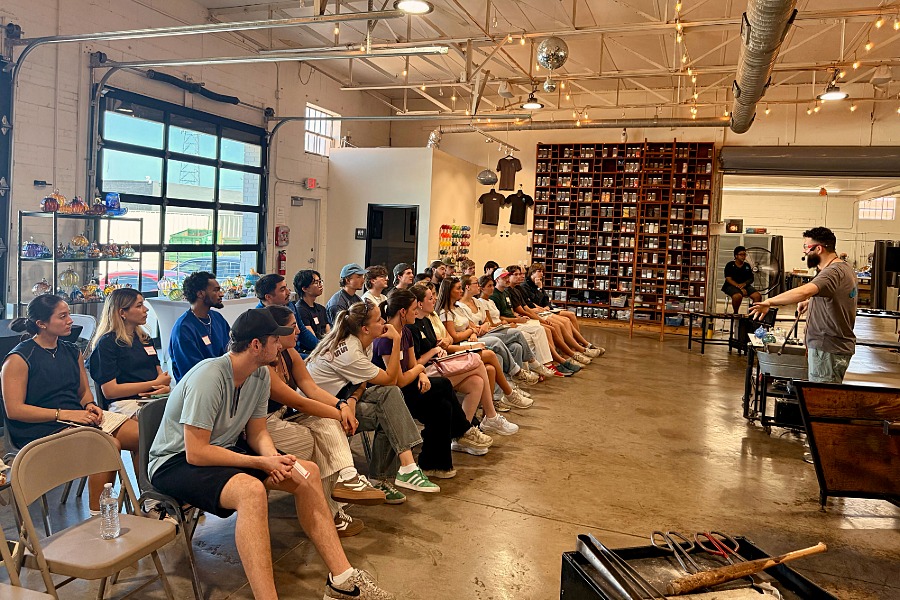
Harris and Warnken’s portion of the project focuses on engaging low-income and disadvantaged communities. The RCPL faculty are also working with graduate students from OU’s Planning, Landscape Architecture and Design division. As a part of their community planning studio, the students are conducting workshops throughout the state to gain a better understanding of climate impacts on local communities and how to address these issues accordingly.
The students began these community workshops in November and will continue into February. The students will then compile a series of reports about these communities for submission to the DEQ.
Gibbs College is pleased to present the exhibition 200 Digital Drawings by Professor Tiziana Proietti, currently on display in the Gould Hall Living Room.
Gibbs College of Architecture Professors Amber Brown and Amy Leveno led 29 students to Dallas, Texas, in September for a learning experience as part of their Design 7 Studio course.
Christopher C. Gibbs College of Architecture professor and Institute for Quality Communities Director Dr. Amber N. Wiley’s book, Model Schools in the Model City: Race, Planning, and Education in the Nation’s Capital, has received two major honors from the Urban History Association.