Michael Mann, a distinguished architect and Consulting Principal at Skidmore, Owings & Merrill (SOM) in Los Angeles, is an alumnus of the University of Oklahoma’s Gibbs College of Architecture. Over his career, he has led the design and execution of more than 55 million square feet of world-class projects, earning numerous industry awards and international recognition. A Fellow of the American Institute of Architects since 2003, Mann has collaborated with renowned architects like Rem Koolhaas and Peter Zumthor. His leadership and people-focused approach have shaped some of the world’s most innovative buildings.
Dean Hans Butzer (H): Michael, and so would you please introduce yourself, tell us where you’re from. Where did you study? What’s your latest stop so far in terms of work?
Michael Mann (M): I’m Michael Mann. I’m a principal at Skidmore, Owings & Merrill (SOM). I’ve just semi-retired. I was trying to fully retire, but when the LACMA project came up, I was kind of strong armed into sticking around for a little while longer to get that across the finish line. I took on more of a consulting principal role. That’s my official title at this point, because I gave up running the LA office to another guy I had mentored for a number of years. I’m now just focused on the one project for SOM.
I went to University of Oklahoma, got a four-year Bachelor of Science in Environmental Design (BSED) degree, I think this was in 1975 and then a masters in ’77. Right after that I was recruited by SOM to go to the Houston office, which was really an amazing time in our lives. We were a bunch of kids doing these huge buildings all over during that boom time in Texas. My first building was a 71-story office building that I did from age 25 to 29, and when I finished it, I was like what do I do now? Maybe I should go be a doctor or something, maybe I kind of peaked a little early.
H: Yeah, quick question here, Michael. You graduate, and suddenly you’re lured away by one of the most famous, influential firms in architectural history in the 20th century, SOM. But you’re from Oklahoma City, right?
M: I am. I grew up in Oklahoma City, went to Putnam High. Growing up like I did, there is a very provincial life. To go to the big university at OU felt like a real big step for me, and little did I know where this world was going to end up taking me. I’ve often said life is what happens when you’re busy making other plans.
H: Agreed. What was the most exciting thing going on in Oklahoma City when you were growing up there?
M: Well, you know, there wasn’t really a lot of excitement going on in Oklahoma City in my life. I mean, I remember as an architecture student, you know, kind of being amazed by the old Mummers Theater. That was kind of an eye opener, of like, wow. That’s what buildings can be you know? When I was in seventh grade, my neighbor, we started drawing, and it turns out they had a family friend who was a single practitioner in Oklahoma City as an architect. We went to his office one day, and I was just like, this is it. This is what I’m going to do with my life. So, I knew when I was in seventh grade I was going to be an architect. I didn’t understand my friends in high school and college who didn’t know what they were going to do. It just baffled me because I was on such a mission about it.

Mummer’s Theater, designed by John M. Johansen and completed in 1970 in Oklahoma City. It was torn down in 2015. Photo courtesy of The Oklahoman.
H: Share a little bit about how not just design skills are important in management skills, but people skills.
M: This is actually a huge topic, and a really important one to what the arc of my career was really about. Maybe it’s just my upbringing and what my parents model for me, but I’ve just always got along really well with people. In our profession, there’s some real characters and lots of big egos and all kinds of variations on the human condition that you encounter in our practicing, so being able to just maneuver through those and learning how to get the most and the best out of people is a great skill set to have. It definitely has served me well. It’s a big deal. It’s allowed me to get involved in projects that I wouldn’t have otherwise.
H: Yeah, and this leads into the whole conversation about collaboration. In design studio in school, we typically work, for the most part on our own, developing our own idea. We’re making decisions alone, on our own, for the most part. Did you find that transition from school into the workforce pretty easy, realizing it’s not just you alone, but you’re part of a team? Everyone’s looking to you to contribute and support.
M: It actually came pretty naturally to me. I functioned really well in team environments. I always had a pretty clear vision about where we were going as a team and to keep it moving in a somewhat linear fashion. I had that ability to kind of think ahead about where we were needing to go, and not just where we were at the moment, trying to get the team organized in a way and have the right kinds of talent on the team that we could actually progress these projects through. Yeah, it came pretty natural to me to be in a team.
H: I’m guessing, over your career, you’ve gotten to work with, you mentioned earlier, unique personalities like famous architects or designers, in addition to yourself and your SOM team. I mean, SOM is super famous. I grew up and a good part of my childhood in Chicago, all I knew was SOM, and Sears Roebuck, and John Hancock, and so forth. Who are some of the unique personalities that you’ve gotten to work with?
M: Oh, boy, this is actually the fun and memorable part of my career. Certainly at SOM, that 71-story building I did, we ended up going to San Francisco to work with Chuck Bassett, one of the design partners there. Chuck was a great classic SOM designer, and just a great human being to work with a number of the design partners at SOM over the years. I also had a project that we did jointly with SOM and with Ricardo Legarreta out of Mexico City [awarded the UIA Gold Medal in 1999, the AIA Gold Medal in 2000, and the Praemium Imperiale in 2011]. We ended up spending some time down in his studio in Mexico City.
Then while I was at AECOM, really being responsible for running the practice, I got a call one day from Rem Koolhaas [winner of the 2000 Pritzker Prize], who had won the competition to do the LA County Art Museum. Somehow, he got my name and called and wanted to meet for lunch. So, we met at the museum for lunch, and he said, I won this competition here, but I really need somebody locally that can do this with me. Would you do it? I said, yeah, sure, yeah we’ll definitely want to talk about that. So, he immediately walked me into the board meeting of the museum, which I had no idea we were doing that, to introduce me as his teaming partner. We did that, and he said, great we’ll be in touch. All of a sudden, things just went kind of quiet for a while.
I was starting to wonder what was happening with the project, and he called me and said, hey, it looks like we’re not going to be doing the museum after all, but I’d also won this other competition just recently for CCTV in Beijing, and he said, why don’t you just do that with me instead? And I said, okay. He said come to Rotterdam and let’s talk about it. So, I flew over to Rotterdam and went over the project with him, and he literally had just won the competition to do it, and so I went back and I told AECOM. I said, look, I’ve been managing this practice for a long time now, but I want to do this. This is for me. Everything will be fine in the practice. We have lots of good people here that I’ve surrounded myself with who can keep everything going here, but I’m going to go do this. I’m not asking you, I’m telling you I’m doing it. I’ll make a piece of business out of it. I’ll bring some more people along with me that can work on it and all that.

The CCTV building in Beijing, designed by Rem Koolhaas and Ole Scheeren, and completed in 2012. Image: New York Times/Philippe Ruault
I spent the next year in Rotterdam every other week, working with Rem and Ole Scheeren at the time doing CCTV. What a wild experience that was, one you can imagine. It was funny, because in my office, I had a little area on this mezzanine level overlooking the CCTV studio. He had a whole studio just for the project. Huge project. I could look out over the studio, and I could see him down there doing what he does, and then he’d come up and he’d pull up a chair close next to me, and go, so Coach, how we doing? They just didn’t have a leadership and management structure in place to organize that size of a team. Plus, they had the local Design Institute out of China there. It was quite a scene.
H: Amazing. This is so cool, Michael, for a whole host of reasons. One reason you should know is that for many years, I co-taught an introduction to architecture course here at OU and in the section where we talked about architectural programming, one of the projects we featured was the CCTV project from Rem Koolhaas in OMA. Now I can say in all my future lectures that Michael Mann, one of our amazing OU alumni, worked on that project too, and could tell us all there is to know about it.
M: Oh, I can tell you a lot. There’s a lot of great stories. As a matter of fact, we were just having this conversation the other day, I was doing a meeting with some students from ASU, and we were talking about the need to kind of record the history on some of these projects. The oral histories, because they’re filled with great stories. Just amazing stories of things that happened on these jobs. That one had lots of those kinds of stories as you can imagine.
H: Now you’re working with another amazing architect, one who certainly anyone who’s practiced in Germany or in Europe in general knows all about, Peter Zumthor [winner of the 2009 Pritzker Prize and 2013 RIBA Royal Gold Medal]. Tell us, what’s it like to work with Peter Zumthor on the stunning design for the Los Angeles County Museum of Art (LACMA)?
M: That was an interesting project for the firm, really, because SOM had never, I don’t think had ever really played a role like this. We’re a design firm in our own right. We do our own design and execution, but we never had really kind of played more of an execution role with another architect before. Obviously, we have a pretty significant and talented structural engineering group within SOM. It started out working with Peter on how to structure the project, and that very quickly turned into we’re just going to follow through with architects as well. Now, I’ve been overseeing the design team for the past five years on it.
Peter’s a really interesting guy, unlike some of these other characters who don’t have a lot of sense of humor. Peter actually does have a pretty good sense of humor. We’ve had some fun working with Peter on this. What we found is that you have to develop this instinct for what would Peter do as you’re working through the project. Trying to get in his head, and understand how he thinks about architecture, how he thinks about his built buildings is really pretty key.

In October 2024, construction was about 90 percent complete on LACMA’s David Geffen Galleries, designed by Peter Zumthor. Image: ©Museum Associates/LACMA
We kicked the tires on a number of his projects in Europe, and really went and examined him, and understood kind of where he was coming from, how he thought about the details. His father was a cabinet maker, so he comes out of this mentality about craftsmen. He wanted to talk to the people hands on doing the work. That went across basically all the trades. His work is very authentic. He really cares about the nature of the materials, the nature of how craftsmen can manipulate the materials in a skilled way.
It’s been a real interesting ride to get this thing done. I mean, I’ve done a lot of really big projects over five decades of work, and this one is one of the most complicated. It’s one of the hardest buildings I’ve ever worked on.
H: That’s amazing. For you to be the person that people have sought out to work with, you can’t forget, Michael, that at your stage in your career, with all that you’ve accomplished, you’re just like the Rem Koolhaas and the Peter Zumthor out there. They’re probably saying the same thing. What a privilege it is to work with Michael Mann, do you ever think about that?
M: Actually? No, not at all!
H: In terms of thinking back, what is something that, let’s say you wish you had spent more time thinking about or learning in school?
M: I mean, truthfully, I really had not prepared myself for the journey I was about to take. I’ve laughed a lot of times and said, I kind of screwed up and got it right. I think just the notion that when the door knocks, answer it, you make your own luck. It’s all these kinds of phrases that are so true. The other thing that I learned, and I was glad I learned it when I did, because I came into SOM, as a junior designer. I thought I was hot, going to wear this design hat and play that out.
What I really discovered, because I liked the idea of just being an architect, not specializing in any one kind of phase of work, which is so common in bigger firms. What I quickly found as I took projects from start to finish was I really loved the DD phase. I really loved taking a good idea, a good clean idea for a building, and then making it something really special. Learning what you’re good at early will just get you on the ultimate path you’re going to be on so much sooner, and you can really start your journey, as opposed to struggling with what you think your journey is supposed to be.
H: That’s a great point. Too often we think we’re heading in a certain direction, but maybe if we were more honest with ourselves as well, about what we’re good at. In our freshman class, we talk about architecture and really the disciplines of the built environment. They’re a really big tent, and you need personalities and skill sets of all sorts to make it work. So, we shouldn’t be afraid of who we are and what we’re good at, and just embrace it and dive in. Be the best at who we should be, right?
M: Yeah. I mean, I was just so much happier when I finally just said, this is what I really enjoy about what I’m doing, and so I’m going to focus on that and not worry about what label somebody thought I should have, you know?
H: Yeah. Did you think, as you were getting these calls and invitations and people are just like, amazing world architects calling to have coffee with you, did it dawn on you that at the end of the day you were taking risks each time you would meet with someone and there being this life changing or firm altering decision that’s about to come in?
M: No, I never saw it as risky at all. Like I’ve often said, my parents raised me to leave home, so I was out in the world, and I needed to just make the best of what I could in the world I was in. Very quickly that world got big. It became a pretty big world, and then became really kind of fascinating as I really started doing a lot of international travel and just kind of realizing, wow, there’s a lot out here to explore. So, as projects or invitations for these started coming in, this is where I’m supposed to be, you know?

Oregon Coast (Michael’s background referred to near the end of the podcast)
H: That’s fantastic. So, in a certain sense, you could argue you never felt the risk. To some extent, you had confidence, right?
M: I really didn’t. Maybe I should have been more scared, but I wasn’t, and I just went for it, you know?
H: Yeah, but I mean, you say with such comfort. When the door knocks, answer it. I mean, people that are just afraid to open the door, right?
M: Yeah, that’s really true.
H: Any last advice for our students, whether they’re Architecture, Planning, Construction, Interior Design, Environmental Design, Urban Design students in our college? What advice do you have for all of them?
M: Really kind of what I’ve been saying, look for those opportunities. Go make some opportunities for yourself. Don’t be afraid of them, and just go for it, because you won’t know unless you try it. Get to a place where you understand what you’re really good at and what makes you want to get up every day and go to work. Just be true to yourself about that, and you know you’ll have a great life.
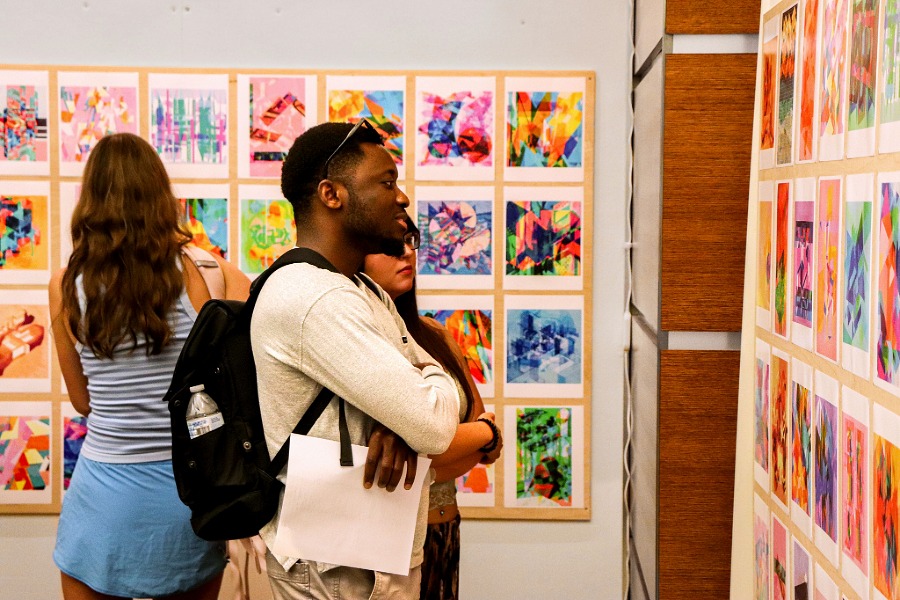
Gibbs College is pleased to present the exhibition 200 Digital Drawings by Professor Tiziana Proietti, currently on display in the Gould Hall Living Room.
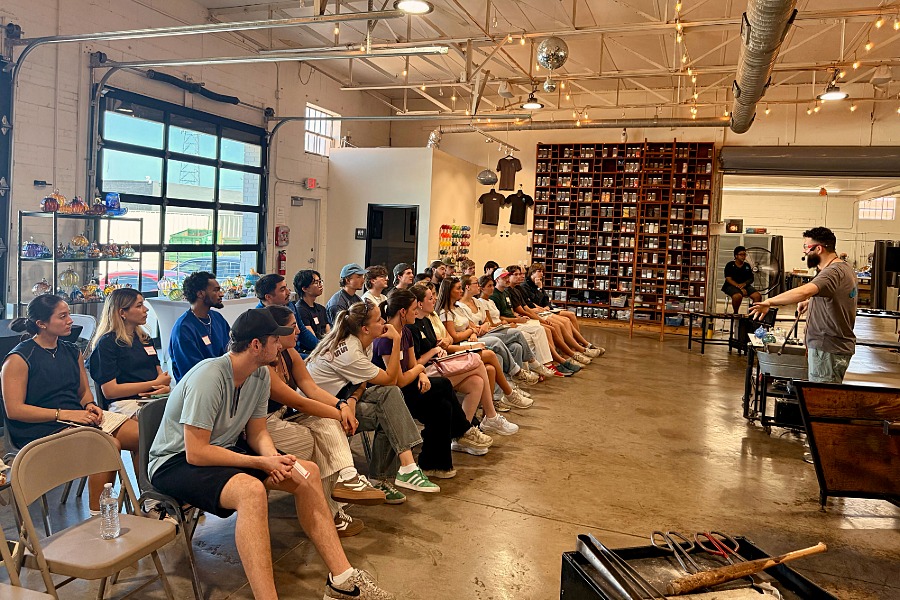
Gibbs College of Architecture Professors Amber Brown and Amy Leveno led 29 students to Dallas, Texas, in September for a learning experience as part of their Design 7 Studio course.
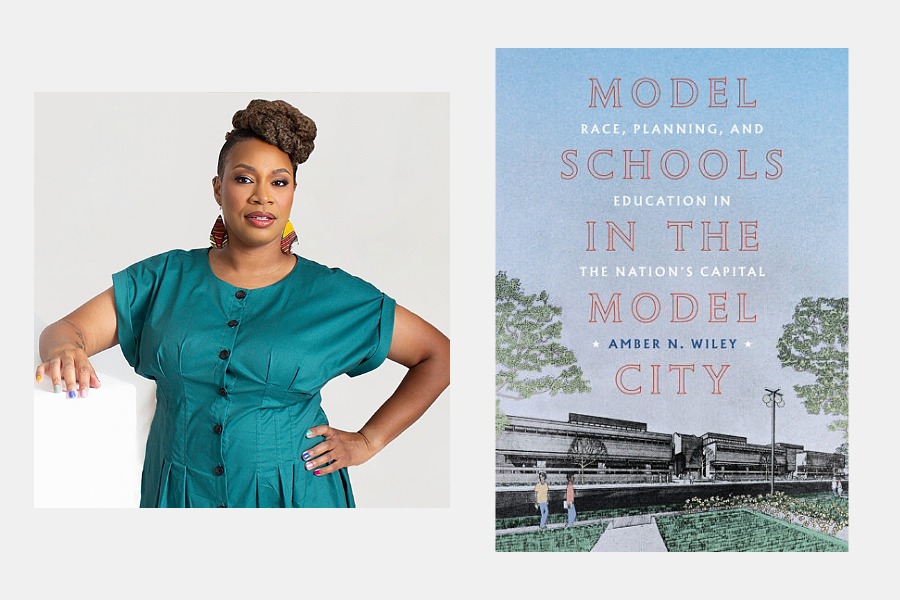
Christopher C. Gibbs College of Architecture professor and Institute for Quality Communities Director Dr. Amber N. Wiley’s book, Model Schools in the Model City: Race, Planning, and Education in the Nation’s Capital, has received two major honors from the Urban History Association.