GCA Communications intern Kali Curtis (K) spoke with Sam Callahan (C), a lecturer of architecture here at Gibbs! We sat down with Callahan to learn about how the use of technology has influenced design methods in architecture throughout his career. Callahan received his Bachelor of Architecture (1994) and Master of Architecture (2014) from the University of Oklahoma. He is currently working on his Ph.D. at the Gibbs College of Architecture. Read on for highlights or click the link below to access the full podcast.
K: Hello everyone, welcome to the Gibbs Spotlight. My name is Kali Curtis and I am a web development and professional writing intern at the Gibbs College of Architecture. Today we are talking to Sam Callahan. Sam Callahan completed his bachelor’s in architecture in 1994 and his master’s in architecture in 2014. Currently, he’s working on his PhD, and he has been a lecturer of architecture at Gibbs college for the past four years. The first question I have for you is how have design methods changed since you were a student at Gibbs College?
C: It’s changed quite a bit since I was in school. I mean, I was really on the cusp of the computer world, you know. I learned how to draft on a drafting table. You know, the traditional big drafting table on Mylar using ink and pencil and those types of tools of the old world. And then AutoCAD was really just beginning to kind of enter the profession when I was in school. And when I graduated, it was actually my affinity for computers that got me my first job. Because AutoCAD was relatively new in the profession, in the field, in the office. So, coming out of school and having that was kind of groundbreaking if you could call it that back then.
And then I went on to work in computers, on Unix platforms, and on the Macintosh platform. So, all of that stuff was just beginning to come in when I entered the profession, and in education. So, what’s weird is back then the offices were kind of a hybrid. Part of it was hand-drafted, part of it was computer drafted. Back then when printers and stuff were first beginning to come out, you could computer generate details and print them out. And you would literally put stickers on drawings, you know, and create blueprints, and all that kind of stuff.
And then, right about the time I started my own firm is when the computer age basically began to dominate the office. So, then computers really begin to have a much bigger effect on design relative to homogeneity. You know, trying to link all of the professions, the engineers, the architects, people in the real estate field. So, all the things that we call BIM now were really just kind of that fledgling thing about the time that I started my own firm.
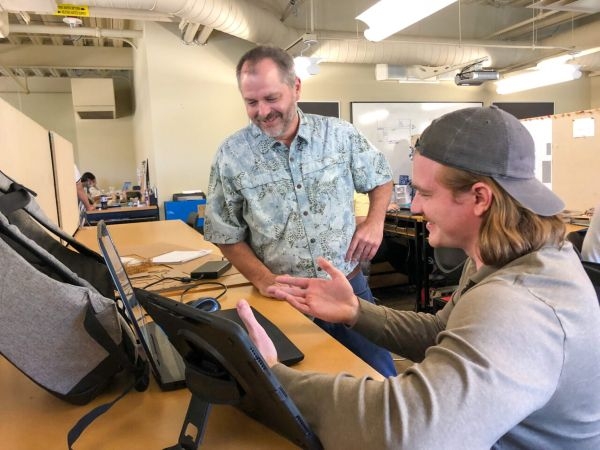
Sam Callahan (left) with Tyler Kohl in ARCH 4756 discussing a universally designed apartment complex in central Norman.
C: And then in education, it’s completely changed just since I’ve been teaching. I mean, I was first an adjunct in the mid-2000s. 2007 I think was when I first was an adjunct. And so, we were just beginning to introduce things like rendering software. And this is when Revit was just beginning to really kind of come on. Rhino was a little baby platform back then. And then, now we look at it now. And what’s weird or interesting in education now is that that pendulum has swung so far the other way, that now they’re beginning to think that, you know, particularly parametric design software has almost began to dominate too much of our design thinking.
And so now, it’s almost kind of interesting that my old world is beginning to re-infuse a little bit back into the design world. In that if we let Rhino do all the work for us, we get really innovative and maybe unique form-finding type of activities, but are they really human design? That’s really what we’re kind of encountering now, is that the computer is a computer and the human is the human. So how much can we begin to infuse humanity into the computer so that it can begin to do some of that work for us? And it’s scary in the profession, but I think it’s kind of innovative too.
K: I mean, it’s kind of like now trying to find a balance between using technology and hand drawing.
C: Yes, the tabletop and the desktop. I mean, we literally got rid of the tabletop for a while and only lived on the desktop. And now we’re beginning to find out that that humanness is really important to understanding design. So now it seems to be the thinking is, you know, refocusing a little bit on the tabletop before we move to the desktop in the design world, and I don’t think that that’s a bad thing.
I think, you know, you take somebody like Zaha Hadid, who is passed now, obviously, but she was really in that innovative front of how much do we turn over to the computer and how much do we leave inside of our brain as far as human creativity goes. She and people like Bjork Ingels and stuff have really begun to kind of blur that line. But I think it’s really kind of innovative. I’m really going to be curious to see where we go in the next decade.
I mean, think of things like parking, you know what I mean? Parking is going to completely change in your lifetime. You know, your generation is going to completely see a paradigm in the design thinking world. I mean, autonomous driving, electric vehicles, either cars park themselves, or vehicles are shared. So, our concept of what entry is, you know the big box with a big huge parking lot in front of it, thank God, is probably going to go away. We’re gonna see more and more buildings hopefully become more and more attached to the human as we begin to leave the vehicle behind.
I mean, think about it, particularly here in America, and in Oklahoma and Texas, we worship the vehicle. I mean, everything that we do relative to architecture somehow responds to the vehicle. I mean, they are more important than we are, you know. The parking lots dominate the fronts of everything that we experience in our daily life. I mean, look at that behind you, that doesn’t really exist in the real world, that much green space with just a drive to drop people off. Like the campus was originally designed at a time period where the average person didn’t have a vehicle. So, the car was rare and the campus was designed for people to walk around on because that’s the way the majority of people got around back then. So, it’s kind of interesting that what was the paradigm at the beginning of the century is going to be a paradigm again, probably at the end of this century.
K: Yeah, that is really interesting. How would you say that the changes in design methods and technology affected your own career and projects?
C: My firm was a consultant-based firm. So, we were hired consultants for both architectural firms and for the retail and real estate industries, and insurance. So, in my own life, particularly BIM technology, we really got to kind of ride the wave at the front of BIM technology. So, it influenced my firm because literally clients were pushing us to the front of the industry back then. It was very much a client-driven effort more so than an industry-driven effort to adopt the concept of BIM, the software platform that goes across all professions.
So, as I mentioned before, you know, that not only do you have the architects functioning in the same digital environment, but you have the mechanical, electrical, plumbing, interiors. Everybody’s supposed to be functioning in this modeling environment. And when I was in the middle of my firm life in the, you know, early 2000s, is right when that technology was coming along. It was very, very expensive back then. And luckily, I had very large clients at the time, like Nike and stuff that came to us and said, “Look, we really want to drive this technology, we want to be out in front of it.” And so, we were working constantly with Autodesk and with our clients and really trying to figure out how to get those technologies to communicate better, and when you look at them now versus just how clunky they were in the mid-2000s.
You know, credit number-crunching has come along, the computer that we’re sitting in front of right now. I mean, look at this, I’m coming to you at 60 frames per second. I mean, that’s amazing compared to where we were 25 years ago. And so, I got to see the industry change for better or for worse, I mean, we can have a discussion on whether it benefited the profession or not. But what was really interesting is that the resistance was inside the profession back then. And the people that were really trying to drive it were the clients. It really led to many of the mega-firms that we see now. The Gensler’s of the university, RTKL, and the Callison’s, are all people that I worked for back then. And the computer age has allowed them to just continue to just get huger and huger. And so, now we have this world of these mega-firms that can function. Again, we can argue about whether it’s beneficial or not. But it’s certainly a consequence of the computer age.
I don’t think that we could have these huge firms if it weren’t for that innovative technology of the mid-2000s that kind of dominates everything now. I mean, you’re a student now. I mean look at how much time you spend in front of the monitor on software, you know, just trying to make things look pretty, right. I mean, in the old days, we spent all that time rendering with markers and then had to be photographed and screened and printed and all this stuff. And what’s interesting is the amount of time that an individual spends on it really hasn’t changed that much. It’s just that the product is really all that’s changed. You’re spending time clipping and finding art and extruding masses and putting surfaces and rendering. I mean all of those things that you spend all that time making the computer do for you is really not that much different than we used to work with these, you know, in the old days.
K: So, even though the technology or methods and design have changed a lot, it’s still taking the same amount of time to work on.
C: I obviously have not run a firm for a while, but I’m willing to bet that the amount of work hours for a product have not really changed that much over the years. It’s just the tools that they’re using are really all that’s changed.
K: Okay, that makes sense. What would you say is the most valuable thing that you’ve learned at Gibbs college?
C: That learning is forever. You mentioned I’m working on my Ph.D. I’ll be 60 in five years; I’m 55 years old. And I still learn new things every single day. Both in the past, the present, and the future, you can’t learn it all. We are so fortunate to be in a profession that has such a big tent. I mean, there are so many places for people of all different kinds of creativity levels, all kinds of different personality types, all kinds of different focuses. I mean, it’s just an amazing profession. And I think what I’ve learned most about bouncing out of the Gibbs College and back into the Gibbs College.
I mean, if you think about it, I first walked through the doors of the College of Architecture in 1989. And that’s when I was convinced that I was going to go back and get my degree in architecture, left, went through the traditional career path, came swinging back as both professional participating in the PAB back then and as an adjunct, and then completely leaving my professional life behind and dedicating myself to education now and I wake up every day energized by something new that I’m gonna learn, whether it’s from my students, or from my research, or just preparing to teach students I learned things. So that’s probably what I could honestly say is an inexhaustible amount of stuff that I’m interested in learning, and it’s all available for you there at the call.
K: Thank you. What would you say is the most notable difference in the Division of architecture, now as a faculty member, compared to when you were students at Gibbs college?
C: One word, and it’s a word that’s a focus of both the university and the college. And that’s research. When I was in school we had one faculty member that had a Ph.D. in our entire program, and everybody else were professionals that either came back to teach or were practicing professionals and teaching at the same time. And the entire focus of the college back then was the profession. Producing graduates that could participate in the profession. And we had a very low graduation rate back then, you know, it’s still fairly low compared to other colleges. But it was much lower then because it was specifically meant to sharpen very specific pencils, to go out into the world and become professionals.
And so that’s what’s really changed a lot is that you see the level of education of the faculty members of the College of Architecture now is astronomically higher than it was back then. And that the college is really interested in producing well-rounded humans, and not just people to go participate in a specific area of architecture. So that’s the largest or the most amount of change that I’ve seen in the years that I’ve been involved with the college.
K: Thank you. Now, my next question is, what thoughts did you have about the field when joining? And how did your thoughts differ from reality?
C: I don’t know if we have enough time for that. I am not the typical practitioner. I’m not the typical member of our community. In architecture, I started my life thinking I was going to be a historian. And I guess I am a historian now, but I wanted to know about ancient history, specifically ancient cultural history and identity when I was a young man. I didn’t think I could be an architect. I thought that they were these kind of magical people. But what was interesting is at the same time, I wanted to be a historian. My practical life from the time I was 13 years old, I was working in construction. I was either in concrete fields or carpentry, framing, just general contracting, drafting, all that kind of stuff. I mean, I knew that the way I would probably earn a living as a young man was in construction, but my intellectual life was always I wanted to be a historian. And then I just decided that I could combine all those and give architecture a shot. So that’s when I went to school. I was late. I graduated or joined the profession very quickly, was kind of called out in my firm because of my construction knowledge.
And unfortunately, or fortunately, depending on how you look at it, a great deal of my career was kind of spent forensically proving or somehow helping indicate that an architect made a mistake, or erred in some way, or created a situation that needed to be resolved. And a lot of times, that’s what we were kind of hired for. So, in one sense I was kind of like the foil to the profession. At the same time, I’m kind of participating in it. And I’ve always been one that, I was kind of like Groucho Marx, I never really wanted to be a member of any club that would have me. So, I’ve always been kind of finding ways to work on the perimeters of the profession.
And I guess, back to the origin of your question, I think about how much I’ve changed or how much my approach has changed is that I really entered the profession, from the other side of the drafting table from the guys that were out there trying to make plans work in the field and build things. And then when I got into the field of architecture, I also was kind of dissatisfied with being slaved to a drafting table in the office. I missed being practical in my daily activities. And so, I’ve always kind of swung between construction and architecture and management, and now education, and unfortunately, I’m a master of none of those. I just kind of got my feet really wet in all of those areas. So, in that sense, I don’t know if that really answers your question. But I have had a very interesting relationship with architecture. I think it probably the best way to say it, is that everything from the guy I got yelled at, from the architect to the architect yelling at other people, to now yelling at students.
K: Well, thank you. That’s really interesting, though, you kind of found your own niche, and kind of worked around with different areas.
C: I did. I always kind of created my own box to get into. And I mean, even in our own college, now, I serve really kind of weird places. You know, I teach the survey history class, which history is my passion, I’ve always been really interested in that. That’s what my master’s and Ph.D. are related to. And then I’ve also taught classes that are all about our professional responsibilities for like safety and code and understanding basic design practices, to introducing our freshmen to our studio culture and what our college is like and what it means to be a designer, and how to think like a designer and how to unthink like you’ve done most of your life. So yeah, even now, I kind of don’t really fit into a singular category.
K: Thank you. Do you have any projects that you would want to share?
C: I have lots of anecdotal stories. I guess probably some of the most interesting projects, you know, and actually what kind of made me think of what we were just talking about. It’s a project I’ve talked to my students about was a project I was able to participate in, in Chengdu, China, a joint development between a Chinese company and a Hong Kong developer. They were developing this huge mall that was going to be this big multi-use project. They were going to have I think it was 10 decks, below-grade parking, and a multi-story mall. Then on top of this mall is a big office and a residential complex on top of this. And Apple computer was participating in this, and on this site that they were about to completely demo out for this building was originally a Chinese traditional temple. During the Communist Revolution, it had been converted to a Chinese traditional opera house. You know, which is better than what happened to many of the temples during Mao’s rise because a lot of those temples were destroyed as part of the communist detachment from religion.
But interestingly enough, this old building had been there. And they needed somebody who knew something about Chinese architecture and about modern architecture and about Apple computers standards for their stores. And so, I got hired to go check out this temple basically. And so, at the same time, they’re building this huge high rise and I have these pictures of where they dug 100 feet down into the ground, and they literally dug right around this temple complex. And they’re beginning to construct the underground parking garage. And there’s this little island in the middle of this site with this little Chinese temple that’s perched on it. And the deal that Apple Computer signed with the government there was that they would restore it and put their structure inside of it that way they wouldn’t be lost inside of the mall. So, this is a huge amount of money on Apple’s part, a great deal of coordination with the Chinese government, to try and get that figured out. And I guess relative to what we were talking about, is that modernity was tugging at the ancient world, that old temple that had been there since the 1700/1800s, and this kind of juxtaposition between these two worlds and to turn this old temple into an apple store, you know, with the paragon of modernity inside of it. And so, it was just really kind of an interesting project.
I worked on a similar project for Starbucks out there, where they had to convert a historic development there and they converted an old Hutong building into a coffee shop, into a Starbucks. So again, I think that that’s one of those things that we realize, no matter how modern we are and no matter where we are in this world. And when you talk about my age, and everything else, when I first traveled to China in the 90s, versus you take China now, nobody has changed more, nobody has responded more to the world than they have in good ways and in bad ways. That project, to me, just kind of encapsulates everything that we’re dealing with in our world right now. This tugging of the ancient, this tugging of the modern, and where they kind of clash or where they interrupt each other sometimes.
K: Yeah, that’s really interesting and I do think it really fits well into the topic, the evolution of Gibbs college, like how the division of architecture has changed, and there are new technologies.
C: When I first entered the college, we were at the end of the stadium. The entire College of Architecture was at the north end of Owen stadium. When we used to go to studio on Saturdays, literally the underside of the concrete bleachers was one of the ceilings of our studios. So, when we would go to work on studio on Saturday, literally the whole building would be jumping, you know, from everybody at the football games and stuff. And we’d have to get there early in the morning or we couldn’t get in or out of the college. Because back then, all of the entry into the stadium was from the east and the west side. So, we kind of dominated that more side. And then the athletic department took it over. And we moved to old Gould Hall. And then we moved out of old Gould. I mean, I graduated, but then old Gould Hall moved to where Sprout’s grocery store is now while they were renovating the building. And that’s when I started adjunct. And then I was there when we transitioned into the new Gould Hall.
So, I mean, I’ve literally seen us move from concrete bunkers underneath the stadium, to what we have now, you know, which is a $38 million measurably better building. That’s a whole story on its own. I mean, you talk about the evolution of the college, the effort that it took to get that building remodeled, and the absolute circuitous route that it took is a story all on its own, you know, because originally, the reagents did not want to approve a remodel for that building. President Boren is the one who really kind of pushed the remodel. And originally, that building was supposed to be remodeled for I think $18 million. That was like the max. I mean, they didn’t even want to give that much for the building. And then once they got into the building, and they found all of the nightmares that were inherent in that structure, it cost us $38 million to put that thing together. So yeah, I mean, even the way that it is now was quite a journey to get there.
K: That’s really interesting. Thanks so much for sharing with us today. Thanks again for listening to the Gibbs Spotlight. Tune in next time to hear more stories from the Gibbs College of Architecture.
Editor’s note: the interview has been edited and condensed for clarity.
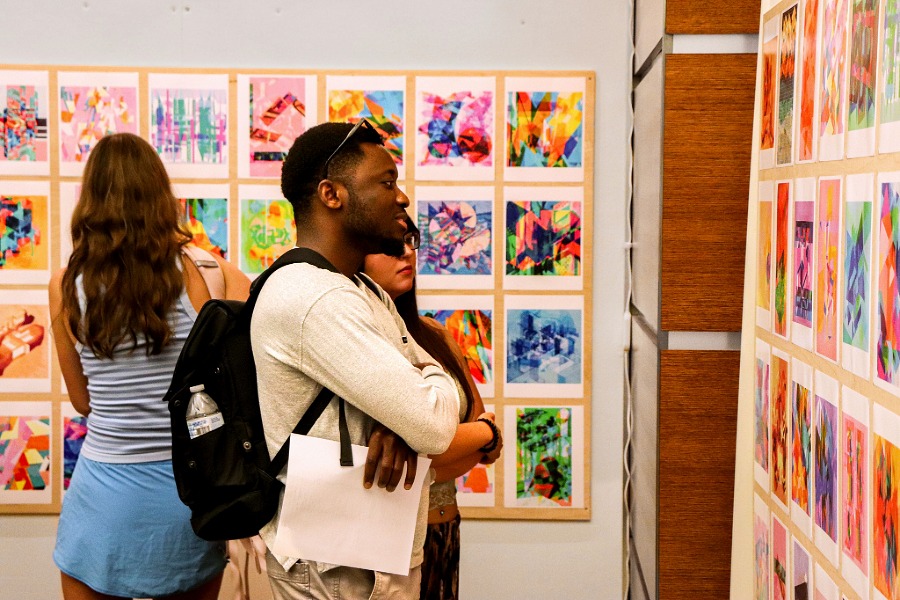
Gibbs College is pleased to present the exhibition 200 Digital Drawings by Professor Tiziana Proietti, currently on display in the Gould Hall Living Room.
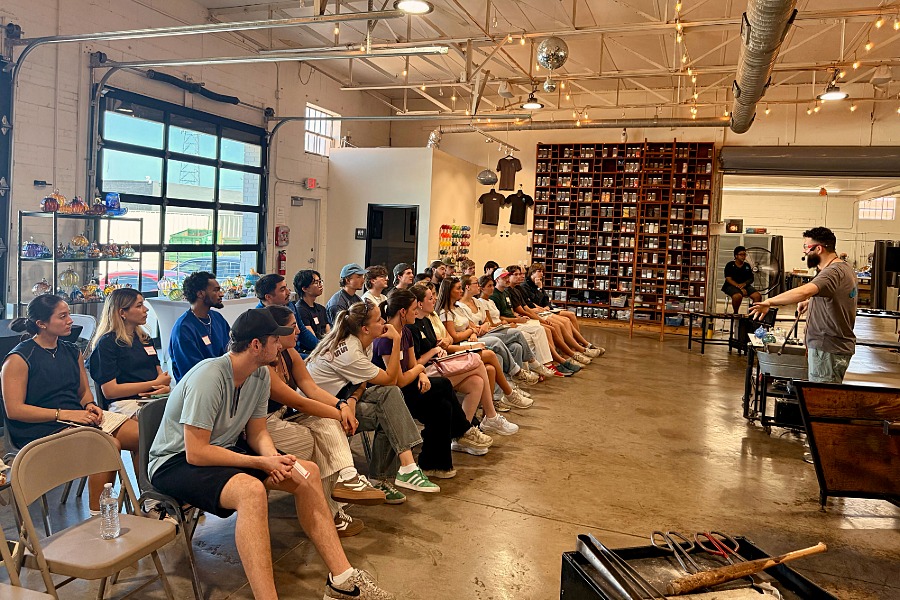
Gibbs College of Architecture Professors Amber Brown and Amy Leveno led 29 students to Dallas, Texas, in September for a learning experience as part of their Design 7 Studio course.
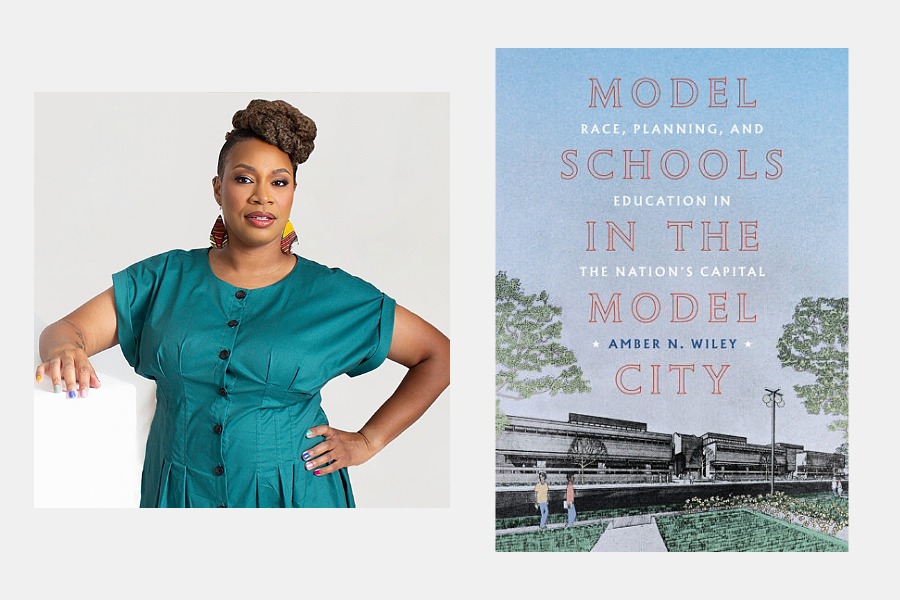
Christopher C. Gibbs College of Architecture professor and Institute for Quality Communities Director Dr. Amber N. Wiley’s book, Model Schools in the Model City: Race, Planning, and Education in the Nation’s Capital, has received two major honors from the Urban History Association.