Date
2nd Year Architecture students have recently completed an accessibility review of OU’s campus. Under the direction of Francesco Cianfarani, Ken Marold, and Dr. Shooka Motamedi, students completed a two-part project to explore the accessibility of campus as well as better understand the concepts of universal design. The studio also received help and materials from the Division of Interior Design, including Dr. Suchi Batthacharjee and Tony Cricchio. Sam Callahan also gave the studio a lecture on universal design.
The students first explored the campus using wheelchairs, walkers, and visual impairment glasses in order to understand the experience of accessing campus buildings when you have a disability. They also assessed whether buildings met the bare minimum of ADA requirements and whether those requirements resulted in an equal experience for able bodied and disabled users.
The studio students were surprised to find how difficult it is to access campus if you have different needs.
Noelle Zimmerer said, “Unfortunately most of the buildings on campus are not very accessible. A lot of them have these grand entrances with beautiful staircases, but the reality is staircases do not provide accessible entrances for those who are disabled.”
Students believe that the university needs to work to improve the level of accessibility on campus.
Breanna Walls, a student in the studio, said, “… despite meeting the basic ADA criteria, I think that the University could improve at designing spaces that are a single experience for all. For example, instead of putting a ramp off to the side of an entrance, incorporate the ramp with the stairs to make an exclusive experience”
After exploring campus buildings, each group of students was assigned a campus building to redesign the entry way for. While many campus buildings do have ramps that allow wheelchair users to access the building, these ramps are often on the side or back of the building while a large staircase is the only way to easily and quickly access the front. This is a violation of the ideals of universal design, which as student Breanna Walls describes aims, “to create a single experience for all.”
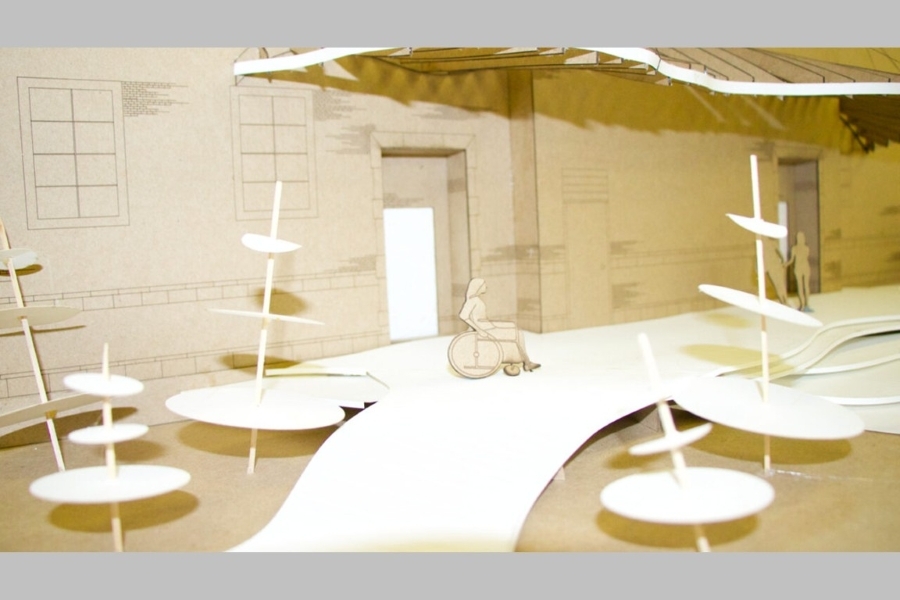
Students then redesigned the entryways for their assigned buildings in a way that created a universal, equal experience for all users.
Pictures of students’ models of redesigned campus building entrances.
The students that worked on this project learned a lot about universal design and ensuring that their designs include the needs of everyone.
Zoe Piper Smith wrote, “After doing this project, I have realized that designing for people with disabilities tends to feel like an afterthought; therefore, I want to design for everyone and create an experience that can be celebrated and appreciated by all people.”
Breanna Walls stated, “Lastly, I would like to further emphasize how important accessibility is to the daily lives of individuals with impairments. They are forced to encounter difficulties preforming everyday tasks, some of which might be rather simple tasks to others. That is why I believe that empathy is important in creating a built environment that complies with universal design.”
Noelle Zimmerer explained, “As architects we are tasked to design for people. If our designs don’t serve all types of people including those who may be disabled, then we have failed at our job. It’s our responsibility to ensure that everyone feels welcome in each of our designs.”
This studio project, like many others here at Gibbs, aims to educate a future generation of designers and architects that design projects for all users’ needs.
Gibbs College is pleased to present the exhibition 200 Digital Drawings by Professor Tiziana Proietti, currently on display in the Gould Hall Living Room.
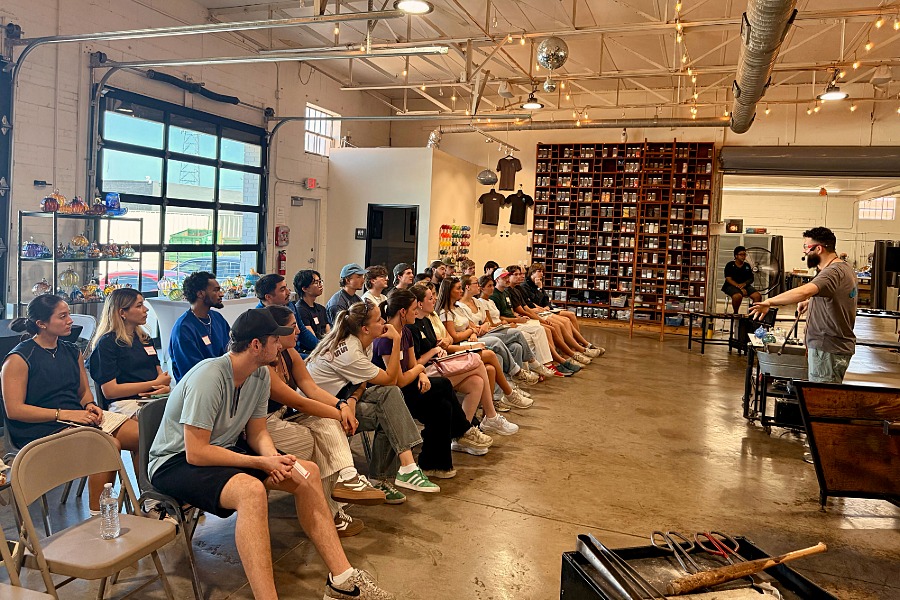
Gibbs College of Architecture Professors Amber Brown and Amy Leveno led 29 students to Dallas, Texas, in September for a learning experience as part of their Design 7 Studio course.
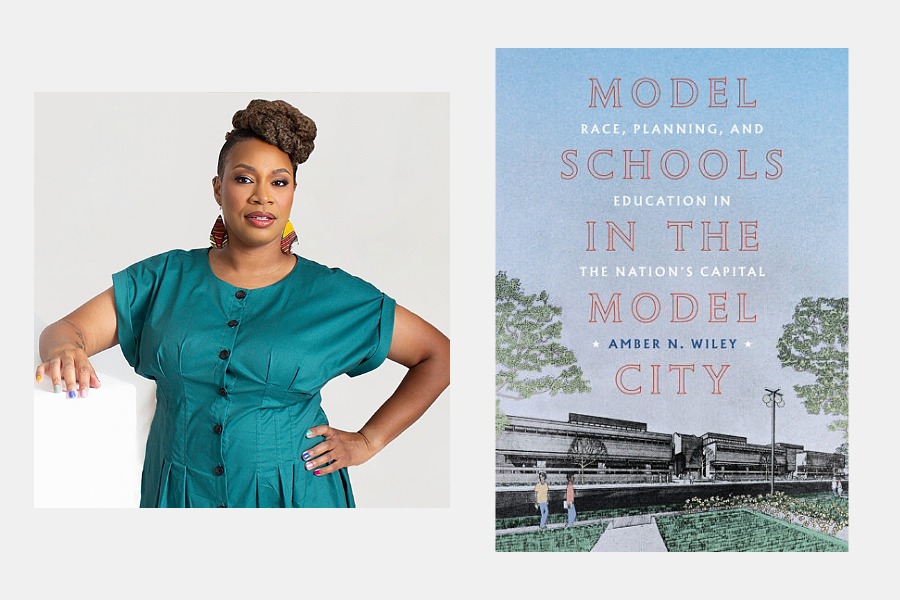
Christopher C. Gibbs College of Architecture professor and Institute for Quality Communities Director Dr. Amber N. Wiley’s book, Model Schools in the Model City: Race, Planning, and Education in the Nation’s Capital, has received two major honors from the Urban History Association.