Mickey Muennig
April 20, 1935 – June 10, 2021
George Kaye “Mickey” Muennig was born in Joplin, Missouri. Muennig transferred from Georgia Tech to the University of Oklahoma after seeing a travelling exhibition of Oklahoma student work. At Oklahoma, Muennig embraced organic architecture and the resourcefulness inspired by the work of Bruce Goff. He worked in Missouri and Colorado before moving to Big Sur, California in the 1970s. He became known for designs constructed from ordinary materials, structural innovation and connections to nature. He designed iconic buildings deeply rooted in the landscapes of the California coastline. His most notable works include: the Foulke House (1963; Joplin, Mo.); the Psyllos House (1988; Big Sur, Ca.); the Post Ranch Inn (1988; Big Sur, Ca.); Esalon Institute Baths (1998: Big Sur, Ca.); the Hawthorne Gallery (1995; Big Sur, Ca.) and the Pavey Residence (1998; Big Sur, Ca.). Muennig’s archives are held at the University of Oklahoma American School Archive, part of the Western History Collection of OU Libraries.
Words by Michelle Muennig, Mickey’s daughter
“Mickey Muennig passed away peacefully in his sleep on June 10, 2021. He was at home with his adopted granddaughter Nuan, whom he adored. He spent his last two years in Chiang Mai Thailand with his granddaughter and, the majority of the time, his son Peter. Although his health had been deteriorating significantly for some time, Peter believes they were some of his happiest years.
“Mickey was born ‘George Kay Muennig,’ but when his sister saw him in the hospital with his large ears, she exclaimed ‘He looks like Mickey Mouse!’, and the name stuck. Later in life, he was sometimes referred to as ‘The White Elf’ because of his abundant frizzy white hair, funny stance, and one raised eyebrow. Mickey was an anomaly. He had a sharp wit, didn’t say much, but could conjure a funny line from left field, just when you were certain he wasn’t listening. He resided somewhere deep inside of himself; in his own world. He attended college for a degree in aeronautics but stumbled upon architecture. For Mickey, his life seemed to happen this way. Architecture became his focus, passion, and it took precedence above everything. My childhood was spent driving across the country to see a Frank Lloyd Wright or Bruce Goff house in a snow blizzard while he drew floor plans in the condensation on the windshield, with my mother amidst a hysterical fit in the passenger’s seat for fear we would crash. I did a lot of praying.
“Mickey came to Big Sur in the early ’70s to take a workshop at Esalen and returned home to announce that we, his wife and two children, were moving to Big Sur California. My parents were convinced Esalen workshops would save their marriage, but as was destined to happen, it disintegrated, and they soon parted ways. His architecture became a legend both in Big Sur and around the world. It was innovative, original, and he often forgot to add a closet. You can feel him within his structures.”
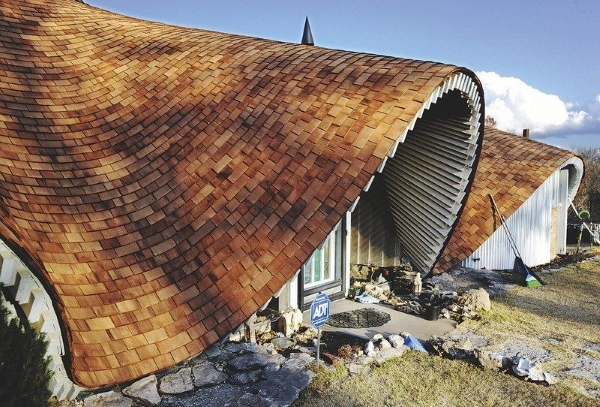
Mickey Muennig, Foulke House
Words by Herb Greene, Mickey’s professor at the University of Oklahoma
“I first met Mickey Muennig when he walked in late to one of my first design classes after I returned to teach at OU in 1958. It wasn’t long before I realized that he had incredible design talent. In contrast to his mild manner, he could be uncommonly forceful in thought and action. In addition to his courses at OU Mickey went to Bartlesville to study with Bruce Goff at his Price Tower studio.
“We became friendly and Mickey indulged my enthusiasm for Alfred North Whitehead. We also had young children about the same age. Mickey had studied architectural engineering at Georgia Tech and did much of the engineering for his early work, including the landmark Foulke house near Joplin, Missouri, where Mickey had lived before college.

Mickey Muennig with Herb Greene
“I believe we reconnected again in the late ’60s in Big Sur, on the California coast, where Mickey and his young family settled. Thus began Mickey’s brilliant career as the architectural guru of Big Sur. He first built a circular glassed-in conical-shaped structure resting on a low circular stone wall. I remember camping out on Mickey’s land in 1976, on a wood platform, and being awakened by the rooting of wild pigs.
“The Hawthorne Gallery on coastal Highway One and the Post Ranch Inn are two built projects that demonstrate Mickey’s genius. The latter with an earth-sod roof built into the ocean edge of the site with other units raised on pole supports, high enough so that the effect is to frame and enhance the views to the natural surroundings.
“Mickey, more than any architect I know, can make poetry with wood construction. His work in Big Sur is imbued with metaphors of aspiration, uplifting the human spirit and bringing us closer to a connection with nature. We will continue to remember him through the legacy he leaves behind as a remarkable architect and brilliant thinker.”
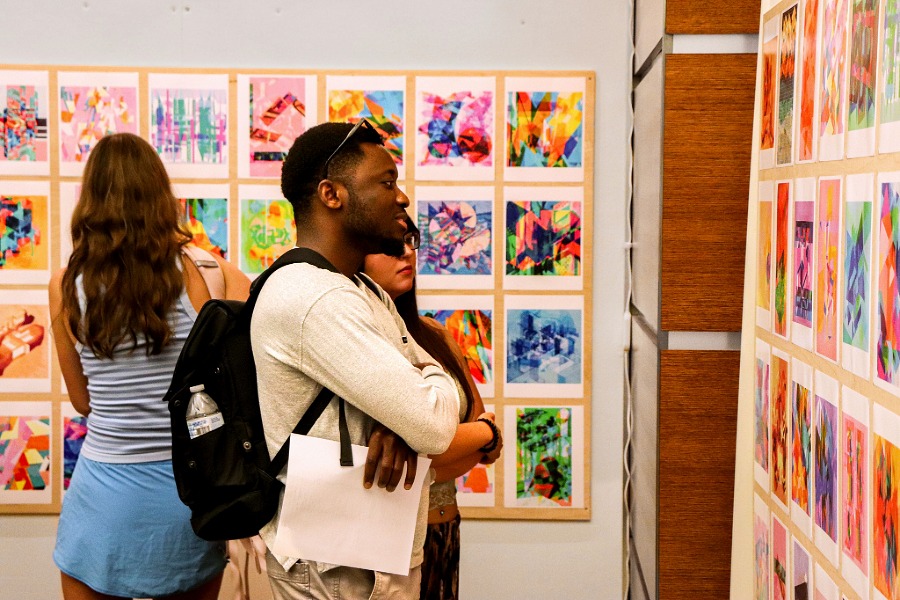
Gibbs College is pleased to present the exhibition 200 Digital Drawings by Professor Tiziana Proietti, currently on display in the Gould Hall Living Room.
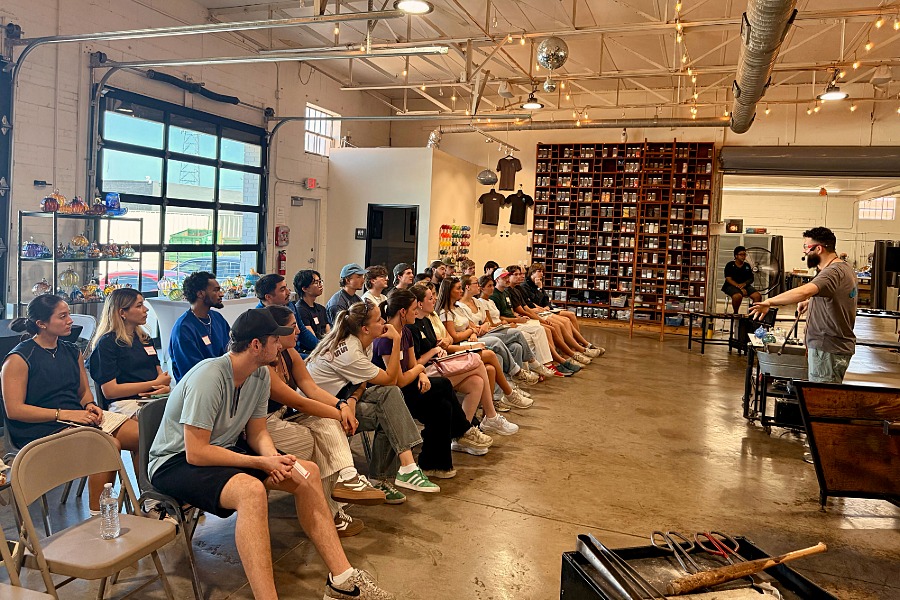
Gibbs College of Architecture Professors Amber Brown and Amy Leveno led 29 students to Dallas, Texas, in September for a learning experience as part of their Design 7 Studio course.
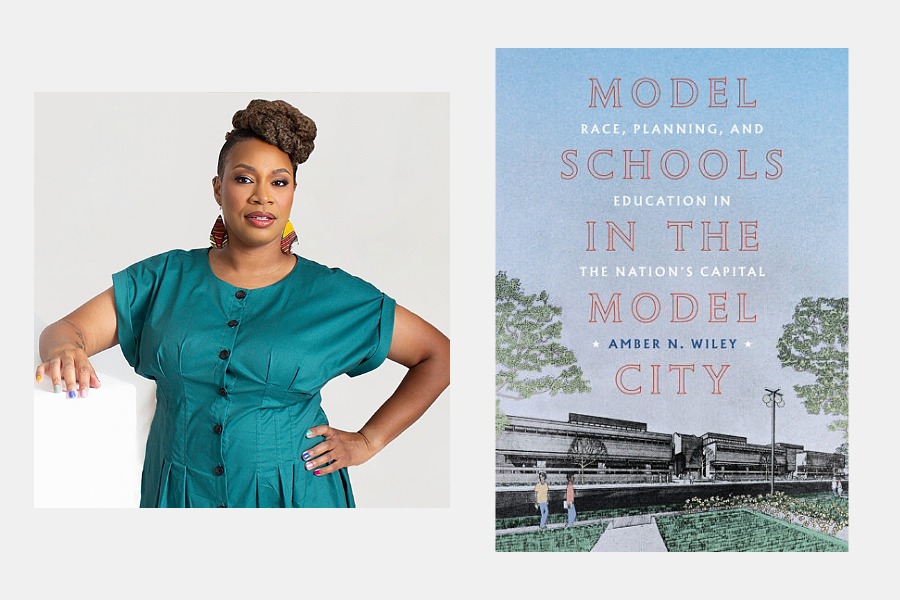
Christopher C. Gibbs College of Architecture professor and Institute for Quality Communities Director Dr. Amber N. Wiley’s book, Model Schools in the Model City: Race, Planning, and Education in the Nation’s Capital, has received two major honors from the Urban History Association.