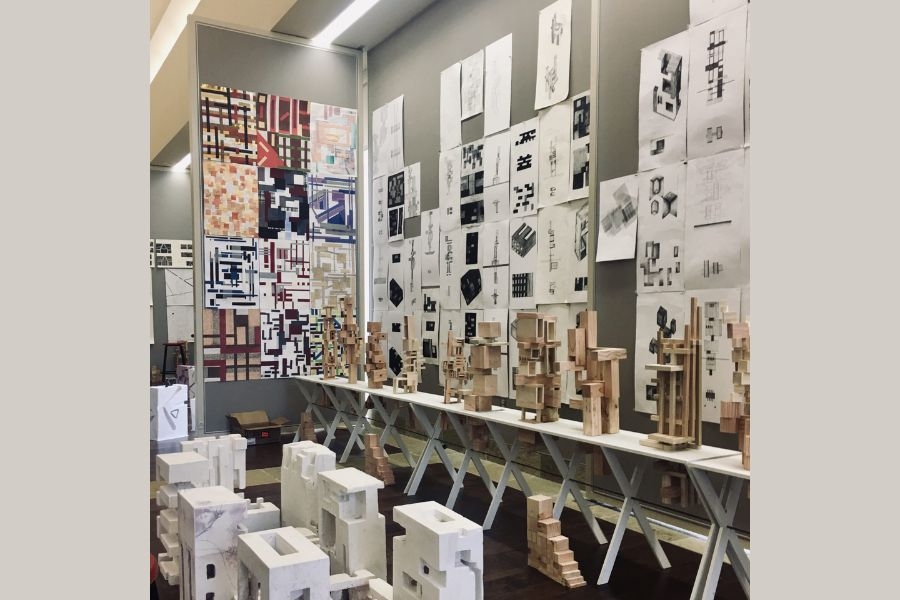
Using different materials to complete multiple projects involving wooden towers and hydrostone plaster, first-year architecture students in the Design II class taught by Profs. Dan Butko, Sam Callahan, Tiziana Proietti, Haley Cytacki, and Luca Guido have completed their mid-term projects.
For the wooden towers, students had to create vertical progression and an interdependency of the pieces involved.
“I gained a greater understanding of how to create a visual path of movement throughout the vertical progression of the tower,” said Emma Stapleton, a student in the class.
The students also gained an understanding of the importance and differences of mass and void.
“This project challenged me to see space as both mass and void, whereas before I was mainly focused on creating space strictly through the use of mass,” said Abby Janka, a student in the class. “This will be very useful moving forward in my education as now I am able to design with a more dynamic sense of space.”
In the hydrostone slab project, they were expected to show progression and movement through excavations and penetrations. Hydrostone is the strongest and hardest gypsum cement available, and is used primarily for tooling and high-quality art object applications. Prof. Butko discussed the voids in hydrostone with his students, encouraging them to consider the panels’ acoustic properties in the Gould Hall Buskuhl Gallery space.
The use of hydrostone was a new experience for the students as it allowed them to utilize new mediums.
“This was my first time working with hydrostone, so I learned a lot about its properties and how to create mold forms that were strong enough to hold the weight of the stone while pouring,” said Janka.
In addition to learning how to utilize new materials, students gained insight into creating visual paths.
“This project also utilized my previous knowledge from the tower about movement and progression in a model that creates a visual path,” said Stapleton.
The projects were on display in the Buskuhl Gallery in Gould Hall.
Construction Industry Speaker Series welcomed Stephen Evans from the Oklahoma City National Memorial & Museum to give a lecture on better conversations and relationship building.
The University of Oklahoma Christopher C. Gibbs College of Architecture Hall of Fame recognizes a select number of high-character individuals who have made a significant and lasting positive impact on Gibbs College, its students, staff, faculty, alumni and/or to communities across the globe. The impact may have been, or continues to be, in the form of service and mentorship, sustained professional excellence, and/or advancement and financial support. Joseph Edgar Smay is part of the 2025 Hall of Fame class.
Christopher C. Gibbs College of Architecture congratulates three architecture students who were recognized in the 2026 AIA Dallas Student Design Awards.