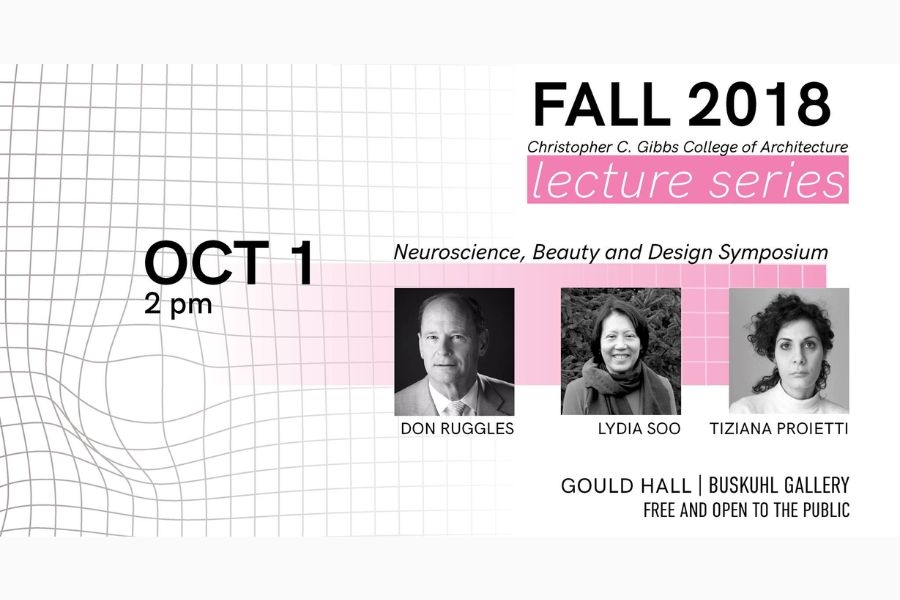
The Christopher C. Gibbs College of Architecture hosted the Neuroscience, Beauty and Design Symposium on October 1, 2018. The symposium was made possible by the Bruce Goff Chair of Creative Architecture.
The symposium brought together an exciting group of scholars and practitioners who work at the intersections of architectural history and theory and emerging understandings of geometry, proportion, neuroscience and well-being: Dr. Lydia Soo, Dr. Tiziana Proietti, and Mr. Don Ruggles.
Constructive Geometry and the Changing Concept of Beauty in Early Modern Architecture
Dr. Lydia Soo lectured on “Constructive Geometry and the Changing Concept of Beauty in Early Modern Architecture. Dr. Soo is associate professor emerita at the University of Michigan and a historian of architecture and architectural theory, specializing in the Early Modern period. Dr. Soo earned her PhD in Architecture from Princeton. In addition to her book on Christopher Wren’s architectural theory, Wren’s “Tracts” on Architecture and Other Writings, she has written articles examining specific problems of 17th century culture, theory, architecture, urbanism, and maps. Her recent publications concern pre-orientalist knowledge of buildings in the Levant and beyond as well as geometrical procedures in Italian Baroque design. Dr. Soo is completing a new book, The Places and Spaces of Architectural Discourse in Restoration London, examining architectural knowledge production and its physical context following the Great Fire. Dr. Soo
Proportion and the Seeing Mind: The Intelligibility of Architecture
Dr. Tiziana Proietti lectured on “Proportion and the Seeing Mind: the Intelligibility of Architecture.” Dr. Proietti is an architect and researcher, whose interests span the history and theory of architecture and industrial design and theories of proportion and phenomenology, as well as the anthropology of senses, neuro-aesthetics and sensorial design. Dr. Proietti earned her PhD from the University of Rome Sapienza. Dr. Proietti has authored several books, including Aesthetic principles in the work of Leon Battista Alberti and Hans van der Laan and the expressiveness of architectural space. Currently, she is researching the cognitive values of proportion by connecting neuroscience and architecture.
Timeless Patterns and Their Impact on Our Well-Being
Mr. Don Ruggles, AIA, lectured on “Timeless Patterns and Their Impact on Our Well-Being.” Mr Ruggles is president of Ruggles Mabe Studio, a boutique residential architecture and interior design firm based in Colorado. Founded in 1970, the firm is dedicated to the idea that beauty can improve the lives of its clients. Mr. Ruggles earned his Bachelor of Architecture degree from the University of Oklahoma. He is the founding president and current board member of the Institute of Classical Architecture and Art Rocky Mountain Chapter, and also serves on the Boards of Advisors for the Colorado University Denver College of Architecture and Planning and the Center of Advanced Research for Traditional Architecture. Mr. Ruggles is author of the book Beauty, Neuroscience, and Architecture: Timeless Patterns and Their Impact on Our Well-Being.
The symposium was moderated by, Dr. Stephanie Pilat, Director of the OU Division of Architecture. Dr. Pilat is a designer and architectural historian whose teaching and research examines points of intersection between politics and architecture. Dr. Pilat earned her PhD from the University of Michigan. She is the author of Reconstructing Italy: The Ina-Casa Neighborhoods of the Postwar Era, which tells the story of an Italian postwar housing program that activated the design and construction process for social aims. The book was awarded the 2015 Helen and Howard R. Marraro Prize for the best work on Italian history by the Society for Italian Historical Studies.
The moderated discussion covered such wide ranging topics as the role proportion and constructive geometry can play in guiding parametric design that yields wellness outcomes, sympathetic and parasympathetic responses as applied to architecture, and whether architects have a responsibility to create proportionate designs that have a neurological resonance.
Gibbs College is pleased to present the exhibition 200 Digital Drawings by Professor Tiziana Proietti, currently on display in the Gould Hall Living Room.
Gibbs College of Architecture Professors Amber Brown and Amy Leveno led 29 students to Dallas, Texas, in September for a learning experience as part of their Design 7 Studio course.
Christopher C. Gibbs College of Architecture professor and Institute for Quality Communities Director Dr. Amber N. Wiley’s book, Model Schools in the Model City: Race, Planning, and Education in the Nation’s Capital, has received two major honors from the Urban History Association.