Date
Architecture graduate student Tayana Ghosh has developed a new building material that combines mycelium fungus with glass. To understand the potential of this material, she has also conducted a series of compression tests.
She believes that a mycelium-glass composite could serve as an environmentally friendly material in built environments, as it requires less energy to manufacture than conventional building materials. To test this hypothesis, Ghosh’s research combines mycelium, a filiment fungus, with recycled fire-glass to make a composite brick unit.
“Mycelium is a natural adhesive material consisting of the vegetative part of a fungus,” Ghosh described. “Mycelium is a living organism and grows at room temperature, feeding on natural local feedstocks.” These feedstocks include dust and agricultural wastes such as wheat husks, corn stalks and more.
Mycelium do not require extra energy to perform the chemical reactions necessary to form a fibrous hardened block. Ghosh says that, “Nature shows time and again that everything around us happens at normal temperatures and does not need extra energy.”
Ghosh said this work is significant because “We face challenges everyday due to global warming and fast depletion of natural resources and fossil fuels.”
Ghosh’s research shows potential for the mycelium-glass material to be used for insulation boards or sandwich panels, instead of foams. As next steps, she recommends additional testing of the material, including its fire resistance and shear strength.
Ghosh is advised by Prof. Lee Fithian, with support from Profs. Marjorie Callahan and Shideh Shadravan, from the Division of Architecture. Her work was completed in the Christopher C. Gibbs College of Architecture’s Creating_Making Lab and the Gallogly College of Engineering’s Fears Lab at the University of Oklahoma.
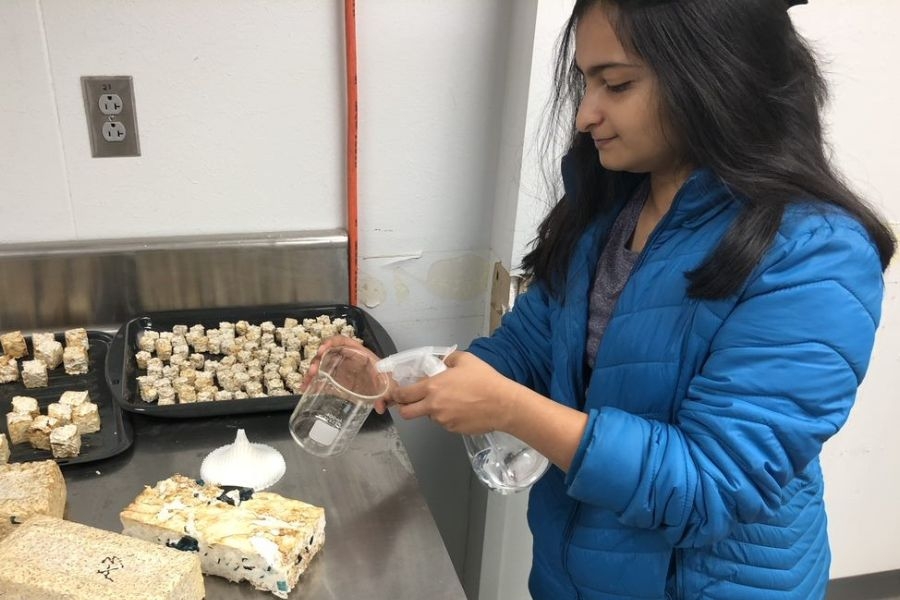
Featured image: Tayana Ghosh working with her mycelium-glass bricks in the lab.
Gibbs College is pleased to present the exhibition 200 Digital Drawings by Professor Tiziana Proietti, currently on display in the Gould Hall Living Room.
Gibbs College of Architecture Professors Amber Brown and Amy Leveno led 29 students to Dallas, Texas, in September for a learning experience as part of their Design 7 Studio course.
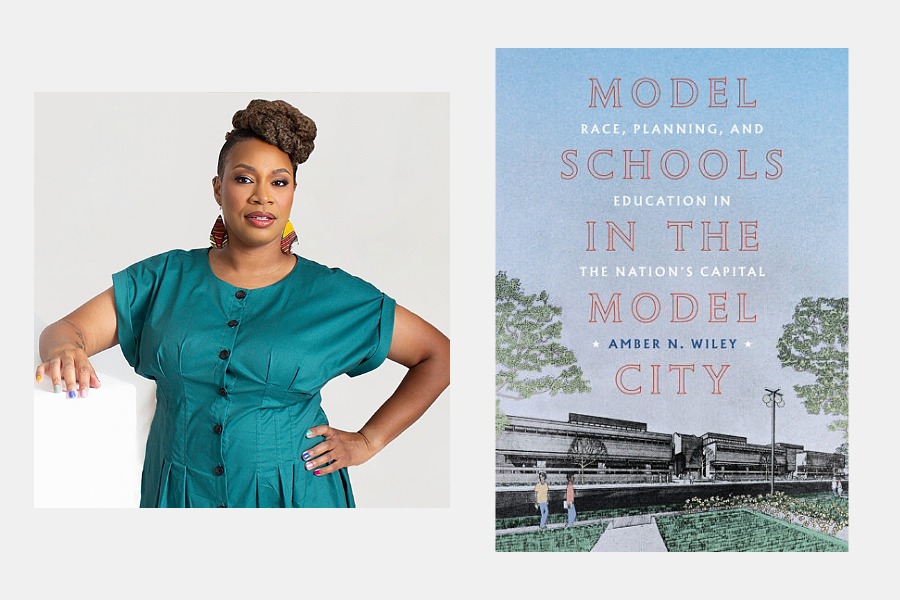
Christopher C. Gibbs College of Architecture professor and Institute for Quality Communities Director Dr. Amber N. Wiley’s book, Model Schools in the Model City: Race, Planning, and Education in the Nation’s Capital, has received two major honors from the Urban History Association.