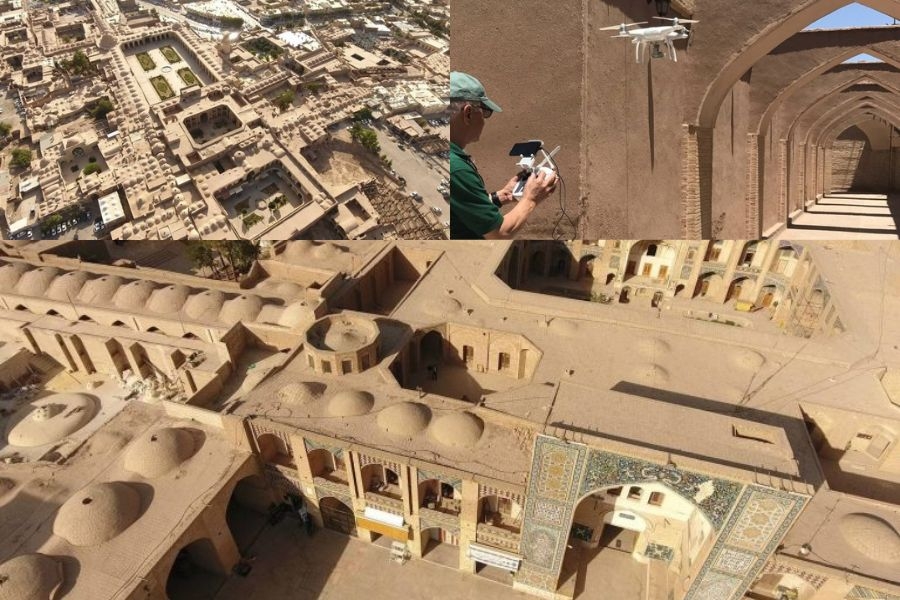
In July 2018, Dr. Khosrow Bozorgi began his research on and documentation of the Ganjali Khan complex, located in the desert city of Kerman, Iran. The Ganjali Khan complex was built in the 15th century from clay and mud bricks, typifying the millennia-old architectural tradition of the region. The massive structure consists of bazaars, baths, mosques, other public and private buildings, courtyards of various sizes, and connecting paths. Dr. Bozorgi used a drone to document the inside and outside of the complex and has recorded 19,000 square meters of the complex thus far; the data will be used to create the complex’s first plan layout. Dr. Bozorgi’s results will be exhibited by the Christopher C. Gibbs College of Architecture’s Center for Middle Eastern Architecture and Culture (CMEAC) in the coming semesters.
All images are property of Dr. Khosrow Bozorgi and CMEAC.
Construction Industry Speaker Series welcomed Stephen Evans from the Oklahoma City National Memorial & Museum to give a lecture on better conversations and relationship building.
The University of Oklahoma Christopher C. Gibbs College of Architecture Hall of Fame recognizes a select number of high-character individuals who have made a significant and lasting positive impact on Gibbs College, its students, staff, faculty, alumni and/or to communities across the globe. The impact may have been, or continues to be, in the form of service and mentorship, sustained professional excellence, and/or advancement and financial support. Joseph Edgar Smay is part of the 2025 Hall of Fame class.
Christopher C. Gibbs College of Architecture congratulates three architecture students who were recognized in the 2026 AIA Dallas Student Design Awards.