For the first time in its history, the U.S. Department of Energy-sponsored Solar Decathlon was held in Denver, Colorado, which made for a compelling weekend road-trip from Norman. The Decathlon is scored across 10 contests: Architecture, Market Potential, Engineering, Communications, Innovation, Water, Health and Comfort, Appliances, Home Life and Energy. The Solar Decathalon has been held every two years since 2002, primarily on the National Mall in Washington, D.C., and in California.
Eleven teams completed Solar Decathlon homes, bringing them to Denver from across the United States and around the world. This year’s winner was the Swiss Team, made up of a consortium of four universities, including the École Polytechnique Fédérale de Lausanne, the School of Engineering and Architecture (Fribourg), the Geneva University of Art and Design, and the University of Fribourg.
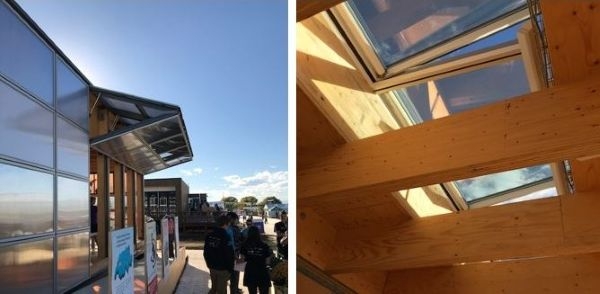
Images from Prof. Fithian's visit to the Solar Decathlon.
When reflecting on my experience at the 2017 Solar Decathlon, of considerable was the Swiss Team, especially the fact that their design was the highest cost per square foot of any of the homes. Not coincidentally, the Swiss Team received the lowest score on the Market Potential component of the contest. While the Market Potential piece of the contest attempts to regulate cost issues, it is apparent that future Solar Decathlons need to mandate more stringent and holistic cost constraints if these houses are to succeed in the market transformation for which the U.S. Department of Energy created the contest.
In the end, several teams failed to generate enough power to score any points in the Energy category, and it became clear that the Swiss Team had experiential advantages. The second place team from the University of Maryland also came to the competition with the advantage of past experience, as they have participated in several Solar Decathlons, winning first place in 2011. The finish-level of their home integrated sunspace, and excellent water capture and wastewater recycling gave their team top scores in the Innovation and Water categories.

Additional images from Prof. Fithian's visit to the Solar Decathlon.
The logistics associated with the development and construction of all of the elements that lead to a viable Solar Decathlon entry have prevented qualifiers, such as Yale, from completing the competition. Kudos, therefore, go out to last-place Team Daytona Beach, who arrived to Denver with a complete entry despite suffering damage due to Hurricane Irma. Once in Denver, the local climate brought with it its own excitement and challenges, as many teams were also at a loss regarding what to do about an impending winter storm that shut down the competition for several days due to safety concerns.
Attending the Solar Decathlon in person is a revelation. Studying drawings, video, and photographs from afar gives the sense that the entries are close to perfect. The reality of the onsite build and adaptation to site conditions shows that transport and assembly issues are considerable factors in the realization of the entries.
By Lee Fithian, Associate Professor of Architecture.
Christopher C. Gibbs College of Architecture is proud to announce the promotion of Ph.D. student Rafael Hernandez to lieutenant colonel in the U.S. Army Reserve.
Gibbs College of Architecture Assistant Professor Dr. Ladan Mozaffarian, in the Division of Planning, Landscape Architecture and Design, has co-authored a new book chapter with Josh Newton and Andrew Born, published in De Gruyter Handbook of the Geographies of Race.
Planning, Landscape Architecture, and Design (PLAD) alumni Trey Ingram, AICP recently spoke with current PLAD student and graduate media assistant Molly Strobel to share his experiences with the Regional and City Planning program and current work with the Toyota Mobility Foundation.