
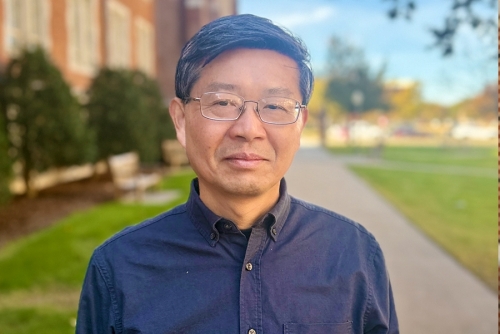
Rui Yang, Ph.D., professor in the School of Electrical and Computer Engineering, is leading pioneering work on mid-infrared interband cascade lasers (ICLs) - compact, energy-efficient light sources with wide-ranging real-world applications. By developing an innovative approach, his team has demonstrated ICLs with improved device performance in a wide range of emission wavelengths from below 3 μm to beyond 14 μm and achieved the lowest threshold input power density near 3.3 μm among mid-infrared semiconductor lasers, which altered the long-held optimal wavelength of ICLs.
"Mid-infrared lasers can detect and measure trace gases with remarkable sensitivity," said Yang. "They're useful for chemical sensing, greenhouse gas monitoring, leak detection, food safety, medical diagnostics, and industrial process control."
Yang’s research spans a wide range of multidisciplinary areas, from materials science, semiconductor physics and devices to quantum engineering, photonics, and their practical applications. His group works closely with Professor and Chair of Engineering Physics, Michael Santos, as well as researchers at Sandia National Laboratories and other partner institutions. Their research has evolved from theoretical concepts to material growth and high-performance functional devices.
Yang and his team are advancing both the fundamental understanding and device performance of ICLs while working to reduce manufacturing costs, paving the way for mass adoption and commercial deployment of these powerful laser technologies.
“We expect our research to generate significant impact and result in useful practical applications,” said Yang. “At the same time, we are committed to answering fundamental scientific questions and tackling the challenges that arise as we explore the unknown.”
For more information about Dr. Yang’s work:
