
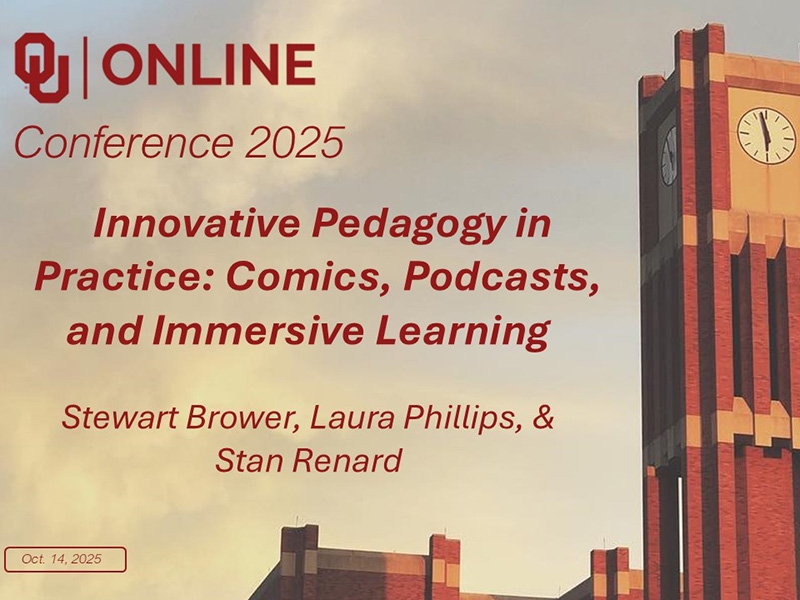
Dr. Laura Phillips presented in a panel entitled Innovative Pedagogy in Practice: Comics, Podcasts, and Immersive Learning.
Her talk shared an engaging assignment she is using in MST 5403, Museums and Indigenous Cultures, at the OU Online conference on October 14, 2025. Her session looked at using the concept of ‘pecha kucha’ (Japanese for chit chat) to create engaging student led presentations and discussions in an online asynchronous format. This assignment demonstrates participatory teaching methods, as espoused by David Kolb’s learning theories, especially around learning retention.
Students connect weekly readings to Indigenous led exhibits, media, and community perspectives, fostering dialogue beyond theory to create presentations that inspire meaningful small group discussions. The format encourages creativity, peer exchange, and respect for Indigenous voices, while deepening critical engagement with course themes.
The course description is as follows:
MST 5403 Museums & Indigenous Communities
This course helps students to challenge and dismantle ongoing structures of colonialism inherited in museums to understand relationships between museums and Indigenous Nations. The content is equally relevant to students interested in libraries, archives and galleries [GLAM]. We will draw on resources found in a variety of media, critical resources and experiential learning opportunities. We will engage our unique positionalities to find ways to work towards futures that center the needs of Indigenous Nations. We will look at how our work in the GLAM sector can challenge (rather than perpetuate) colonialism, colonial violence, and ongoing attempts at Indigenous erasure.
We will investigate museums as enacting ‘scopophilic’ desires, as explained by Metis scholar, artist, curator David Garneau (2016):
The colonial attitude is characterized not only by scopophilia, a drive to look, but also an urge to penetrate, to traverse, to know, to translate, to own and exploit.
The attitude assumes that everything should be accessible to those with the means and will to access them; everything is ultimately comprehensible, a potential commodity, resource, or salvage.
The academic branch of the enterprise collects and analyses the experiences and things of others; it transforms story into text and objects-in-relation into artifacts to be catalogued and stored or displayed. (23)
Scopophilia names the actual practice that museums are founded on, and continue to enact daily – seeing these actions defined, as a condition, affliction or affectation helps us to understand where so many museums find themselves today - storage facilities jammed with countless (and repetitive) examples of objects, specimen, belongings. Scopophilic desires are very strongly tied to the ordering, naming and structuring that the Euro- Enlightenment way of seeing the world promotes.
This course will focus on moving beyond this foundation to understand new ways forward, with emphasis on using the words shared by Indigenous scholars, curators, artists and other cultural mediators.
The activities, content, and assignments in this course will guide your learning process to ensure you can:
Students will develop and deliver a concise, engaging presentation (Pecha Kucha or podcast discussion) that integrates visual and/or audio materials with clear oral explanation.
Students will use appropriate references, avoid harmful or offensive content, and present Indigenous perspectives and museum practices with cultural awareness and ethical responsibility.
The Assignment:
This assignment adds audio / visual illustrations of the weekly content, themes and readings and gives students the opportunity to bring in specific content that is of interest to them or that students want to learn about in more detail (for example, an exhibit that is mentioned in the text, or a contemporary exhibit that touches on similar themes).
Podcasts, exhibits, blogs, social media, you tube content – all of these formats present contemporary and current discussions that include perspectives formed outside of academic realms. These are important sources of the societal contexts that are important additions to the topics discussed in this course.
Option 1: a 5 minute “Pecha Kucha” presentation
For our purposes, I define this as 3-5 slides that show ONLY visuals (a current exhibit, art, anything at all relating to the Indigenous communities, Nations and their engagement with museums, archives) that relate to the weekly theme/ readings. This can illustrate something mentioned in the readings - for example, an exhibition, event, artist, etc.
OR
Option 2: Play a 3-5 minute clip from a podcast or youtube video/movie etc.
In addition to the clip you play, include a 3-5 minute discussion to share a brief explanation of how the clip relates to the weekly theme/readings.
Additional important points to note about this assignment:
The rubric for this assignment assesses the depth of their research, their choice of visuals, the level of engagement with course themes, respectful representation and cultural sensitivities, clarity of narrative and the overall formatting and style of the presentation.
References:
https://practicalpie.com/david-kolb/
https://practicalpie.com/experiential-learning-definition-examples/
Garneau, David. 2016. “Imaginary Spaces of Conciliation and Reconciliation: Art, Curation, and Healing.” In Arts of Engagement: Taking Aesthetic Action In and Beyond the Truth and Reconciliation Commission of Canada, edited by Dylan Robinson and Keavy Martin. Wilfred Laurier University Press.
