
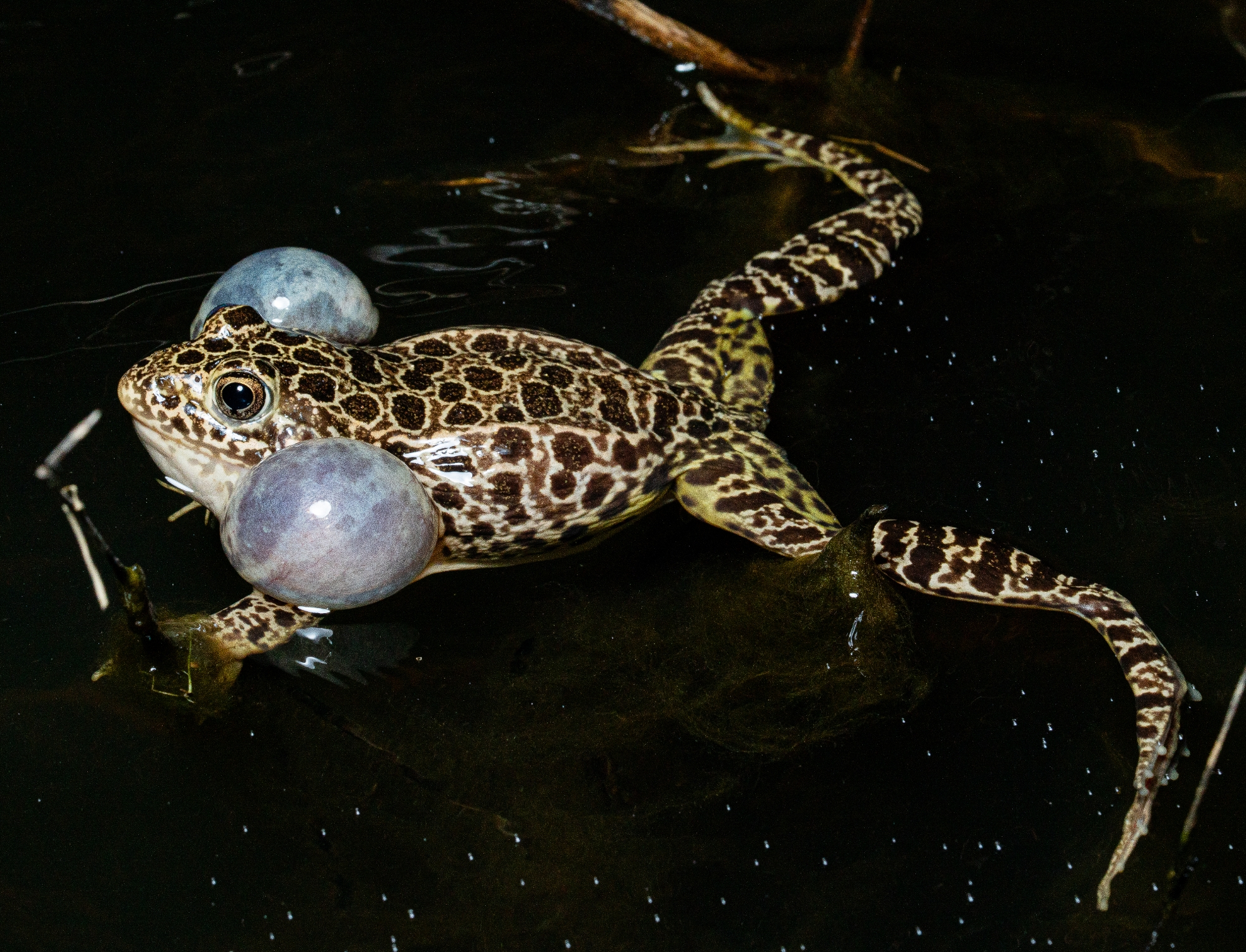
Date: 2023-2025
Primary Contact: Owen Edwards
Research Location: Atoka Public Hunting Area
Abstract
The Crawfish Frog (Rana areolata) is an ecologically unique species endemic to the U.S. and is undergoing population declines throughout many parts of its historical range. Despite conservation concerns and recent research efforts, more information about the population characteristics and details of the breeding biology of this species throughout its range is needed. We present data from a 2-y mark-recapture study conducted at a breeding pond in southeastern Oklahoma, USA, to assess R. areolata population dynamics (including breeding population size, sex ratio, body size, and directional movements), environmental variables that may influence adult immigration and emigration during the breeding season, and the abundances of other amphibian and reptile species at a breeding pond used by R. areolata. We found that population size and sex ratio fluctuated between years, and directional movements into and out of our breeding pond were random, even though some parts of our pond were situated by open prairie and other parts by forest habitats. We also found that daily rainfall and minimum temperature affected arrival to the breeding pond for males but not females, and daily rainfall and maximum temperature only affected emigration when not accounting for sex. Over the duration of the study, we captured 1,989 individual amphibians and reptiles from 17 species (nine anurans, one caudate, four squamates, and three turtles). This study contributes essential baseline data on R. areolata population dynamics in Oklahoma and emphasizes the importance of detailed, site-specific monitoring to complement broader conservation efforts.
Read the full publication here
