
3 credit hours | Spring Semester
This course explores nature-based solutions (NBS) - strategies inspired by nature to protect, manage, and restore ecosystems for environmental sustainability and societal benefit. Students will gain a foundational understanding of NBS concepts and ecological engineering practices, with a focus on water resource applications.
Course Format: Lectures, case studies, site visits, guest speakers, and collaborative projects examining real-world challenges and solutions related to:
Key Topics: Erosion, contamination, nutrient loading, biodiversity loss, and flooding
Applied Practices: Floodplain restoration, coastal protection, habitat enhancement, and regenerative agriculture
This course emphasizes working with nature to design resilient, sustainable systems.
3 credit hours | Fall Semester
This course introduces students to the use of small unmanned aerial systems (sUAS)—commonly known as drones—for capturing high-resolution aerial imagery to support water resource planning and management. Students will gain hands-on experience in the full workflow of remote sensing and GIS mapping, from drone operation to digital map creation.
The course emphasizes practical applications in watershed planning, with a focus on safety, technique, and data analysis.
Course Format:
Lectures, field training, and computer-based lab sessions
Key Topics & Skills:
By the end of the course, students will be equipped to take the FAA Part 107 Certified Remote Pilot test (non-OU affiliated, if desired by the student) and able to collect, process, and apply geospatial data to real-world environmental challenges.
3 credit hours | Fall Semester (Odd Years)
This is an advanced undergraduate and graduate level course which explores applied environmental biology, microbiology, ecology, and toxicology. In this course, students will examine the biological and ecological foundations of the multidisciplinary fields of environmental science and engineering.
Course Format: lecture roughly evenly divided into presentation of new material, discussion, and individual and/or team activities; weekly laboratory (field and indoor components) with work in small groups
Key topics: biological consequences of environmental impacts; mitigation of environmental impacts via biogeochemical, ecological, and microbial processes.
Objectives:
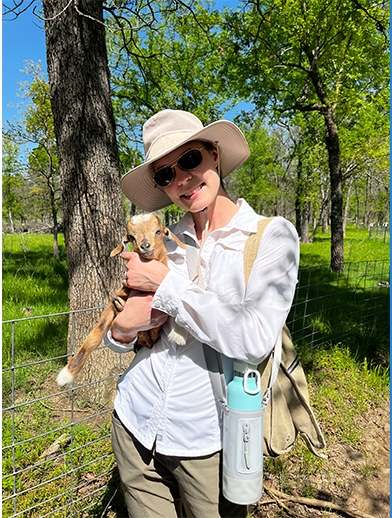
Lori Han, Ph.D., holding a baby goat during an NBS course field trip.
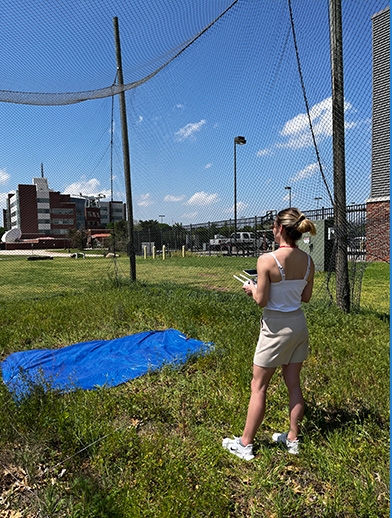
Lori Han, Ph.D., flying a sUAS (drone).
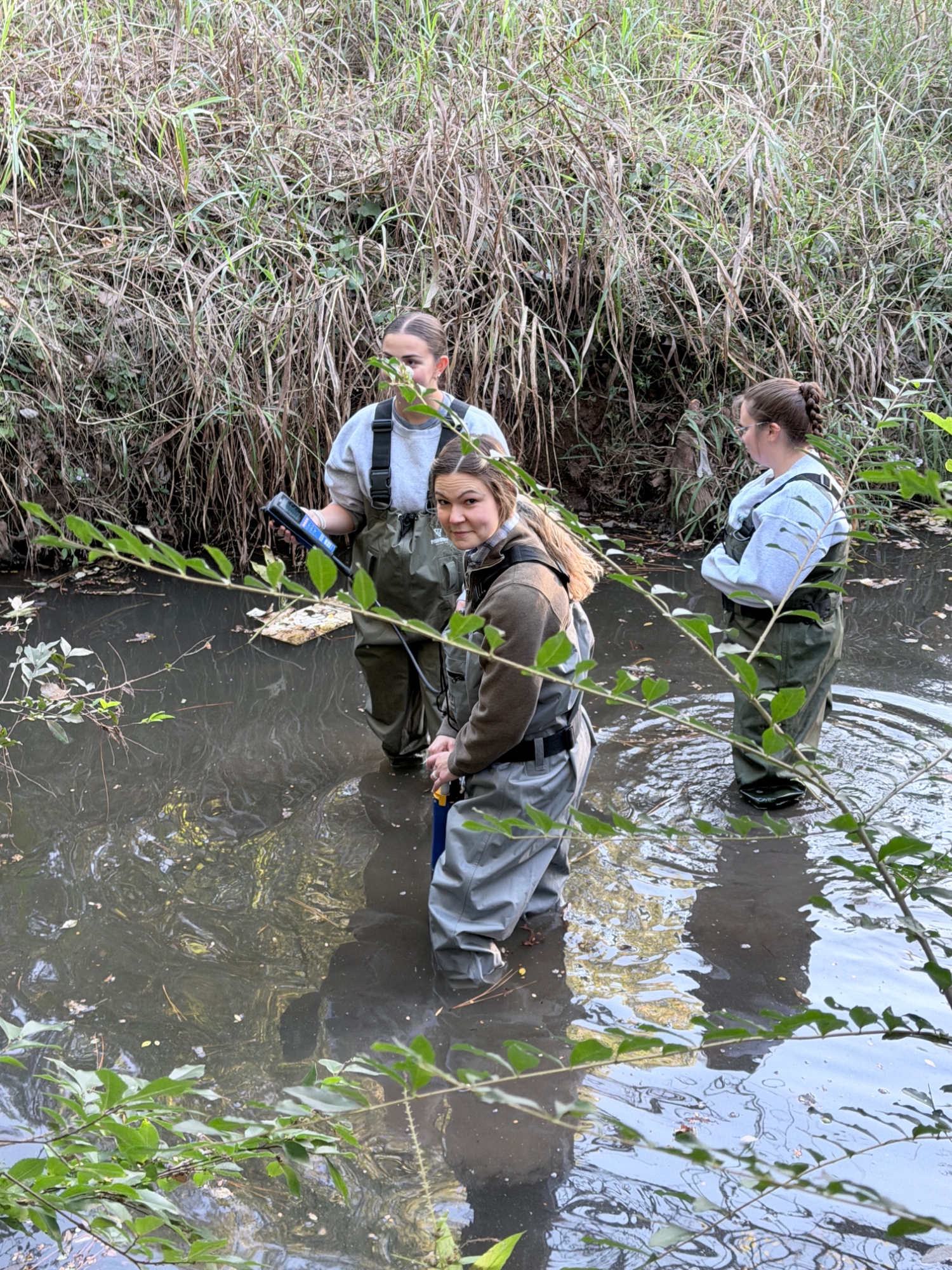
Lori Han, Ph.D., collecting water quality data with two students.
1–2 credit hours | Spring and Fall Semesters
This course guides students through the development of an annotated bibliography on a graduate-level research topic selected in collaboration with the instructor. The bibliography is conducted adjacent to the student’s thesis or research work.
1 credit hour = 25 annotated sources
2 credit hours = 50 annotated sources
Students will engage in critical reading, synthesis, and documentation of scholarly literature relevant to their field of study.
3 credit hours | Spring or Fall Semester
This course offers undergraduate students in the Honors College the opportunity to engage in independent research under faculty mentorship. Students will explore a topic of mutual interest with their instructor, culminating in the completion of an honors thesis.
The course emphasizes critical thinking, research design, and scholarly writing, providing a strong foundation for future academic or professional pursuits.
