NEWS


NORMAN, OKLA. – A study recently published in the journal Nature Astronomy upends conventional wisdom regarding the formation and stability of pairs of orbiting objects in the Kuiper Belt beyond the planet Neptune.
“Nearly a third of all objects in the Kuiper Belt orbit one another, similar to the way the Earth and Moon interact,” said Hunter Campbell, lead author and 2023 graduate of the University of Oklahoma, where the research was conducted. “However, in one region of the Kuiper Belt, this population of co-orbiting objects are roughly equal in mass. This would be like an Earth orbiting another Earth – which doesn’t normally happen in our solar system. Of these, a small number are really widely separated, which causes a great deal of instability.”
The existence, formation, history and evolution of these co-orbiting, widely separated objects have been the subject of past research. Many previous studies have hypothesized that collisions from meteorites and other foreign bodies disrupt the orbits of paired bodies and cause one of them to get knocked away. Using the OU Supercomputing Center for Education and Research, Campbell’s team, which also included former OU professor Nathan Kaib and OU graduate teaching assistant Kalee Anderson, was able to demonstrate a different hypothesis.
“We analyzed a variety of models in our simulation and have been able to demonstrate that gravitational interactions are an equal, if not stronger, factor in the long-term stability of these objects. So, instead of having a meteorite collision causing disruption, it’s more likely that a really large Kuiper Belt body would pass through the binary system and its gravity would pull one object away from the other,” he said.
Before this research, it was assumed that these widely separated bodies formed as they are now and simply survived the solar system’s four-billion-year history. Now, Campbell’s team has shown that the co-orbiting systems could have started with much tighter rotations and widened thanks to the gravitational pull of large passing bodies.
“The most widely separated binary ever observed, QW322, is very unstable. We believe it formed as a much tighter binary and gradually widened. Perhaps in the future, it will completely separate and will be replaced by another widening binary,” he said.
These simulations are the first step in making potentially important future discoveries.
“If we were to do more research, we could pin down a lot of things we don’t know – like how the Kuiper Belt migrated to its current position and how that migration impacted how the outer planets of Jupiter, Saturn, Uranus and Neptune moved throughout history. Simply put, this research opens up a lot of new possibilities.”
About the project
“A Non-Primordial Origin for the Widest Binaries in the Kuiper Belt” is published in the journal Nature Astronomy, manuscript no. NATASTRON-23080752, DOI no. 10.1038/s41550-024-02388-4. Campbell graduated from the University of Oklahoma in 2023 with a doctorate in physics and is now a simulation engineer for Axiom Space in Houston, TX. Kaib is a former associate professor of astrophysics and cosmology at the OU Dodge Family College of Arts and Sciences who now works at the Planetary Science Institute in Tucson, AZ. This project was conducted while both were at the University of Oklahoma and was supported by Emerging Worlds grants no. 80NSSC18K0600 and 80NSSC23K0868 from the U.S. National Aeronautics and Space Administration.
About the University of Oklahoma
Founded in 1890, the University of Oklahoma is a public research university located in Norman, Oklahoma. As the state’s flagship university, OU serves the educational, cultural, economic and health care needs of the state, region and nation. For more information about the university, visit www.ou.edu.
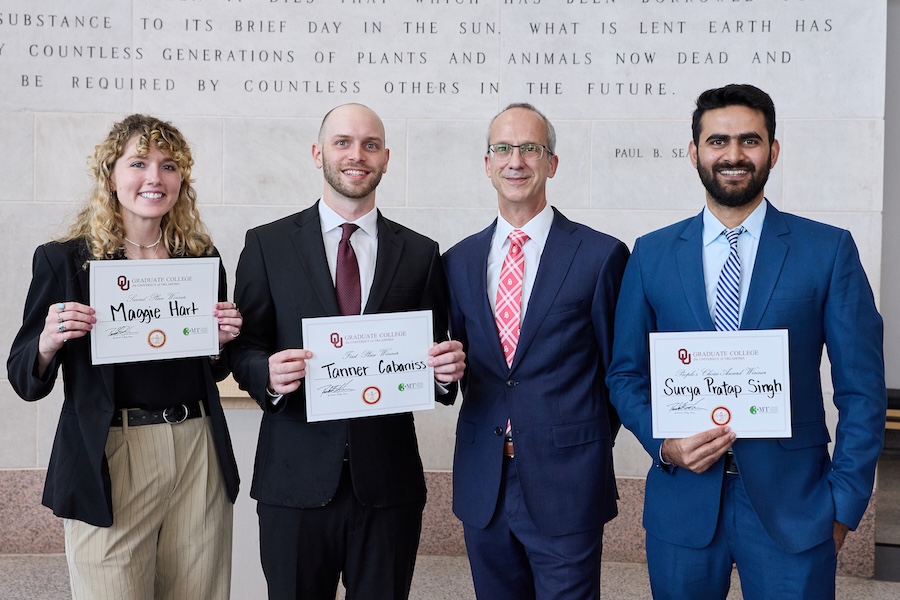
Three University of Oklahoma graduate students have been named winners of the 2025 Three Minute Thesis competition, which challenges participants to explain their research in three minutes to a non-specialist audience.
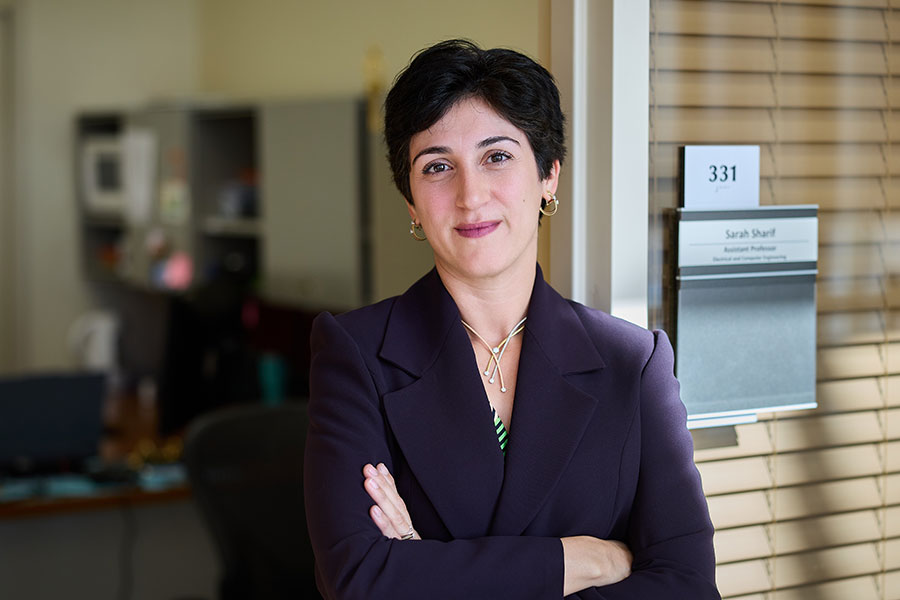
Sarah Sharif, a researcher with the University of Oklahoma, has been awarded funding from the U.S. Department of Defense (DoD) to create innovative light detectors that pick up mid-wave and long-wave infrared signals at higher temperatures than previously considered achievable.
A team from OU and WVU recently earned a five-year, $3.5 million grant from the National Institutes of Health to study how concept cigarillos influence the potential for addiction. The results will be used to inform the FDA’s impending flavor ban on cigar products and could have wider-reaching implications for other tobacco products that come in flavors, such as e-cigarettes and tobacco-free nicotine pouches.